
A good everyday watch is the one you reach for without thinking. It works with a t-shirt and with a blazer, it survives the gym bag and the dishwasher splash, and it tells the time clearly when you glance down in a dim parking garage. That kind of watch is less about flash and more about quiet competence.
So what actually makes a watch an “everyday” watch? Four things, mostly: versatility (it pairs with most of your wardrobe), comfort (the right case size and weight for your wrist), durability (a crystal and case that shrug off normal life), and legibility plus enough water resistance that you never have to baby it.
A watch can be beautiful, but if you take it off before washing your hands, it is not really an everyday watch.
These picks are chosen from specs, owner consensus on r/Watches and WatchUSeek, and value for money. We sell nothing here, so the goal is simply to match real watches to real wrists and budgets, from about $50 to roughly $1,500, with a few aspirational luxury options for context.
Our top everyday picks
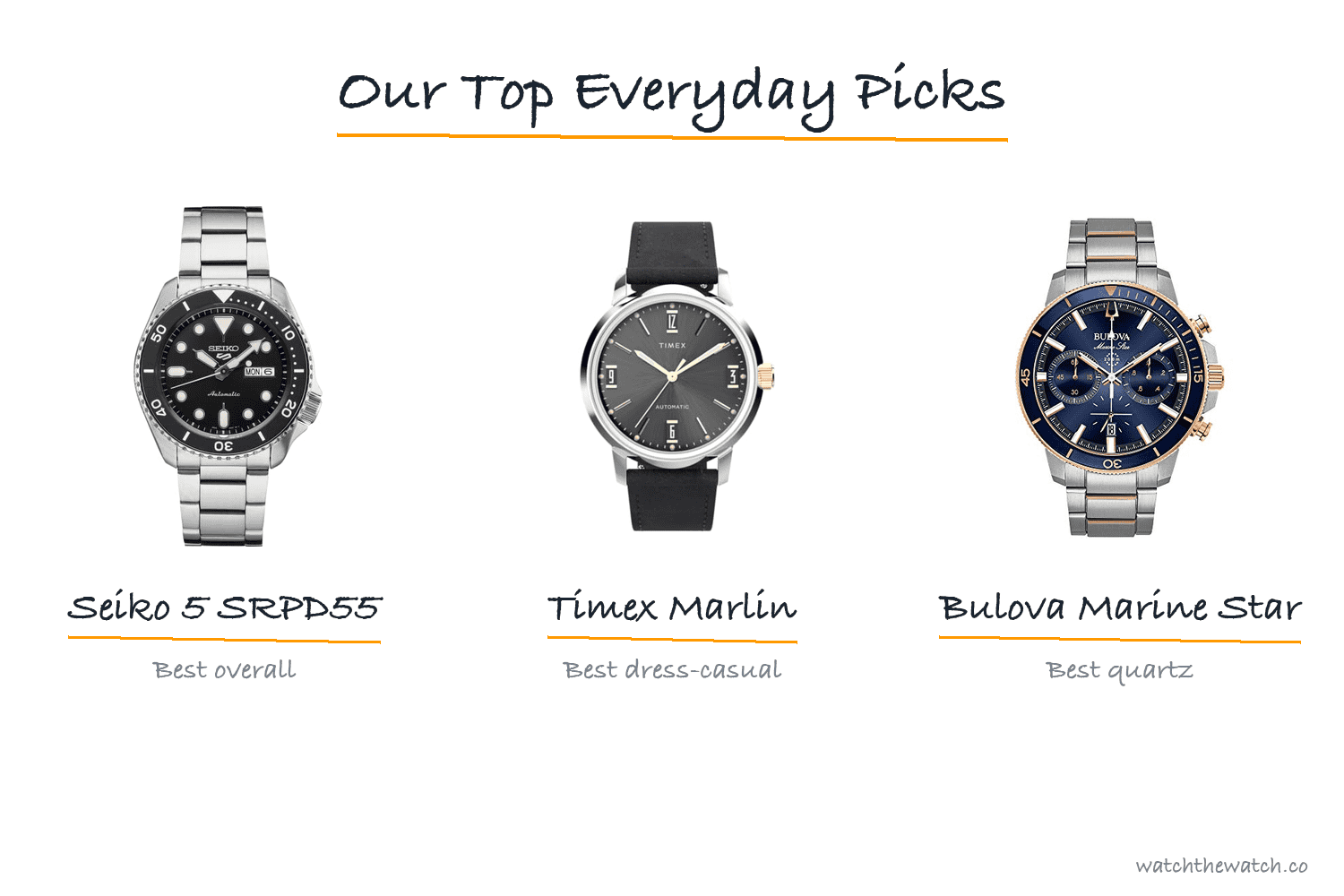
Three everyday watches we’d genuinely recommend across budgets — prices change, so tap through for the current price.


As an Amazon Associate, Watch The Watch earns from qualifying purchases at no extra cost to you. Some links go to other retailers. See our affiliate disclosure.
Seiko 5 Sports SRPD55
If you want one automatic watch that does almost everything, the SRPD55 is the default recommendation across enthusiast forums for good reason.
It runs Seiko’s 4R36 automatic movement, a 24-jewel caliber with hand-winding and hacking seconds and roughly a 41-hour power reserve. You get a day-date display, an exhibition caseback, a 42.5mm stainless steel case, an unidirectional bezel, and 100m of water resistance.
That spec sheet at well under $350 (often closer to $200-$250 on the street) is hard to beat.
It suits the first-time automatic buyer or anyone who wants a sporty daily that can handle swimming, yard work, and a casual office. Owners consistently praise the LumiBrite lume and the modular bezel-and-strap design that makes it easy to customize.
The honest drawback: it uses a Hardlex mineral crystal rather than sapphire, so it scratches more easily than pricier rivals, and the 4R36 is rated only to roughly -35 to +45 seconds per day, so accuracy is workhorse-grade, not chronometer-grade. At 42.5mm with a longish lug-to-lug, it can also wear big on slim wrists.
Timex Marlin Automatic
The Marlin Automatic is the affordable way to get a genuinely vintage-feeling watch on your wrist.
It revives Timex’s mid-century dress look in a compact 40mm stainless steel case with a 21-jewel automatic movement (about a 40-hour reserve) and, crucially, a domed acrylic crystal.
That domed acrylic gives the dial a warm, slightly distorted vintage glow that flat sapphire simply cannot replicate. It currently retails around $249.
This is the pick for someone who wants charm and character over outright toughness, and who likes a slim, dressy watch for everyday smart-casual wear. The proportions are friendly for smaller wrists, and reviewers note it punches above its price on looks.
The trade-offs are real, though. Water resistance is modest at 30-50m depending on the model, so it is splash-safe but not a swimmer. The acrylic crystal will pick up surface scratches (the upside is they buff out easily with polish), and the budget automatic movement can run a bit fast or slow, so treat it as a casual companion rather than a precision instrument.
Bulova Marine Star Series C
Bulova’s Marine Star Series C is a sporty, diver-styled quartz watch with a party trick: the Precisionist movement.
Where ordinary quartz ticks at 32 kHz, Bulova’s high-frequency Precisionist runs at 262 kHz, which delivers a smooth, near-mechanical sweeping seconds hand and stronger accuracy. The Series C pairs that with a 43mm stainless steel case, a sapphire crystal, a ceramic bezel insert, a screw-down crown, and a serious 200m water resistance rating.
Pricing generally lands in the $500-$795 range depending on dial and bracelet.
It is a strong choice for the buyer who wants a rugged, set-it-and-forget-it sports watch with a bit of visual flash, no winding or wrist-time required.
The honest caveats: at 43mm it wears large and somewhat thick, so it is not ideal for slim wrists, and the styling leans bold and busy, which is not to everyone’s taste. And while the Precisionist is a clever movement, some enthusiasts will always prefer a mechanical caliber at this price.
Tissot Gentleman
The Tissot Gentleman is frequently cited as one of the best one-watch-does-it-all options under $1,000.
The headline feature is the Powermatic 80 automatic movement, an evolved ETA-based caliber with an 80-hour power reserve, meaning you can take it off Friday night and it is still running Monday morning. Higher Silicium versions add an antimagnetic silicon balance spring.
It sits in a clean 40mm steel case, 11.5mm thick, with a sapphire crystal, anti-reflective coating, an exhibition caseback, and 100m water resistance. The standard model runs around $775.
This is the watch for the man who wants a single grown-up piece that swings from a suit to weekend jeans without missing a beat, often with a quick-change bracelet and strap system.
The genuine drawback: the lug-to-lug is on the longer side for a 40mm watch, so it can wear bigger than the diameter suggests, and the standard Powermatic 80 is not chronometer-certified, so accuracy varies unit to unit. The Silicium versions improve on this if precision matters to you.

Hamilton Khaki Field
The Hamilton Khaki Field is the quintessential field watch, descended from military-issue designs and prized for legibility.
The standout is the hand-wound Khaki Field Mechanical: it uses Hamilton’s H-50 caliber, a manually wound movement with an 80-hour power reserve and hacking seconds, in a tidy 38mm case just 9.5mm thick with 50m water resistance, typically around $595. There is also an automatic version (the H-10, also 80 hours) in 38mm and 42mm with 100m resistance, usually closer to $745.
It is ideal for someone who values a no-nonsense, highly readable dial and a slim case that disappears under a cuff. The matte dial, clear numerals, and railroad minute track make it one of the easiest watches to read at a glance.
The honest drawback: the Mechanical version is hand-wound, so you need to wind it daily, which some love as a ritual and others find tedious. Its 50m water resistance also means it is splash- and rain-safe but not built for serious swimming, and the lume is functional rather than exceptional.

Timex Weekender / Todd Snyder MK1
This entry is really two related budget heroes. The classic Timex Weekender is the quintessential starter watch: a 38mm quartz piece with the Indiglo backlight, an easy slip-through fabric strap, and a price that often dips under $50.
The dressed-up cousin is the Timex MK1, including the Todd Snyder collaborations, a 40mm field-style quartz with 50m water resistance and upgraded finishing, usually in the $138-$190 range (with hand-wound and chronograph variants in the lineup).
These are the watches for a true beater, a first watch, a teenager, or anyone who wants something to knock around in without a second thought. The Weekender’s interchangeable straps make it endlessly customizable for almost no money.
The drawbacks are what you would expect at the price. The Weekender is only 30m water resistant, its acrylic crystal scratches, and owners famously note the quartz tick can be loud in a quiet room. The MK1 fixes the water resistance and feels more substantial, but you are paying a design premium for what is still a basic quartz movement.

TAG Heuer Aquaracer Professional 200
Stepping into luxury, the Aquaracer Professional 200 is TAG Heuer’s accessible daily diver, redesigned with a sharper, more angular case.
The core spec is genuine dive-watch territory: a 40mm steel case about 11mm thick, 200m water resistance, a screw-down crown, a sapphire crystal, and a ceramic bezel insert. It comes in several flavors, including a Swiss quartz, an automatic Calibre 5 (a Sellita-based movement with roughly a 38-hour reserve), and a solar-powered Solargraph.
Pricing generally spans about $2,500 for quartz and solar models up to roughly $3,050 and beyond for the automatic.
It is a smart choice for someone who wants a recognizable Swiss luxury watch that can still be worn every single day, including in the water, without anxiety. The 40mm sizing is versatile and the build quality is a clear step up from the affordable tier.
The candid drawback: at this price the automatic uses an outsourced movement rather than an in-house caliber, and that 38-hour reserve is modest by modern standards. Enthusiasts often debate whether the Aquaracer’s value lies more in the name and finishing than in the mechanics.
Shinola The Runwell
The Runwell is the watch that launched Shinola’s Detroit-assembly story.
It uses the Argonite quartz movement, a Ronda-based caliber assembled in the United States with imported components, housed in a 41mm stainless steel case with a double-domed sapphire crystal and 5 ATM (50m) water resistance.
Pricing typically falls in the $550-$795 range depending on dial and strap. The styling is clean and American-industrial, with a distinctive railroad-inspired dial.
It appeals to the buyer who cares about design, brand story, and domestic assembly, and who wants the convenience of quartz in a handsome package with leather straps that are easy to swap.
The honest caveat that comes up repeatedly in enthusiast circles: you are paying automatic-watch money for a quartz movement, and the price reflects the Detroit-assembly narrative and design more than horological complexity. The 41mm case with fairly long lugs also wears large, so it is worth checking against your wrist before committing.
IWC Pilot’s Watch Chronograph
This is the aspirational benchmark on the list, a luxury flieger chronograph with serious horological credentials.
The current Pilot’s Watch Chronograph 41 measures 41.1mm and runs IWC’s in-house caliber 69385, a column-wheel automatic chronograph with 33 jewels and roughly a 46-hour power reserve, beating at 28,800 vibrations per hour. You get a day-date display, a soft-iron inner case for magnetic resistance on many references, a sapphire crystal secured against displacement under pressure changes, and 100m water resistance.
Expect pricing in the rough range of $6,500 to $8,000 depending on dial, reference, and whether it is on leather or a bracelet.
It is for the established collector who wants a do-everything luxury chronograph with genuine pilot-watch heritage and an in-house movement, worn daily as a statement piece.
The real drawback: at nearly 15mm thick it wears tall, the case can feel substantial on smaller wrists, and a 46-hour reserve is fairly average for an in-house movement at this price. This is a want, not a value play, and the cost puts it well beyond the everyday-budget tier for most readers.

Laco Paderborn (Type B Pilot)
For authentic Flieger heritage without IWC money, the Laco Paderborn is a compelling pick.
Laco is one of the original makers of German WWII-era B-Uhr pilot watches, so the lineage here is real rather than borrowed. The Paderborn uses a Type B dial layout (the inner hours, outer minutes arrangement) in a 42mm sandblasted stainless steel case about 13mm thick, with a domed sapphire crystal, a Swiss automatic movement (Laco’s ETA- or Sellita-based caliber), and 50m water resistance.
The current automatic version runs around $1,190.
It suits the buyer who wants a large, legible, historically faithful pilot watch with a movement that can be serviced anywhere, and who appreciates the matte, anti-glare case finish.
The honest drawback: at 42mm with a tall, slab-sided case and a busy Type B dial, it is a big and specific look that will not work for every wrist or wardrobe. The 50m water resistance is modest for daily wear near water, and the movement is a dependable workhorse rather than anything exotic, so you are paying largely for the brand’s genuine historical pedigree.
How to choose an everyday watch
The best everyday watch is the one that fits your wrist, your routine, and your budget, not the one with the longest spec sheet. Use the table below to compare the picks at a glance, then read the decision factors underneath to narrow it down.
| Watch | Best for | Movement | Case size | Water resistance | Price band |
|---|---|---|---|---|---|
| Seiko 5 Sports SRPD55 | First automatic / sporty daily | Automatic (Seiko 4R36) | 42.5mm | 100m | ~$200-350 |
| Timex Marlin Automatic | Vintage dress-casual | Automatic (21-jewel) | 40mm | 30-50m | ~$249 |
| Bulova Marine Star Series C | Sporty diver look | Quartz (Precisionist) | 43mm | 200m | ~$500-795 |
| Tissot Gentleman | One-watch dress-sport | Automatic (Powermatic 80) | 40mm | 100m | ~$775 |
| Hamilton Khaki Field | Field / military style | Hand-wound H-50 (or auto) | 38mm | 50-100m | ~$595-745 |
| Timex Weekender / Todd Snyder MK1 | Budget beater / starter | Quartz | 38-40mm | 30-50m | ~$40-190 |
| TAG Heuer Aquaracer Professional 200 | Luxury daily diver | Automatic Cal. 5 / quartz / solar | 40mm | 200m | ~$2,500-3,300 |
| Shinola The Runwell | American-assembled style | Quartz (Argonite) | 41mm | 50m | ~$550-795 |
| IWC Pilot’s Watch Chronograph | Luxury chronograph | Automatic (in-house 69385) | 41mm | 100m | ~$6,500-8,000 |
| Laco Paderborn | Authentic Flieger heritage | Automatic (Swiss) | 42mm | 50m | ~$1,100-1,300 |
Automatic vs. quartz
This is the first fork in the road. Quartz movements are battery-powered, accurate to a few seconds a month, low-maintenance, and cheaper, which makes them the practical everyday choice; a Timex, the Bulova Precisionist, or the Shinola will just work.
Automatic (mechanical) movements wind from the motion of your wrist, give you a smooth sweeping seconds hand and a window into traditional watchmaking, and never need a battery, but they run less accurately and stop after a day or two off the wrist. Choose quartz for convenience, automatic if the mechanics are part of the appeal.
Case size for your wrist
Diameter gets all the attention, but lug-to-lug length (the distance across the case from one strap end to the other) matters more for fit.
As a rough guide, wrists under about 7 inches tend to look best with 36-40mm watches, while 7 inches and up can carry 40-44mm comfortably. The watch should not overhang the edges of your wrist. This is why a slim 38mm Hamilton suits more people than a 43mm Bulova, even though both are excellent.
What water resistance actually means
The ratings are conservative and often misunderstood. 30m means splash-resistant only, so do not swim in it. 50m handles hand-washing, rain, and a quick shower.
100m is genuinely swim-safe and the sweet spot for a worry-free everyday watch. 200m and up is true dive territory, usually with a screw-down crown, which is overkill for most people but adds peace of mind. For one daily watch, aim for 100m or more if you can.
Materials and crystal
The crystal protecting the dial is a quiet but important detail. Acrylic (as on the Timex Marlin) is cheap and shatter-resistant but scratches easily, though those scratches polish out. Mineral crystal, like Seiko’s Hardlex, is harder but still scuffs over years of wear.
Sapphire, found on the Tissot, TAG Heuer, Shinola, and IWC, is the most scratch-resistant by a wide margin and is what you want on a watch you plan to wear hard for a decade. Stainless steel cases are the durable default across every watch here.
Frequently asked questions
What is the best everyday watch for men?
The best everyday watch balances versatility, comfort, and durability for your budget. For most men, the Seiko 5 Sports SRPD55 (automatic, 100m water resistance, under $350) or the Tissot Gentleman (40mm, 80-hour Powermatic 80) hit that sweet spot. The right pick ultimately depends on your wrist size, your style, and how much you want to spend.
Automatic or quartz for everyday wear?
Quartz is the more practical everyday choice: it is accurate to seconds per month, needs no daily attention, and costs less. Automatics offer mechanical craftsmanship and a smooth sweeping seconds hand, but run less accurately and stop after a day or two of non-wear. Choose quartz for convenience, automatic if the hobby appeals to you.
What size watch is best for everyday use?
For most men, a 38mm to 42mm case suits everyday wear, with lug-to-lug distance mattering more than diameter. Measure your wrist: under 7 inches favors 36-40mm, while 7 inches and up handles 40-44mm comfortably. The case should sit within your wrist edges and slide easily under a shirt cuff.
How much should I spend on an everyday watch?
Spend what fits your budget, because excellent everyday watches exist at every tier. Around $50 buys a reliable Timex quartz, $200-$800 gets a solid automatic like a Seiko or Tissot, and $2,000-plus moves into Swiss luxury. Most enthusiasts agree the $200-$800 range offers the best value-to-quality ratio for a daily watch.
Is a dive watch good for everyday wear?
Yes, dive watches are among the best everyday options. Their 200m water resistance, screw-down crowns, legible dials, and durable construction handle daily life easily. The main trade-offs are added thickness and weight, plus a rotating bezel you may never use. A Seiko 5 or a TAG Heuer Aquaracer wears well day to day.

Daniel Hart is the editor of Watch The Watch. He researches and writes the site’s buying guides, brand comparisons, and explainers, focused on accessible, enthusiast-level watches — affordable automatics, divers, field and dress watches, everyday quartz, and the straps, winders and tools that go with them. The goal is practical, budget-aware advice that helps readers choose the right watch for their wrist and their budget. Recommendations draw on manufacturer specifications and the wider enthusiast community.

