
Daniel Hart · ·
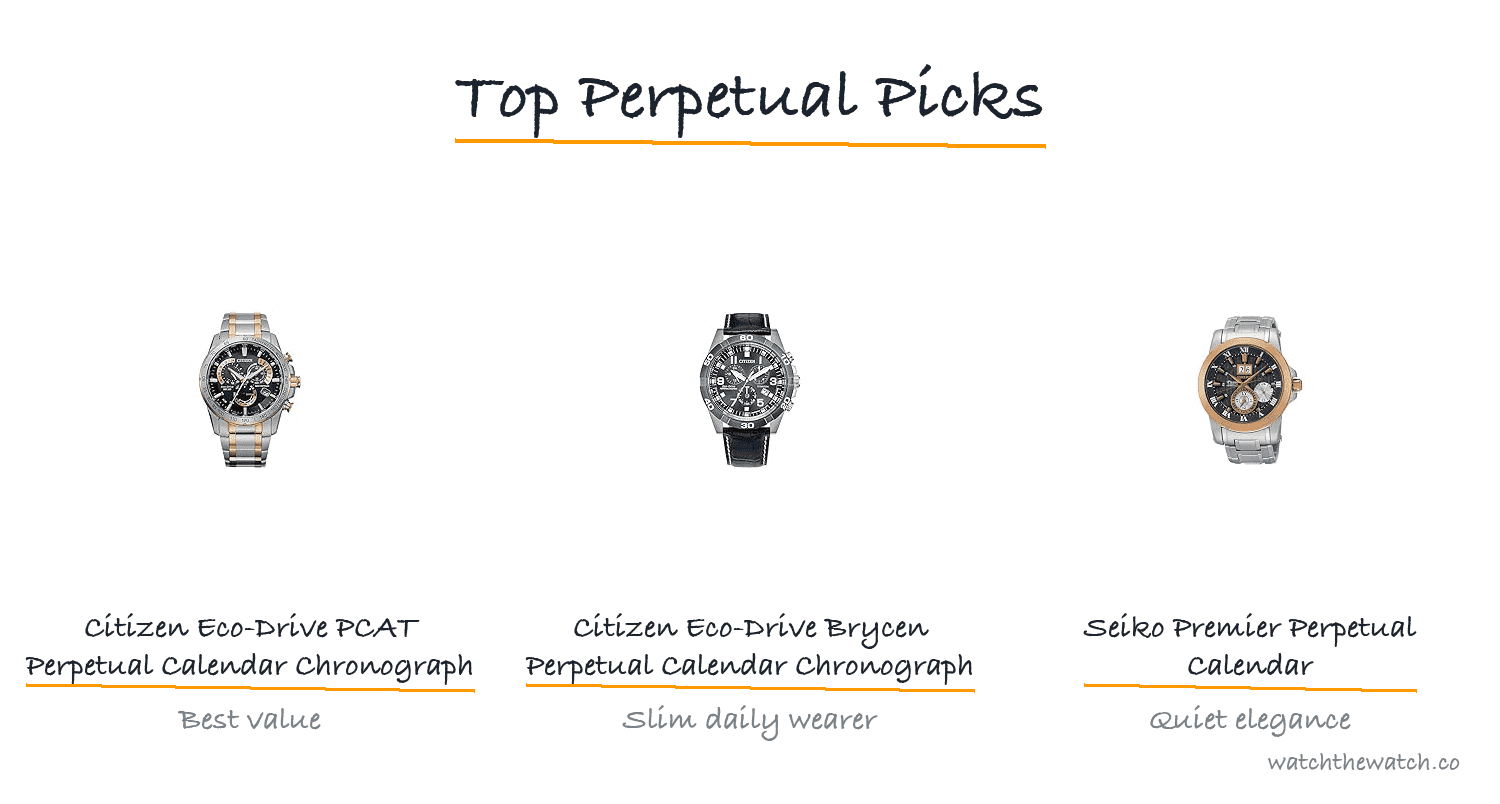
A perpetual calendar is the one complication that quietly earns its keep every single day. It knows that February is short, that some months have 30 days and others 31, and even that leap years exist — so the date on the dial stays correct without you touching the crown for years, sometimes decades.
Here is the part most buyers miss. There are two completely different ways to own a perpetual calendar, and they are not priced anywhere near each other. A quartz perpetual (Citizen, Seiko) does the math with a chip and costs a fraction of a mechanical one. A mechanical perpetual (Frederique Constant on up to Patek) does it with hundreds of tiny gears and levers, and you pay dearly for that craft.
I have worn and serviced both kinds for years. Below I have split this guide cleanly: picks 1–3 are the affordable quartz route, picks 4–7 are the serious mechanical grail watches. Pick the lane that fits your wallet and your reason for wanting one.
Our top picks at a glance
The standouts from this guide — prices change, so tap through for the current price.
As an Amazon Associate, Watch The Watch earns from qualifying purchases at no extra cost to you. Some links go to other retailers. See our affiliate disclosure.
1. Citizen Eco-Drive PCAT — best value, zero fuss
If you want a perpetual calendar and you do not want to spend a house deposit, start here. The PCAT is a quartz perpetual: the date logic lives in a chip, runs off light through Citizen’s Eco-Drive solar cell, and never needs a battery change.
Because it is quartz, the leap-year handling is effortless. You will genuinely never adjust the date for the calendar’s sake — the movement already knows every month length out to 2100. It is also radio-controlled in many references, so it syncs to an atomic time signal and keeps the hands honest too.
- Eco-Drive solar — no battery swaps
- Perpetual calendar + chronograph
- Atomic timekeeping (radio sync) on most refs

2. Citizen Eco-Drive Brycen — slim daily wearer
The Brycen is the dressier cousin of the PCAT. Same Eco-Drive quartz perpetual brain, but in a thinner, more refined chronograph case that slides under a cuff far more comfortably.
I recommend this one to people who want the watch to read as a smart everyday piece rather than a tool watch. The value proposition is identical — light-powered, leap-year-aware, never set the date — just in a more office-friendly package. Sapphire crystal on most references is a nice touch at this price.
- Slimmer dress-leaning case
- Eco-Drive solar perpetual calendar
- Sapphire crystal on most refs

3. Seiko Premier Perpetual (SNP128) — quiet elegance
Seiko’s Premier line is the understated alternative, and the SNP128 is the pick of the litter. It is a solar-powered quartz perpetual chronograph with a clean, grown-up dial that punches above its number.
Rounding out the affordable tier, this one leans more classic-dress than the Citizens. Like its rivals it is a quartz perpetual, so the calendar is fully automatic through leap years — set it once and forget it. If you prefer Seiko’s design language and finishing, this is the obvious choice.
- Solar quartz perpetual calendar
- Chronograph with date sub-dials
- Dressy, restrained dial

4. Frederique Constant Perpetual Calendar Manufacture — the affordable mechanical
Now we cross the line into mechanical perpetuals, and Frederique Constant kicked the door open. This was the watch that brought a genuine in-house mechanical perpetual calendar to a price that does not require a second mortgage.
Understand the trade you are making here. A mechanical perpetual uses real gears, not a chip — it is a feat of engineering, but it must be kept running or wound, and it needs periodic servicing. Let it stop for a long stretch and you will reset day, date, month and moonphase by hand. That is the romance, and the responsibility, of mechanical.
- In-house automatic perpetual movement
- Day, date, month, moonphase
- The entry point to mechanical perpetuals
5. Longines Master Annual Calendar — honest about being annual
I am including the Longines with a clear caveat. It is an annual calendar, not a full perpetual — it handles 30- and 31-day months automatically but needs one manual correction each year at the end of February.
So why is it here? Because for most buyers an annual calendar delivers 95% of the convenience at a far gentler price, and the Master’s finishing is lovely. If you are choosing mechanical and the once-a-year nudge does not bother you, this is a smart, honest middle path. Just know what you are buying.
- Mechanical automatic annual calendar
- One correction per year (end of Feb)
- Classic Longines Master finishing
6. IWC Portugieser Perpetual Calendar — the modern icon
This is where mechanical perpetuals get properly serious. IWC’s Portugieser Perpetual carries Kurt Klaus’s legendary calendar mechanism that can be set entirely through the crown — no fiddly pushers — and includes a moonphase accurate to a single day’s error over more than a century.
It is a big, confident, beautifully legible watch. Fully mechanical, it tracks date, day, month, year and moonphase, and will hold true to 2100 as long as it keeps running. This is a genuine grail piece that many collectors aim their whole journey toward.
- Crown-set perpetual (no correctors)
- Double moonphase, accurate to ~577 years
- Year display through to 2100
7. Patek Philippe Perpetual Calendar 5327 — the benchmark
And at the summit sits Patek. The 5327 is the reference against which every other perpetual calendar is quietly measured — a thin, in-house automatic perpetual with a moonphase and the kind of hand-finishing that defines the genre.
There is no value argument to make here, and I will not pretend otherwise. This is a heirloom-tier mechanical perpetual you buy once and pass down — the price reflects craft, scarcity and a century of pedigree, not practical convenience. If you have arrived at the very top of the market, this is the destination.
- Ultra-thin in-house automatic perpetual
- Moonphase, day/date/month, leap-year
- Heirloom-grade hand finishing
How to choose a perpetual calendar watch
The first decision is the only one that really matters: quartz or mechanical. Everything else — brand, case size, moonphase — follows from that. Use this to place yourself.
| If you want… | Go with… |
|---|---|
| Set-and-forget convenience, low cost, no servicing | Quartz perpetual (picks 1–3) |
| Real horology, heirloom value, the craft itself | Mechanical perpetual (picks 4, 6, 7) |
| Most of the convenience, gentler price | Annual calendar (pick 5) |
| Never to change a battery | Solar/Eco-Drive quartz (picks 1–3) |
| A watch to pass to your kids | IWC or Patek (picks 6–7) |
Frequently asked questions
What is the difference between a quartz perpetual and a mechanical perpetual?
A quartz perpetual uses an electronic chip to track month lengths and leap years, so it is cheap, accurate, and never needs date adjustment for the calendar. A mechanical perpetual does the same job with gears and levers — far more expensive, requires servicing, and must be kept running or it stops tracking.
Does a quartz perpetual calendar ever need date setting?
For the calendar itself, no — it already knows every month length, including February in leap years, typically out to 2100. You would only adjust it after a full power loss, when changing time zones, or after the year 2100 rolls over.
Is an annual calendar the same as a perpetual calendar?
No. An annual calendar (like the Longines here) handles 30- and 31-day months automatically but needs one manual correction each year at the end of February. A true perpetual handles leap years too and needs no yearly fix.
Is a mechanical perpetual calendar worth the money?
If you value horology and want an heirloom, yes — it is one of the great complications. If you only want a correct date with no hassle, a quartz perpetual gives you the same practical result for a tiny fraction of the cost. For the bigger picture, see the day-date complication, moon phase watches and quartz against mechanical movements.

Daniel Hart is the editor of Watch The Watch. He researches and writes the site’s buying guides, brand comparisons, and explainers, focused on accessible, enthusiast-level watches — affordable automatics, divers, field and dress watches, everyday quartz, and the straps, winders and tools that go with them. The goal is practical, budget-aware advice that helps readers choose the right watch for their wrist and their budget. Recommendations draw on manufacturer specifications and the wider enthusiast community.
