
A great solar watch solves the one chore that kills cheap quartz watches: the dead battery. Feed it daylight, even office light, and it runs for years. That’s why solar is the smartest money you can spend on a daily-wear watch in 2026.
This guide runs from genuinely affordable to do-it-all premium: tough digital squares, dive-ready 200m beaters, and a GPS smartwatch that tops itself up from the sun. Every pick is a model I’d happily wear and recommend to a friend.
I chose these on the things that actually matter day to day: real-world reliability, legibility and lume, water resistance, and honest value for the money. No hype, no spec-sheet padding — just watches that earn their place on your wrist.
Our top picks at a glance
The standouts from this guide — prices change, so tap through for the current price.
As an Amazon Associate, Watch The Watch earns from qualifying purchases at no extra cost to you. Some links go to other retailers. See our affiliate disclosure.
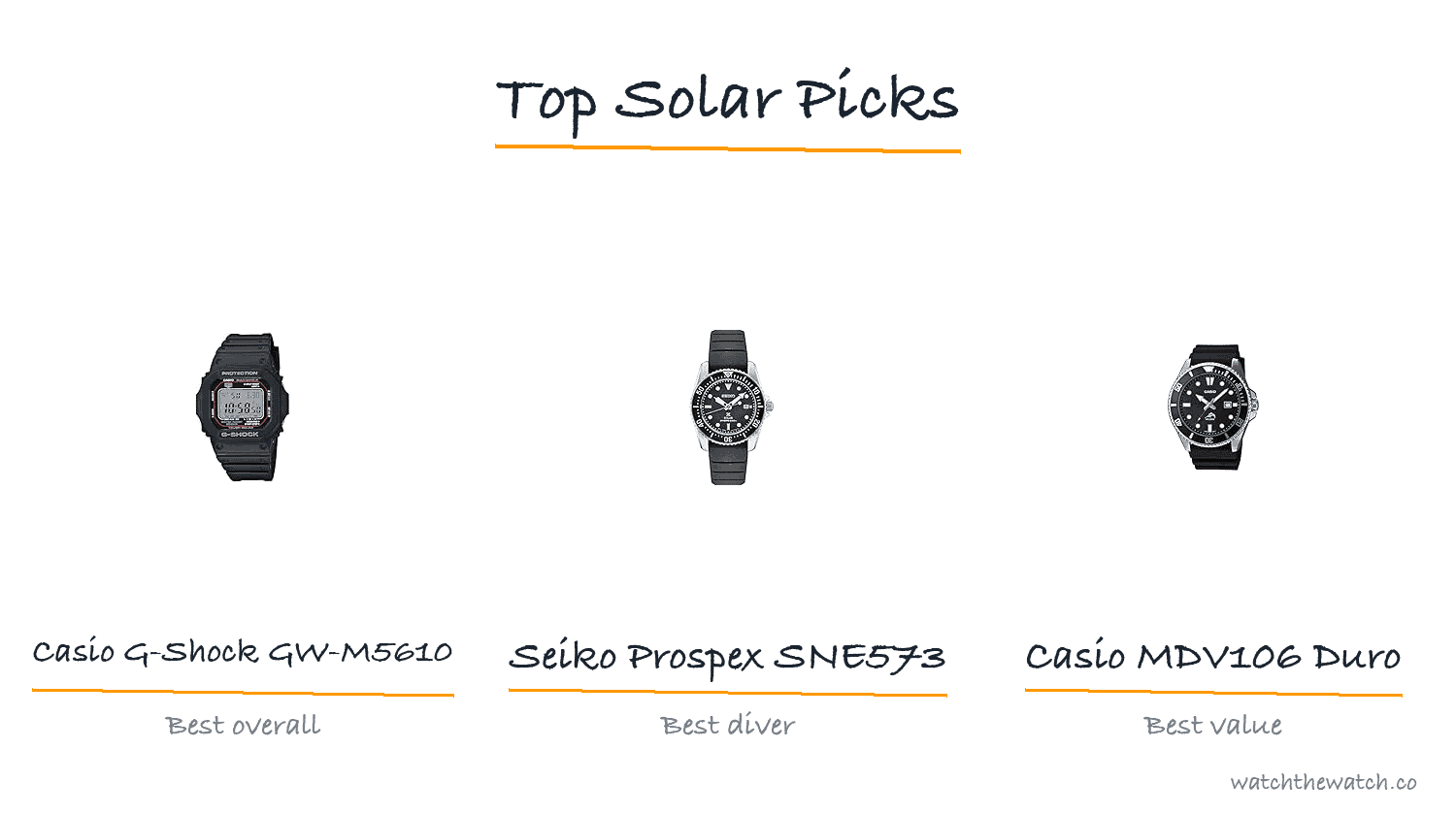
1. Casio G-Shock GW-M5610 — The bombproof everyday square
The GW-M5610 is the watch I hand to anyone who says they want “one watch that never needs attention.” It pairs Casio’s Tough Solar charging with Multi-Band 6 radio sync, so it sets its own time automatically and you essentially never touch it.
It’s the classic 5600 square: light on the wrist, resin case, instantly readable display with a crisp backlight. Build quality is the real story — it shrugs off drops, knocks, and weather without complaint. For the price, nothing matches its set-and-forget toughness.
The honest trade-off is the display. It’s a small monochrome digital screen, and in dim light you’ll need the backlight — there’s no glowing lume like an analog diver. If you want a watch that lights up the dark passively, this isn’t it.
- Tough Solar + Multi-Band 6 auto time sync
- 200m water resistance, resin case
- Featherweight, classic square profile

2. Seiko Prospex SNE573 — Compact solar dive watch
If you want a proper analog diver that runs on light, the Prospex SNE573 is one of the easiest recommendations in Seiko’s lineup. It’s a solar-powered 200m diver with a screw-down crown and a unidirectional bezel, built to actual dive-watch standards rather than just looking the part.
What stands out is the wearability. The compact case suits smaller and medium wrists that get swallowed by 44mm divers, and Seiko’s LumiBrite glows strong and long after dark. It’s the most “grown-up” looking watch on this list for the money.
The honest trade-off: it uses a Hardlex mineral crystal rather than sapphire, so it’s a touch more prone to scratches over the years. Treat it with a little care and it’ll still look sharp.
- Solar quartz, no battery changes
- 200m WR, screw-down crown, dive bezel
- Strong LumiBrite lume, compact case

3. Casio MDV106 Duro — The unkillable everyday beater
Quick honesty first: the MDV106 “Duro” is a standard battery quartz watch, not solar. I’m including it because no affordable-watch guide is complete without it, and the battery lasts years anyway. Think of it as the everyday beater you reach for when you don’t want to baby anything.
For the money it’s almost absurd value: a 200m-rated diver-style watch with a Submariner-ish silhouette, day-date window, and a clean, legible dial. It punches so far above its price that collectors keep one in the rotation on principle.
The trade-offs are predictable at this price: the lume is weak, and the included resin strap is the first thing most owners swap out. Budget a few dollars for a NATO or rubber strap and it transforms.
- 200m water resistance, day-date
- Battery quartz (not solar) — multi-year battery
- Unbeatable value, easy strap upgrades

4. Citizen Eco-Drive Promaster Diver — The reliable workhorse diver
The Promaster Diver is Citizen’s answer to “give me one solar diver that just works for a decade.” Its Eco-Drive movement charges from any light and runs for months on a full charge, even sitting in a drawer, which makes it brilliantly low-maintenance.
This is an ISO-rated 200m diver with a chunky case, a grippy bezel, and a bright, high-contrast dial that’s dead easy to read at a glance. It’s the most “use it and forget it” tool watch here.
The honest trade-off is size and style: the case wears large and the polyurethane strap feels utilitarian rather than refined. On smaller wrists it can feel like a lot of watch.
- Eco-Drive solar, long power reserve
- ISO-rated 200m diver, screw-down crown
- High-contrast, highly legible dial

5. Garmin Instinct Solar — Sun-charged adventure smartwatch
The Instinct Solar is a different animal from the rest of this list — a rugged GPS smartwatch where solar charging dramatically extends battery life, stretching everyday use toward weeks rather than days. For hikers, runners, and anyone who hates nightly charging, that’s a genuine game-changer.
It’s built to MIL-STD-810 durability standards, with GPS, full activity and sleep tracking, and a transflective display that actually gets more readable in bright sunlight. It’s the toughest, most capable watch here if you live outdoors.
The trade-off is the screen: a low-res monochrome display, not a colorful touchscreen, and solar gains depend on real sun exposure. If you want apps and a vivid panel, look elsewhere — this is a focused adventure tool.
- Solar-assisted battery, up to weeks of use
- GPS + MIL-STD-810 rugged build
- Sunlight-friendly transflective display

How to choose a solar watch
Solar is less about the panel and more about matching the watch to how you’ll actually use it. Here’s what I’d weigh before buying.
| Criterion | What to look for |
|---|---|
| Power source | True solar (Tough Solar / Eco-Drive) means no battery swaps; confirm before assuming |
| Water resistance | 100m for daily wear; 200m and a screw-down crown for real swimming or diving |
| Legibility & lume | Analog divers give passive glow; digital needs a backlight — choose for your conditions |
| Case size | 38mm suits smaller wrists; 44mm+ divers wear large, so check before buying |
| Crystal | Sapphire resists scratches best; mineral/Hardlex is fine with a little care |
Frequently asked questions
Do solar watches ever need a battery replacement?
Eventually, yes — the rechargeable cell inside slowly loses capacity, usually after roughly a decade or more of use. But you’ll never deal with the yearly dead-battery routine of a standard quartz watch, which is the whole appeal.
Can a solar watch charge from indoor light?
Yes. Office and household lighting keeps most solar watches topped up, just more slowly than direct sun. A few hours near a sunny window now and then keeps the reserve healthy.
Is the Casio Duro actually solar?
No — the MDV106 Duro is a standard battery quartz watch, and I’ve flagged that honestly above. I included it because it’s the best-value everyday beater at its price, and its battery still lasts years.
Which pick is best for most people?
For pure set-and-forget convenience, the G-Shock GW-M5610 is hard to beat. If you’d rather have a classic analog diver, the Seiko Prospex SNE573 is the sweet spot.

Daniel Hart is the editor of Watch The Watch. He researches and writes the site’s buying guides, brand comparisons, and explainers, focused on accessible, enthusiast-level watches — affordable automatics, divers, field and dress watches, everyday quartz, and the straps, winders and tools that go with them. The goal is practical, budget-aware advice that helps readers choose the right watch for their wrist and their budget. Recommendations draw on manufacturer specifications and the wider enthusiast community.