
Daniel Hart · ·
If you own an automatic watch and it keeps stopping between wears, you already understand the small daily annoyance a winder is meant to solve. A watch winder is a motorized box that gently rotates an automatic watch so its self-winding rotor keeps the mainspring tensioned while the watch sits unworn. No mainspring, no power, and the watch dies on your wrist by tomorrow morning.
The real payoff is not just keeping time. For watches with complications — a perpetual calendar, a moonphase, an annual calendar — a winder saves you from re-setting the date, day, and moon every time you rotate a piece back in. Resetting a perpetual calendar by hand is fiddly and, done wrong, can damage the movement.
I’ve spent years living with automatics and the boxes that spin them. Below are five winders I’d actually recommend, with honest notes on motors, settings, and what to watch out for.
Our top picks at a glance
The standouts from this guide — prices change, so tap through for the current price.
As an Amazon Associate, Watch The Watch earns from qualifying purchases at no extra cost to you. Some links go to other retailers. See our affiliate disclosure.
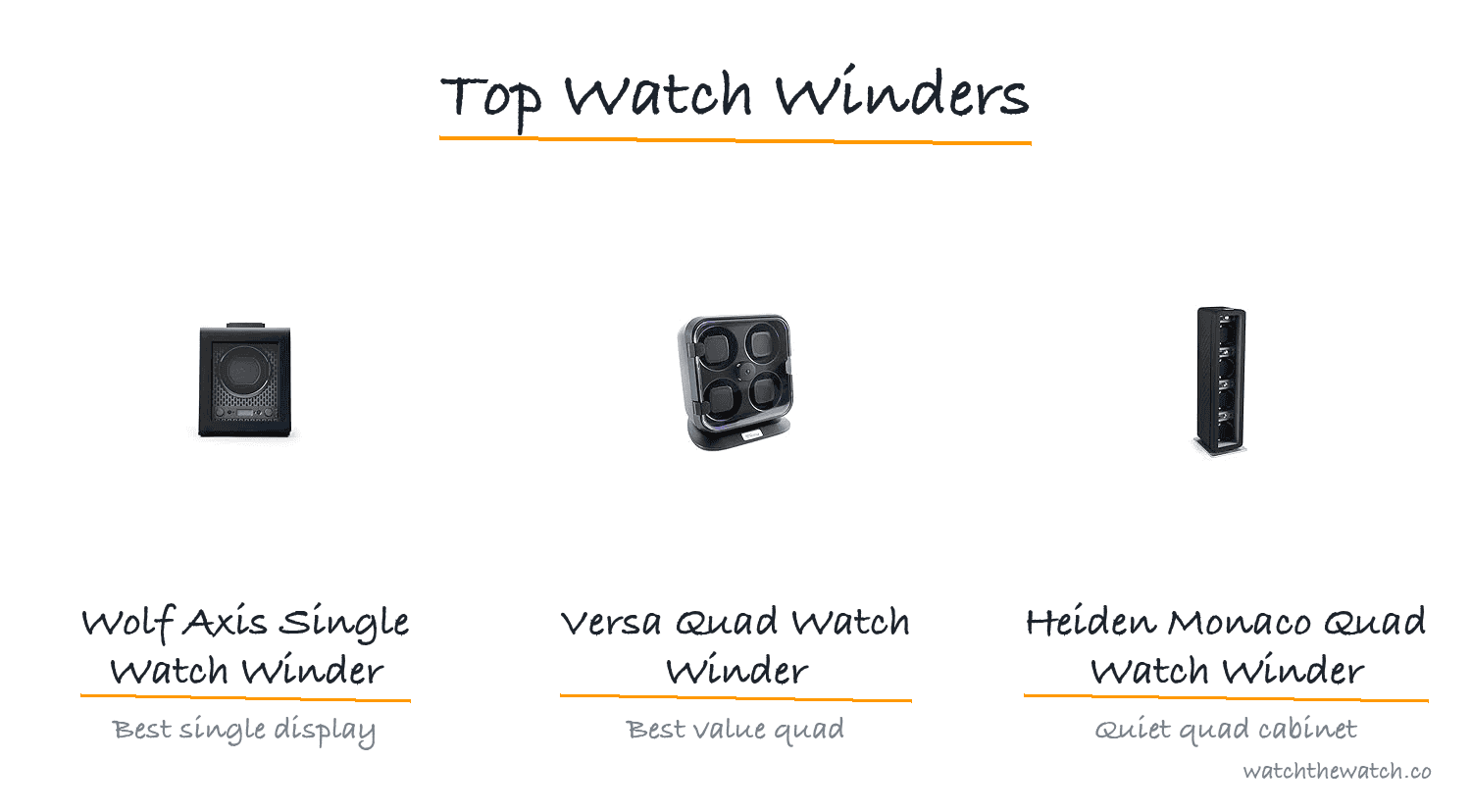
1. Wolf Axis Single Watch Winder — refined single-watch display
Wolf has made winders and watch storage for a long time, and the Axis single shows that experience. It’s a clean, glass-topped single winder that looks at home on a dresser or desk rather than hidden in a drawer. If you own one automatic you care about, it’s an object you don’t mind seeing every day.
The motor is quiet and the cuff is a soft, expandable design that holds most case sizes without strain. You get programmable turns-per-day and direction settings, so you can match the winder to what your specific movement actually needs rather than over-spinning it.
- Glass cover keeps dust off the watch and lets you see it run
- Programmable TPD and rotation direction (CW / CCW / bidirectional)
- Soft expandable cuff fits a wide range of case sizes

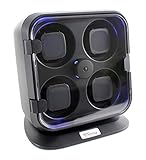
2. Versa Quad Watch Winder — four watches, independent control
The Versa Quad is the value workhorse of multi-winders, and it earns it. Each of the four winder positions runs on independent settings, so you can give a finicky perpetual calendar a different rotation program than a simple three-hander sitting next to it. That independence is the single most important feature in a multi-winder, and plenty of pricier boxes skip it.
It runs on AC power or batteries, which is handy if your outlet situation is awkward. The motors are reasonably quiet for the price, though in a dead-silent bedroom you’ll hear a faint hum, so I’d keep this one in an office or closet rather than on the nightstand.
- Four independent winder modules, each with its own TPD and direction
- AC adapter or battery operation
- Multiple preset rotation programs to cover most movements
3. Heiden Monaco Quad Watch Winder — quiet four-watch cabinet
The Heiden Monaco is a step up in build feel — a more cabinet-like quad that leans toward the calmer, quieter end of the multi-winder market. Its Japanese-style motors are tuned for low noise, which makes it one of the few four-watch boxes I’d actually tolerate in a bedroom.
Like the Versa it offers per-watch programming, but the fit and finish feel more considered. If you’re winding a small collection and you want something that looks like furniture rather than a gadget, the Monaco is the sweet spot between the budget quads and the genuinely expensive cabinets.
- Four positions with adjustable turns-per-day and direction
- Low-noise motors suited to quieter rooms
- Padded cuffs and a more premium enclosure

4. Barrington Single Watch Winder — silent Japanese motor
Barrington built its reputation on one thing: a genuinely quiet single winder that doesn’t look cheap. The Japanese Mabuchi motor is the quietest I’ve used in this price bracket — close to silent in normal room conditions — which is exactly why this is my pick for a nightstand winder.
It’s also flexible on settings. You get a full range of turns-per-day from roughly 650 up to 1,950, plus clockwise, counter-clockwise, and bidirectional modes, so you can dial in the exact program your movement calls for. The modular design also lets you stack units later as your collection grows.
- Near-silent Japanese Mabuchi motor
- Wide TPD range (around 650–1,950) and all three rotation directions
- Stackable / modular if you add more units

5. Billstone Automatic Watch Winder — lockable and secure
If your concern is as much about storage and security as it is about winding, Billstone is the one to look at. These winders ship with a lockable glass door and a proper carbon-fiber or leather-finished enclosure, so the box doubles as a small safe-display for higher-value pieces.
The winding side is no afterthought. Quiet motors and independent per-watch settings mean a multi-watch Billstone handles a mixed collection as well as the others here, with the added peace of mind of a lock. It’s the choice when the watches inside are worth protecting, not just spinning.
- Lockable glass door for security and dust protection
- Quiet motors with adjustable TPD and direction
- Premium finishes (carbon fiber / leather) and interior lighting on some models

How to choose a watch winder
Match the winder to your collection size first, then to your room. The most-missed setting is turns-per-day: too few and the watch still stops, too many and you wear the movement unnecessarily. Most automatics are happy in the 650–900 TPD range, and bidirectional rotation is the safest default if you’re unsure of your caliber’s winding direction. On winder-safe combos: only put true automatics on a winder — never a manual-wind or quartz piece — and on a multi-winder you can safely mix any automatics as long as each slot runs its own TPD and direction.
| If you… | Look at |
|---|---|
| Own one automatic you want on display | Wolf Axis single (glass cover) |
| Wind 2–4 watches on a budget | Versa Quad (independent settings) |
| Want a quiet quad that looks like furniture | Heiden Monaco Quad |
| Need near-silent for a nightstand | Barrington single (Japanese motor) |
| Care about security and value protection | Billstone (lockable door) |
Frequently asked questions
Do I really need a watch winder?
Not strictly, if you wear the watch daily or don’t mind re-setting it. But for complicated movements a winder saves real time and reduces the risk of damaging the movement during frequent manual setting. For a single simple automatic, it’s a convenience, not a necessity.
What turns-per-day setting should I use?
Start in the 650–900 TPD range, which suits the majority of modern automatics. If the watch is losing power overnight, step it up; there’s no benefit to running far higher than your movement needs. When in doubt, choose bidirectional rotation so you cover whichever direction your rotor winds.
Will a winder overwind my watch?
No. Virtually all modern automatic movements have a slipping clutch on the mainspring that prevents overwinding, so a correctly set winder won’t over-tension the spring. The thing to avoid is running an excessively high TPD for years on end, which adds needless wear — set it sensibly and leave it.
Are quiet motors worth paying for?
If the winder lives in a bedroom or quiet office, absolutely. Cheaper motors produce a low hum you’ll notice in a silent room at night. The Barrington and Heiden Monaco are the standouts for noise; the Versa is fine in a less sensitive spot like a closet. If this raised further questions, how long an automatic watch lasts and the best single watch winders pick them up.

Daniel Hart is the editor of Watch The Watch. He researches and writes the site’s buying guides, brand comparisons, and explainers, focused on accessible, enthusiast-level watches — affordable automatics, divers, field and dress watches, everyday quartz, and the straps, winders and tools that go with them. The goal is practical, budget-aware advice that helps readers choose the right watch for their wrist and their budget. Recommendations draw on manufacturer specifications and the wider enthusiast community.

Pingback: List of Best Fancy Watches: Luxury and Budget (2023) - WatchTheWatch.co