
Daniel Hart · ·
If you want one straight answer to the question “Is Tissot a good watch brand?”, here it is: yes, Tissot is one of the best value-for-money Swiss watch brands you can buy. It sits in that sweet spot where genuine Swiss watchmaking meets a price most people can actually justify.
Tissot is owned by the Swatch Group, the largest watch conglomerate in the world, and that ownership gives it access to movements, manufacturing, and quality control that brands twice its price often struggle to match. For a lot of buyers, Tissot is the smart first step into real mechanical Swiss watches.
It isn’t flawless, and I’ll be honest about where it falls short. But as an entry point into Swiss watchmaking, very few brands do it better.
The short answer
Tissot is a genuinely good brand and an excellent choice for the money. You get authentic Swiss build quality, solid in-house-derived automatic movements like the Powermatic 80, and designs that punch well above their price. If you want your first real Swiss automatic without overpaying, Tissot belongs at the top of your shortlist.
Tissot: background & heritage
Tissot was founded in 1853 in Le Locle, Switzerland, in the heart of the Jura watchmaking region. That’s not marketing fluff bolted on later. Le Locle is one of the original cradles of Swiss watchmaking, and Tissot has been making watches there for over 170 years.
Over its history Tissot has racked up real firsts: early mass-produced pocket watches, the first watch made of stone, the first plastic mechanical watch, and decades of timekeeping work in motorsport and cycling. It’s a brand with actual horological credibility, not a fashion label that licensed a name.
Today Tissot is part of the Swatch Group, which also owns Omega, Longines, Hamilton, and the movement giant ETA. That family connection is Tissot’s secret weapon: it draws on the same engineering ecosystem as its more expensive siblings while staying positioned as the accessible Swiss brand.
Quality, movements & value
Tissot runs both quartz and mechanical lines. The quartz pieces are reliable, accurate, and a fine choice if you want low-maintenance. But the watches enthusiasts care about are the mechanicals, and that’s where the Powermatic 80 movement earns its reputation. It’s an ETA-based automatic with roughly an 80-hour power reserve, meaning you can take the watch off Friday evening and it’s still running Monday morning. At this price, that reserve is exceptional.
Build quality is consistently solid: sapphire crystals on the watches that matter, decent bracelets, good water resistance, and finishing that looks more expensive than it is. You’re getting real Swiss assembly and quality control, not a dressed-up import.
Now the honest caveats. The Powermatic 80 often uses a synthetic Nivachron-style hairspring and a regulation system that, while accurate and robust, isn’t the traditionally adjustable, decoratively finished movement you’d find in higher tiers. Some bracelet clasps and stock straps feel a notch below the watch heads they’re attached to. And because Tissot is popular, the dressier models can feel common. None of this is a dealbreaker at the price, but it’s where the cost-saving shows.
Who Tissot is for
- First-time buyers stepping into real Swiss mechanical watches without spending four figures unnecessarily.
- People who want long power reserve and everyday reliability over bragging rights.
- Style-led buyers who want an integrated-bracelet sports watch or a classic dress watch that looks far pricier than it is.
- Anyone building a first “nice watch” collection on a sensible budget.
Two Tissot watches worth knowing
The Tissot PRX Powermatic 80 is the watch that put Tissot back on every enthusiast’s radar. It’s an integrated-bracelet sports watch with a 1970s silhouette, a clean dial, and that 80-hour automatic movement inside. It scratches the same design itch as luxury integrated-bracelet watches costing many times more, and the build genuinely holds up in the metal. If you only look at one Tissot, make it this one.

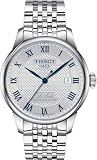
The Tissot Le Locle Powermatic 80 is the classic dress watch of the lineup, named after the brand’s hometown. It’s a refined, traditionally styled automatic with Roman numerals, a clean case, and the same 80-hour movement. It’s the watch I’d point someone toward for weddings, the office, or anytime they want understated Swiss elegance without the integrated-bracelet sporty look.
Frequently asked questions
Is Tissot a good watch brand?
Yes. Tissot is a legitimate Swiss brand with real heritage, backed by the Swatch Group, offering reliable movements and strong build quality at accessible prices. It’s one of the safest value picks in Swiss watchmaking.
Is Tissot a luxury watch brand?
Not quite, and that’s the point. Tissot sits in the premium accessible tier, below luxury names like Omega or Rolex but firmly above fashion watches. You get authentic Swiss quality at a fraction of luxury prices, which is exactly why it’s such good value.
Are Tissot watches worth the money?
For most buyers, very much so. The Powermatic 80 automatics in particular offer movement performance, finishing, and design that comfortably outpunch their price. You’re paying for Swiss substance, not just a logo.
Tissot or a more expensive Swiss brand?
If budget is no object and you want prestige and movement decoration, step up. But if you want 90% of the experience for a fraction of the cost, Tissot is the smarter buy and a brand you’ll never feel embarrassed to wear. Worth reading alongside this: quartz against mechanical movements and the most expensive watch brands.

Daniel Hart is the editor of Watch The Watch. He researches and writes the site’s buying guides, brand comparisons, and explainers, focused on accessible, enthusiast-level watches — affordable automatics, divers, field and dress watches, everyday quartz, and the straps, winders and tools that go with them. The goal is practical, budget-aware advice that helps readers choose the right watch for their wrist and their budget. Recommendations draw on manufacturer specifications and the wider enthusiast community.
