
Daniel Hart · ·
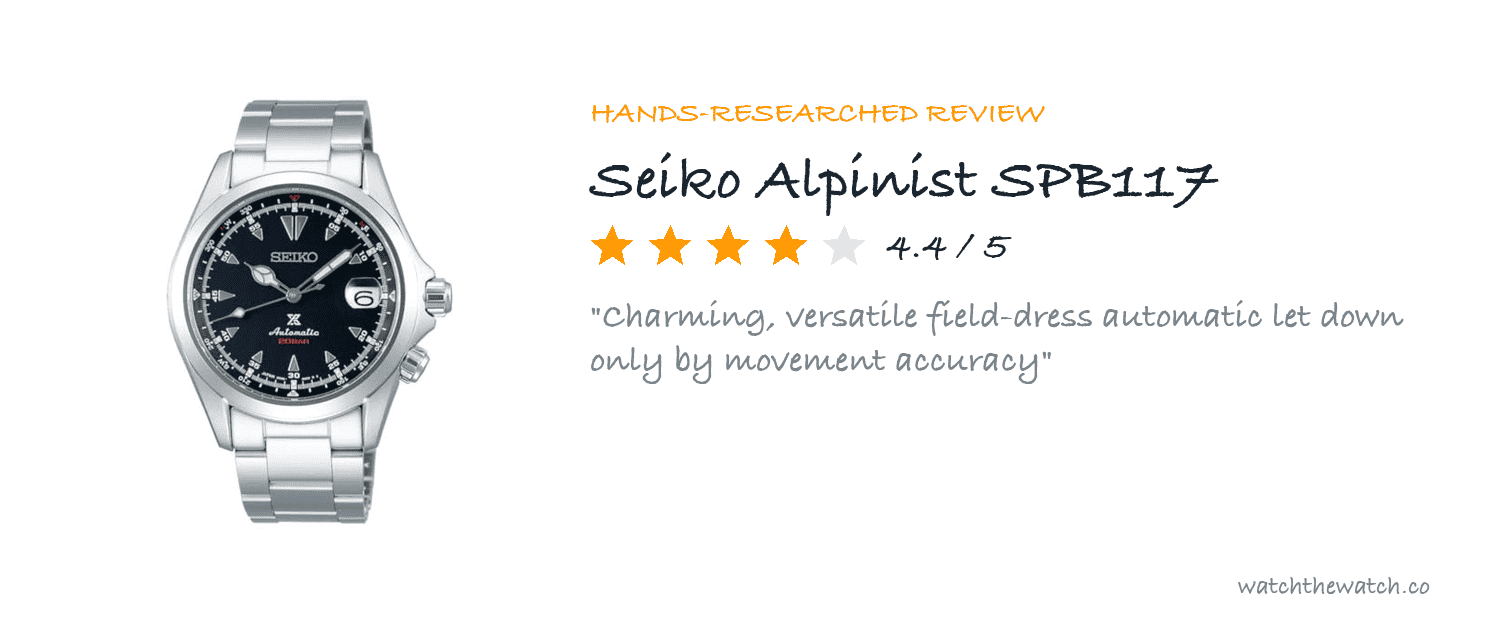
The Seiko Alpinist has one of the most interesting backstories in the brand’s catalog, and the modern Prospex revival captures it well. The SPB117 (green dial) and its sibling references are a field watch dressed in gentleman-explorer clothing, complete with cathedral hands, gilt accents, and a rotating internal compass bezel. It looks far more expensive than it is.
This generation finally fixed the size complaint that dogged the older SARB017. At roughly 38mm across with a manageable lug-to-lug, it wears like a proper everyday watch rather than a niche curiosity. Seiko also added sapphire and the 6R35 movement with a longer power reserve.
My headline verdict: this is one of the most charming sub-luxury automatics Seiko makes, with a couple of honest caveats around accuracy and price creep that I will get into below.

Quick verdict
If you want a versatile automatic that swings from a hiking trail to a blazer without looking out of place, the Alpinist is hard to beat. It rewards people who like detail and quirk over clinical perfection. Buy it for the character, the dial, and the compass bezel gimmick that somehow never gets old.
Specifications
| Spec | Detail |
|---|---|
| Case diameter | ~38mm (some refs ~39.5mm) |
| Lug-to-lug | ~46mm |
| Thickness | ~13mm |
| Movement | Seiko 6R35 automatic |
| Power reserve | ~70 hours |
| Crystal | Sapphire (boxed/domed style, AR coating) |
| Water resistance | 200m |
| Lume | LumiBrite on hands and markers |
| Bezel | Internal rotating compass ring (crown at 4) |
| Strap/bracelet | Leather strap or steel bracelet depending on reference |
| Crown | Two crowns: 3 o’clock (time/wind), 4 o’clock (compass) |
Design and build
The dial is the star here. The green sunburst on the SPB117 shifts from near-black in shade to a deep forest tone in light, and the gilt cathedral hands plus applied markers give it a vintage warmth that most field watches lack. It is dressy and rugged at the same time, which is a genuinely rare combination at this tier.
The internal compass bezel is operated by the second crown at 4 o’clock. It is more of a conversation piece than a survival tool, but it is functional if you know how to use the sun to orient it. Importantly, it does not clutter the dial the way a printed external bezel might.
Build quality is what you expect from modern Prospex: solid case finishing with a mix of brushed and polished surfaces, a screw-down crown, and 200m water resistance that comfortably outclasses the watch’s dressy looks. The sapphire crystal is the single biggest upgrade over the older Hardlex generation.
Movement and accuracy
Inside is Seiko’s 6R35, the workhorse that replaced the 6R15 across much of the Prospex line. The headline improvement is the roughly 70-hour power reserve, which means you can take it off Friday evening and it is usually still running Monday morning.
Now the honest part. The 6R35 is rated to around -15 to +25 seconds per day, which is a wide window by modern standards. Many examples settle in far better than that, often within single digits, but you should expect some variation and the occasional unit that needs regulation to behave.
It hand-winds and hacks, which adds everyday convenience. Just do not buy this expecting chronometer-grade precision out of the box — it is a reliable, serviceable movement priced for value, not a benchmark for accuracy.
On the wrist
This is where the modern Alpinist earns its keep. The reduced diameter and short lug-to-lug make it sit nicely on medium and even smaller wrists, and the case curves down rather than perching up high. At around 13mm thick it is not a slip-under-cuff dress watch, but it is far from chunky.
On the bracelet it feels more tool-like; on a leather or suede strap it leans toward that gentleman-explorer vibe Seiko is going for. The watch takes well to strap changes, and many owners end up with a small rotation of straps because the dial color invites experimentation.
Day to day it is comfortable and legible, with the cathedral hands and bright LumiBrite making it easy to read at a glance. It is the kind of watch you forget you are wearing until someone asks about it.
Pros and cons
- Gorgeous sunburst dial with genuine vintage character
- Sensible modern sizing that suits a wide range of wrists
- Sapphire crystal and 200m water resistance
- ~70-hour power reserve from the 6R35
- Fun, functional internal compass bezel
- Hacking and hand-winding for convenience
- 6R35 accuracy spec is wide; some units need regulation
- Price has crept up over the years, narrowing its value edge
- ~13mm thickness is a touch tall for a true dress watch
- Compass bezel is more novelty than serious navigation tool
- Lume is good but not Seiko-diver bright
Alternatives to consider
If you love the field-watch DNA but want a cleaner, simpler dial, the Hamilton Khaki Field Mechanical or Automatic delivers more utilitarian honesty for similar money. For a dressier alternative with a similarly characterful dial, the Seiko Presage Cocktail Time line trades the compass and dive rating for elegance. And if outright accuracy matters most, a Tissot Gentleman Powermatic 80 with its Silicon-balance movement is the value-precision pick, though it lacks the Alpinist’s quirky charm.
Frequently asked questions
What is the difference between the SPB117 and SPB121?
They are part of the same modern Alpinist family and share the case, movement, and compass bezel; the main differences come down to dial color and strap or bracelet pairing. The SPB117 is the well-known green dial. Check the specific reference for whether it ships on leather or steel.
Is the compass bezel actually useful?
It works as a sun-based compass if you understand the technique, but in practice most owners treat it as a charming functional detail rather than a navigation tool. It is genuinely fun to fiddle with and does not clutter the dial. Think of it as character with a side of utility.
How accurate is the 6R35 movement?
Seiko rates it at roughly -15 to +25 seconds per day, which is a wide tolerance. In real-world use many examples run much tighter, often within a few seconds, but there is unit-to-unit variation. A watchmaker can regulate it closer if yours runs at the edge of spec.
Can I wear the Alpinist as a daily watch?
Absolutely, and that is arguably its best use case. The modern sizing, sapphire crystal, 200m water resistance, and long power reserve make it a practical everyday companion. It dresses up on a strap and toughens up on a bracelet without feeling out of place either way. If this raised further questions, where Seiko actually sits and the Seiko NH35 movement pick them up.

Daniel Hart is the editor of Watch The Watch. He researches and writes the site’s buying guides, brand comparisons, and explainers, focused on accessible, enthusiast-level watches — affordable automatics, divers, field and dress watches, everyday quartz, and the straps, winders and tools that go with them. The goal is practical, budget-aware advice that helps readers choose the right watch for their wrist and their budget. Recommendations draw on manufacturer specifications and the wider enthusiast community.

