
Daniel Hart · ·
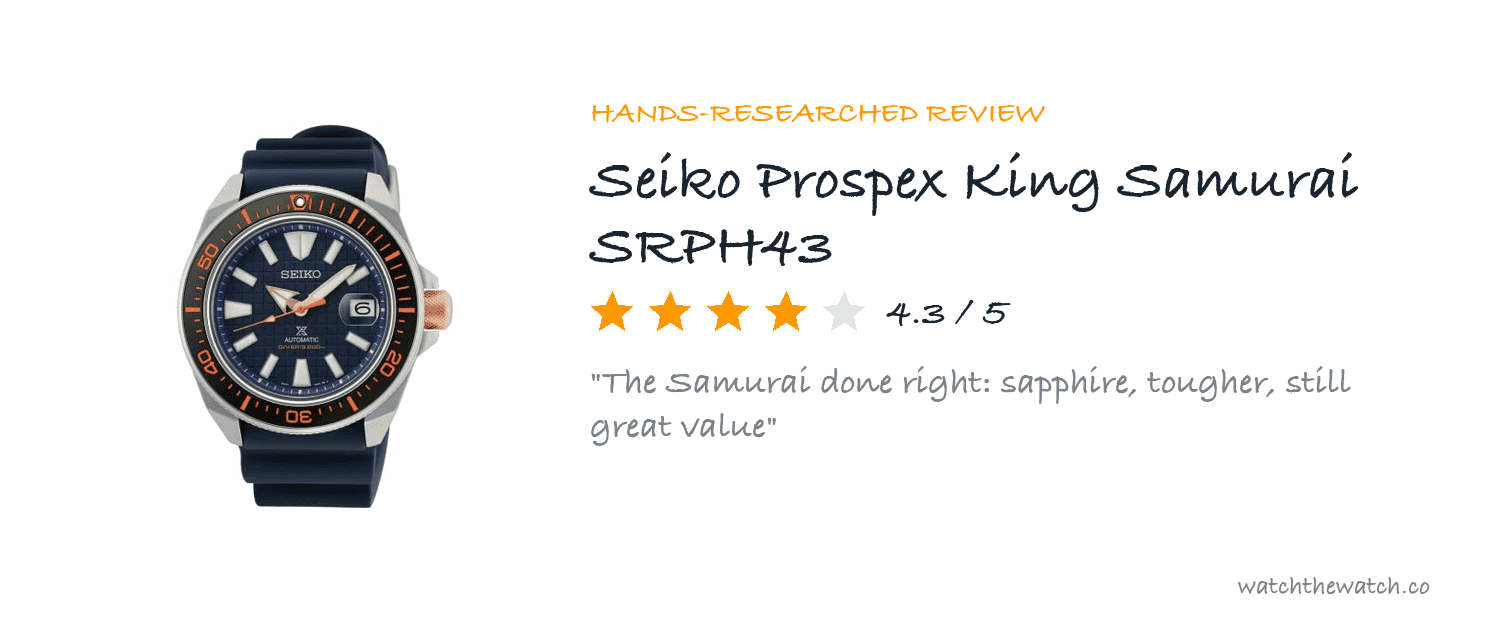
The Seiko Prospex King Samurai (ref SRPH43K1) is what happens when Seiko takes one of its most popular sub-$500 divers and quietly fixes the one thing enthusiasts complained about most. This is the “upgraded” Samurai, and the headline change is a sapphire crystal in place of the old Hardlex. Everything else builds on a case shape that already had a cult following.
If you’ve spent any time in dive-watch forums, you know the standard Samurai gets praised for its angular, almost lightsaber-handle case and criticized for its softer mineral crystal. The King Samurai answers that complaint and tightens up the finishing at the same time. For the money, it’s one of the most complete tool divers Seiko makes.
So is it worth the step up over the cheaper Samurai? Mostly yes. The sapphire alone justifies the premium for most buyers, and you get a nicer bracelet and dial in the bargain.
Quick verdict
The King Samurai is for the buyer who wants a genuine 200m automatic diver with the parts that matter done right, and doesn’t want to babysit the crystal. It’s an angular, distinctive alternative to the rounder Turtle and the slimmer SKX-style cases. If you can live with a budget-grade movement, this is one of the easiest tool-watch recommendations in Seiko’s lineup.
Specifications
| Spec | Detail |
|---|---|
| Case diameter | ~43.8 mm |
| Lug-to-lug | ~47.6 mm |
| Thickness | ~13.3 mm |
| Lug width | 22 mm |
| Movement | Seiko 4R35 automatic (hacking + hand-winding) |
| Power reserve | ~41 hours |
| Crystal | Sapphire |
| Water resistance | 200 m |
| Lume | Seiko LumiBrite |
| Bezel | 120-click unidirectional |
| Crown | Screw-down, 4 o’clock |
| Bracelet | Stainless steel, three-link |
Design and build
The Samurai case is the whole pitch here. Sharp, faceted lugs and a flat, wide bezel give it a presence that reads more modern and aggressive than Seiko’s rounder divers. In photos it can look slab-sided; in the metal the brushed-and-polished facets catch light in a way that flatters the design.
The defining upgrade is the sapphire crystal, which replaces the Hardlex mineral glass used on the standard Samurai. That’s a real-world durability and scratch-resistance gain you’ll appreciate over years of wear, and it’s the single biggest reason to pick this over the cheaper model. Forum owners consistently flag it as the upgrade that finally made the Samurai feel “finished.”
Build quality is classic Seiko Prospex: solid case, properly seated bezel insert, screw-down crown at 4 o’clock, and a dial with thick applied indices packed with LumiBrite. The bracelet on the King Samurai is a step up from older Samurai bracelets in fit and finish, though, like most Seikos at this price, it uses pin-and-collar links rather than screws.
Movement and accuracy
Inside is Seiko’s 4R-series automatic, the 4R35 on this date-only reference. It hacks (the seconds hand stops when you pull the crown) and hand-winds, which the older 7S26 movements famously did not. Power reserve sits around 41 hours, so it’ll comfortably rest overnight but probably won’t survive a full weekend off the wrist.
Be realistic about accuracy: the 4R movement is a workhorse, not a chronometer. Seiko rates it loosely, roughly in the -35 to +45 seconds per day range, and real-world examples often settle somewhere inside that, frequently within ten to fifteen seconds a day once worn in. Some run tighter, some looser; it’s the luck of the draw at this tier.
If precision matters to you, the good news is the 4R35 is easily regulated by a watchmaker to chronometer-adjacent figures for a modest fee. As delivered, though, you’re buying reliability and serviceability, not Grand Seiko timekeeping.
On the wrist
On paper 43.8mm sounds large, but the relatively short ~47.6mm lug-to-lug keeps the footprint in check. The angular lugs hug the wrist better than the diameter suggests, and at ~13.3mm thick it slips under most cuffs without much fuss.
This is a watch that suits medium-to-large wrists best. If you’re around 7 inches or above, it sits beautifully. On wrists under about 6.5 inches the broad bezel and flat case can start to look like a dinner plate, so try one on if you can.
It wears like a proper tool diver: a touch chunky, very legible, and clearly built to be used rather than coddled. The bezel action is firm with the usual slight Seiko back-play, and the lume is excellent, glowing bright and lasting through the night.
Pros and cons
- Sapphire crystal, a meaningful upgrade over the standard Samurai’s Hardlex
- Distinctive angular case with genuinely good brushed-and-polished finishing
- True 200m dive spec with screw-down crown
- Hacking, hand-winding 4R35 movement (a step up from old 7S26 units)
- Outstanding LumiBrite and dial legibility
- Improved bracelet versus older Samurai references
- Movement accuracy is budget-grade and inconsistent unit to unit
- ~41h power reserve won’t clear a weekend off-wrist
- 43.8mm with a wide bezel can overwhelm smaller wrists
- Bracelet uses pin-and-collar links, not screws
- Priced above the standard Samurai, so it’s not the cheapest entry point
Alternatives to consider
The obvious one is the standard Seiko Samurai: same case character for less money, but you give up the sapphire crystal and the nicer finishing. The Seiko Turtle (SRP777 and siblings) offers the same 4R3X movement in a rounder, cushion case that wears shorter and suits smaller wrists better. And if you want sharper out-of-the-box accuracy and a similarly tough build, the Citizen Promaster Diver is light-powered, never needs winding, and keeps better time, though it trades away the mechanical charm.
Frequently asked questions
Is the King Samurai worth it over the standard Samurai?
For most buyers, yes. The sapphire crystal and refined finishing are real upgrades you’ll appreciate over years of wear, and the bracelet is improved. If budget is tight and you don’t mind Hardlex, the standard Samurai is still a great watch for less.
Does the King Samurai have a sapphire crystal?
Yes. The sapphire crystal is the King Samurai’s headline feature and the main thing separating it from the standard Samurai, which uses Seiko’s Hardlex mineral glass. Sapphire is far more scratch-resistant in everyday use.
What movement does the King Samurai use?
This date-only reference runs Seiko’s 4R35 automatic. It hacks and hand-winds, has roughly a 41-hour power reserve, and is rated for loose-but-reliable accuracy typical of Seiko’s entry-level mechanical calibers.
Is 43.8mm too big to wear?
It depends on your wrist. The short ~47.6mm lug-to-lug helps it wear smaller than the diameter implies, so medium-to-large wrists are well served. Under about 6.5 inches it can look oversized, so try one on first if you can. Worth reading alongside this: what actually makes a watch a dive watch and how to use a dive bezel.

Daniel Hart is the editor of Watch The Watch. He researches and writes the site’s buying guides, brand comparisons, and explainers, focused on accessible, enthusiast-level watches — affordable automatics, divers, field and dress watches, everyday quartz, and the straps, winders and tools that go with them. The goal is practical, budget-aware advice that helps readers choose the right watch for their wrist and their budget. Recommendations draw on manufacturer specifications and the wider enthusiast community.

