
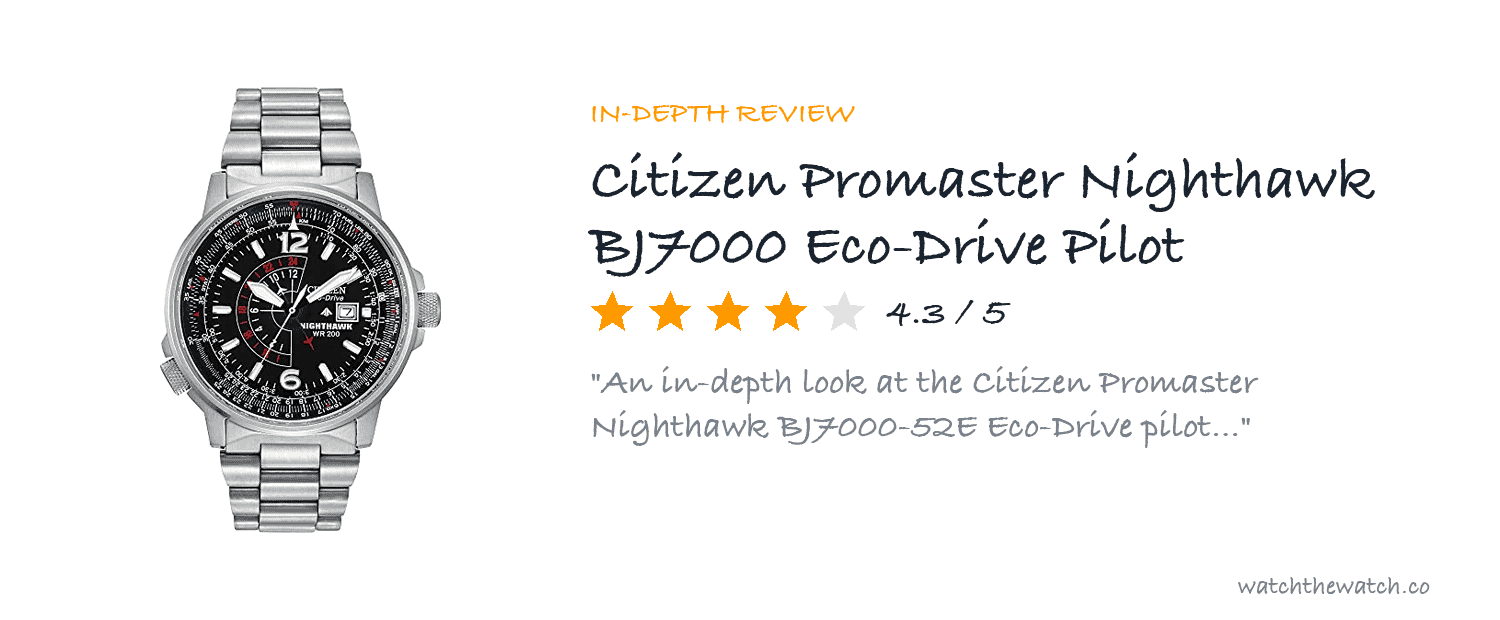
The Citizen Promaster Nighthawk BJ7000-52E is one of the most capable pilot watches you can buy under $300. It is solar-powered via Eco-Drive, water resistant to 200 metres, and it carries both a rotating compass bezel and a functional slide rule inner bezel.
Every pilot watch invites the same question. Genuine tool, or a dressed-up prop? The Nighthawk answers with a firm both.
If you want a hard-wearing daily driver with real aviation credentials and no battery anxiety, this is an easy recommendation in the price bracket.
Overview
The Nighthawk name has been in Citizen’s lineup for over three decades. The BJ7000-52E is the Eco-Drive version of that classic design.
Light hits the dial, charges an internal capacitor, and you never replace a battery for the life of the watch.
It sits inside the Promaster sub-brand, Citizen’s tool-watch line built around real professional use across aviation, diving, and land, not fashion positioning.
What sets the BJ7000 apart from simpler pilot watches is the dual-bezel layout.
The outer bezel rotates to track compass direction. The inner bezel carries a slide rule scale for airspeed, fuel consumption, and unit conversions.
Together they make this a watch you can actually use in a cockpit, not one that just looks the part.
Citizen pairs all of that with a street price that usually lands well below $400 on Amazon, and often lower during sales.
Specifications at a Glance
| Specification | Detail |
|---|---|
| Case diameter | ~42 mm |
| Case material | Stainless steel |
| Crystal | Mineral |
| Water resistance | 200 m / 20 bar |
| Movement | Eco-Drive solar quartz |
| Power reserve | Up to 6 months in darkness (fully charged) |
| Lug width | ~22 mm |
| Dial colour | Black |
| Price band | Around $200–$350 (Amazon; MSRP ~$395) |
Design and Dial
The black dial puts legibility ahead of everything else. Big luminous hour markers and broad lume-coated hands stay high-contrast even in poor light.
That is the baseline for anything sold to pilots.
The typography is purposeful, not decorative. You get bold index numerals at the cardinal positions, a date window at three o’clock, and a power reserve subdial that shows charge at a glance.
The stainless steel case is sized for a big wrist, or for anyone who likes a watch with presence. At around 42 mm, the Nighthawk does not slip under a shirt cuff.
If you prefer smaller cases, factor that in before you buy.
The dual-bezel system is the visual signature here. The outer compass bezel and the inner slide rule ring give it that layered, instrument-panel look.
Both bezels turn with firm, deliberate action and resist accidental knocks, which matters when you are actually flying.
The look is unapologetically utilitarian. Citizen made no effort to slim the case or soften the lines.
The BJ7000 looks like a piece of equipment, and that is exactly the point for its buyers.
Want something closer to a dress-pilot hybrid? The Citizen NB1060 Silver Leaf is a useful contrast at the upper end of Citizen’s design range.
Movement and Accuracy
The BJ7000-52E runs on Citizen’s Eco-Drive. It is solar quartz, turning natural and artificial light into energy stored in a rechargeable cell.
There are no battery costs, and no finding the watch dead after a month in a drawer.
Accuracy runs within about ±15 seconds per month. That is standard for good solar quartz and plenty for daily wear and most aviation use.
The charge-state subdial earns its place. It warns you before power runs critically low, so the watch does not stop on you unannounced.
Fully charged under strong light, Citizen rates the reserve at up to six months in the dark, and owners broadly back that up.
What Eco-Drive does not give you is mechanical character. The movement is quartz, not automatic, so there is no rotor, no winding weight, no heartbeat under the caseback.
If you want reliability and zero maintenance, solar quartz is hard to beat at this price.
If a mechanical movement is the draw, that is a different watch entirely. It is worth knowing how long an automatic lasts before you trade convenience for it. Citizen’s own more premium offerings cover that ground separately.
On the Wrist
Owners say it wears large but sits fairly flat, so the ~42 mm diameter feels less imposing than the spec sheet suggests.
Across watch forums, people keep noting the crown and bezels are easy to work one-handed. That counts on a pilot watch, where your other hand is often busy.
If your wrists run small or narrow, measure the lug-to-lug against your own before committing.
The stock bracelet splits opinion. The clasp and deployment work fine, but the links feel less refined than the case deserves.
Plenty of owners just swap it. At roughly 22 mm lug width the strap options are everywhere, and a NATO or leather strap brings more comfort and a more classic pilot look.
Lume is solid for the first hours of darkness, fine for cockpit low light, but it fades faster than proper dive-watch lume.
Daytime legibility gets consistent praise from owners. The high-contrast black dial and wide hands come up again and again as the real strengths.
Pros and Cons
Pros
- Eco-Drive solar power eliminates battery changes for the life of the watch
- Dual rotating bezel system — compass outer ring plus slide rule inner ring — delivers genuine aviation utility
- 200 m water resistance adds versatility well beyond cockpit use
- Six-month power reserve means the watch survives long unworn periods without stopping
- Strong value for the specification level, typically well under $350 at Amazon
- High-contrast black dial and large luminous markers deliver excellent legibility in varied conditions
Cons
- Case at ~42 mm is large and not well suited to smaller wrists or conservative tastes
- Stock bracelet quality does not match the case — many owners replace it promptly
- Mineral crystal is more vulnerable to surface scratches than sapphire glass, which is common at this price tier but worth noting
- No radio time-sync or GPS correction — setting the time remains a manual process
Who It Is For
This is for buyers who want a real pilot-tool watch without going four figures.
Private pilots, aviation fans, and outdoor types who value zero-maintenance solar over mechanical romance will get on with it.
The 200 m water resistance makes it a genuine crossover, as happy poolside as in the cockpit.
If you keep dealing with dead batteries in quartz watches, Eco-Drive is a real quality-of-life upgrade.
It is a weaker fit if you want sub-40 mm cases, dress-watch elegance, or the feel of an automatic movement.
Alternatives to Consider
Inside the Promaster family, the Promaster Sky series carries different complications, and some models add radio-controlled time sync. That suits frequent time-zone travellers who want automatic correction.
If you are still weighing the lineup, our guide to the best Citizen watches in 2026 maps the Eco-Drive and automatic options side by side.
The Seiko SSC Solar Chronograph is the obvious cross-shop at a similar price. It is solar like the Nighthawk and adds a chronograph, but it has no slide rule bezel.
Casio’s Edifice solar range matches on price and feature count, but it leans sporty rather than aviation.
Got more budget and want a mechanical pilot watch? Look at the Hamilton Khaki Aviation line. It opens around $500–$700 and brings Swiss automatics with real pilot heritage.
At the same Citizen price, the Promaster Diver BN0150 is the one to compare if diving matters more to you than flying.
Verdict
The Citizen Promaster Nighthawk BJ7000-52E has earned its spot in the affordable pilot-watch market.
Eco-Drive reliability, the dual-bezel aviation kit, and 200 m water resistance add up to genuine value at its street price.
The stock bracelet is the obvious weak point, and the ~42 mm case wants a willing wrist.
But if you want low maintenance, high legibility, and a watch that does what it claims instead of just looking the part, this is a confident buy. It has been one for decades of continuous production.
Frequently Asked Questions
What is the case size of the Citizen Promaster Nighthawk BJ7000-52E?
The BJ7000-52E measures roughly 42 mm across. It is a large-format pilot watch by design, built for easy dial legibility and a bold wrist presence, not discreet sizing.
Does the Citizen Nighthawk BJ7000-52E need a battery?
No. It uses Citizen’s Eco-Drive solar tech, which charges from any light source, natural or artificial. Fully charged, it runs up to six months in complete darkness, so battery replacement is a permanent non-issue.
How does the slide rule bezel on the Nighthawk work?
The inner rotating bezel carries logarithmic slide rule markings for aviation math: airspeed, fuel consumption, flight time, and unit conversions. It works just like the slide rules on classic pilot watches and circular flight computers.
You do have to learn the methods to use it, but this is a working instrument, not decoration.
Is the Citizen Nighthawk BJ7000-52E suitable for swimming?
With 200 m water resistance, the BJ7000-52E handles swimming and snorkelling comfortably. It is not a certified ISO dive watch and has no unidirectional dive bezel, but the rating is well beyond what non-scuba water activities need.
What strap width fits the Citizen Nighthawk BJ7000-52E?
The BJ7000-52E has a lug width of about 22 mm. That fits plenty of aftermarket straps, including NATO, leather, and rubber. Many owners switch the stock bracelet for a NATO strap for comfort and a more classic pilot look.

Daniel Hart is the editor of Watch The Watch. He researches and writes the site’s buying guides, brand comparisons, and explainers, focused on accessible, enthusiast-level watches — affordable automatics, divers, field and dress watches, everyday quartz, and the straps, winders and tools that go with them. The goal is practical, budget-aware advice that helps readers choose the right watch for their wrist and their budget. Recommendations draw on manufacturer specifications and the wider enthusiast community.