
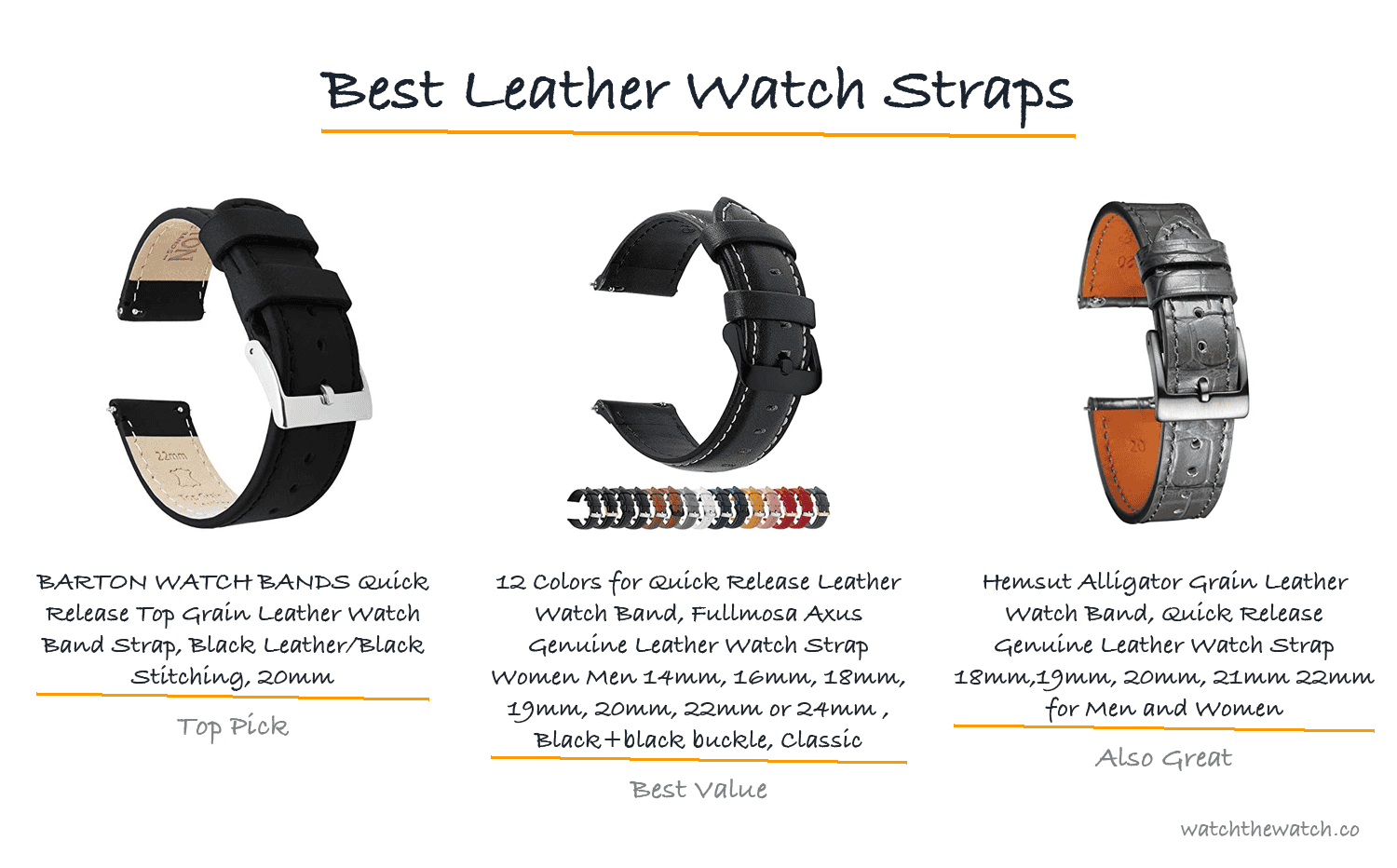
A good leather strap is the cheapest way to make a watch feel new again. The right one uses real top-grain or alligator-grain cowhide, and you can have that for well under $40.
For 2026 my top pick is the Barton Watch Bands Quick Release Top Grain Leather strap. It uses a proper leather grade, and the tool-free swap holds up through years of daily wear, which is what owners on the watch forums keep confirming. It’s the one I’d recommend first.
Tight budget and want options? Fullmosa’s Axus line covers 14mm to 24mm in 12 color options. It’s the standout value pick.
Our top picks at a glance
The standouts from this guide — prices change, so tap through for the current price.
As an Amazon Associate, Watch The Watch earns from qualifying purchases at no extra cost to you. Some links go to other retailers. See our affiliate disclosure.
How We Picked
Leather straps are a crowded category, and the quality swings wildly at the same price. I judged these on five things: leather grade, build quality, hardware, size range, and long-term durability as reported by verified buyers and enthusiast communities.
Price only breaks ties. A $12 strap that lasts two years beats a $25 strap that cracks at six months.
The enthusiast consensus across r/Watches and WatchUSeek rewards the same handful of traits: leather that softens without going floppy, edges that don’t fray at the buckle holes, a neutral smell from day one, and a buckle that survives daily sweat. I held these straps to that bar.
The 3 Best Leather Watch Straps of 2026
1. Barton Watch Bands Quick Release Top Grain Leather — Best Overall

Barton is a US strap brand with a devoted following among people who want a real step up from a factory rubber band or a scratched steel bracelet, minus the boutique price. This listing is the 20mm black-on-black version, but the same design comes in other widths and colors.
The reason it wins is the top grain leather. “Genuine leather” comes from the weaker split layers lower in the hide. Top grain uses the upper surface, so the fiber is denser, holds its shape, and picks up a real patina over months.
The quick release is an integrated pull-pin on each spring bar. You swap the strap with a fingernail in under ten seconds, no tool needed, and owners say it clicks home with no wobble.
Stitching is even and the lining is finished properly, so nothing here feels cut-rate. It suits a dress watch, a vintage-style piece, or any 40mm everyday automatic. For most people, this is the easy recommendation.
2. Fullmosa Axus Genuine Leather Watch Strap — Best Value and Most Versatile

The Axus earns its spot by fixing two real problems at once. It covers oddball lug widths (a 19mm option is genuinely hard to find), and it gives you enough colors to play with pairings without spending real money.
At the $10–15 price point this is genuine leather, a lower hide layer than top grain. It’s embossed to a clean, uniform finish that’s fine for casual and smart-casual wear.
It also breaks in fast and lies flat from day one. That beats stiffer straps that take weeks to mold to your wrist.
The trade-off against the Barton shows up at the edges. Finishing is less refined and the buckle holes wear out sooner.
Still, if you rotate straps across two watches, or just want to try a burgundy or forest-green before you commit to something pricier, this is the sensible place to start. The quick release works reliably by buyer accounts, and twelve colors cover just about any watch.
3. Hemsut Alligator Grain Leather Watch Band — Best Dress-Look Option

Hemsut’s alligator-grain strap gives you the croc-pattern look without the four-figure cost of real exotic leather.
The pattern is pressed into real cowhide, not vinyl or PU. That’s why it resists surface cracking far better than bonded fakes and keeps its texture through normal wear.
The taper (wider at the lugs, narrower at the buckle) is the classic dress-strap shape. It flatters thin dress watches, exhibition-caseback pieces, and vintage-inspired automatics.
Reviewers call the quick release smooth and well-fitted, and the strap comfortable from day one with no real break-in. Sizing runs 18mm through 22mm, which catches most men’s and unisex lugs.
So if your watch leans formal or vintage and you want something that reads “dressed up” in photos and in person, this punches above its price.
Comparison: Best Leather Watch Straps 2026
| Strap | Material | Quick Release | Lug Width Range | Colors | Approx. Price |
|---|---|---|---|---|---|
| Barton Top Grain | Top grain cowhide | Yes | 20mm (multiple widths in brand line) | Several | ~$25–35 |
| Fullmosa Axus | Genuine leather | Yes | 14, 16, 18, 19, 20, 22, 24mm | 12 | ~$10–15 |
| Hemsut Alligator Grain | Alligator-grain genuine leather | Yes | 18, 19, 20, 21, 22mm | Multiple | ~$12–18 |
What to Look For When Buying a Leather Watch Strap
Leather Grade: What the Labels Actually Mean
Leather grade is the single biggest factor in how long a strap lasts. Here’s the hierarchy, best to worst.
Full grain keeps the intact hide surface and ages best, but it’s rare under $50. Top grain is sanded smooth, still dense and durable, and it’s what Barton uses.
Genuine leather is the split layer below top grain: softer, less durable, usually surface-coated to look even. That’s what Fullmosa and Hemsut use. Bonded leather is shredded scraps glued together, so avoid it at any price.
Here’s the catch with the label. “Genuine leather” legally means real hide, but in the trade “genuine” is the minimum bar, not a mark of quality.
Measuring Lug Width Correctly
Lug width is the gap between your watch’s lugs (the horns at 12 o’clock and 6 o’clock), measured in millimeters where the strap attaches. Most men’s watches sit between 18mm and 22mm.
The single most common size is 20mm. It fits most 38mm to 42mm watches, including Seiko 5s, Tudor homages, and mid-range Swiss pieces. If you’re newer to the hobby and weighing whether Seiko is worth it, most of its core lineup lands right here.
Vintage and smaller dress watches often need 16mm or 18mm. Big sports and dive watches can want 22mm or 24mm, and if you’re shopping by model, our best Seiko watches roundup lists the lug width for each. Match the number exactly.
Measure with digital calipers if you can. A ruler works, but a 1mm error leaves you with a strap that won’t seat properly or shows gaps at the lugs.
Quick Release vs. Standard Spring Bars
Quick-release straps have a little pin you slide with a fingernail to free the spring bar. No tools, no scratched lugs.
Standard spring bars need a dedicated tool and five to ten minutes of fiddly work per strap. So if you swap straps at all, quick release is the obvious pick, and all three picks here use it.
Standard bars do hold a small edge for diving or heavy manual work, where an accidental release would actually matter. For office, travel, and daily wear, quick release is fully reliable.
Construction Details That Predict Longevity
- Stitching: Look for even spacing, consistent tension, and no pulled or loose threads at the buckle end. Saddle stitching (two needles, one thread passing through each hole) is more durable than machine lockstitch, though rarely specified at this price tier.
- Taper: A proper dress strap tapers from the lug width to a narrower tail — typically a 20mm strap tapers to 16mm or 18mm at the buckle. Non-tapered straps look stiff and lie awkwardly on the wrist.
- Lining: A suede or leather inner lining cushions the caseback and helps the strap drape evenly. Budget straps sometimes omit this; it matters for both comfort and how the strap folds over time.
- Buckle material: Stainless steel buckles resist sweat corrosion; zinc alloy buckles are cheaper and corrode. When the listing does not specify, check buyer reviews for rust mentions before ordering.
- Edge finishing: Painted, burnished, or beveled edges all outperform raw-cut edges, which fray fastest at the buckle holes.
Care and Maintenance
Water, sweat, UV, and plain neglect are what kill leather. Take the strap off before swimming, showering, or hard outdoor exercise no matter what your watch is rated for, because the strap fails long before the watch does.
Wipe the inner surface with a dry cloth after a hot day. Once a month, work in a little leather conditioner (neatsfoot oil or a commercial balm) to keep the fibers supple and delay cracking at the buckle holes.
Here’s the trick I’d actually push: rotate between two straps and let each dry fully between wears. That alone roughly doubles the life of both. Store them flat or on a strap roll, never coiled tight, or they’ll crease for good.
Frequently Asked Questions
What lug width do I need for a replacement leather watch strap?
Measure the gap between your watch lugs with calipers or a fine ruler. That number in millimeters is your lug width.
The common sizes are 18mm (smaller dress watches, 36–38mm cases), 20mm (the standard for most 38mm–42mm everyday watches), and 22mm (larger sport watches). Your old strap’s width is often printed on its underside or in the spec booklet. Get it even 1mm off and you’ll see gaps at the lugs or the strap won’t seat.
What is the difference between top grain and genuine leather in watch straps?
Top grain comes from the upper layer of the hide. It’s denser, tougher, and develops a real patina over years.
Genuine leather is the split layer underneath. It’s still real leather, but softer and weaker, usually coated to look uniform. Full grain (the top grade) is rare under $50, so for daily wear top grain is the realistic best at normal strap prices.
How long does a leather watch strap typically last?
Worn daily, a quality leather strap usually lasts one to three years before it cracks at the buckle holes or the lining starts separating. Water, sweat, and direct sun speed that up a lot.
Rotate two straps and condition them monthly and a top-grain strap can push to three or more years. A budget genuine-leather strap worn every day with no rotation might need replacing in 12 to 18 months.
Can I wear a leather watch strap while swimming or in the shower?
No. Leather and sustained water don’t mix, whatever your watch is rated for. Water weakens the fibers, delaminates the lining, rots the stitching, and leaves a smell.
If you swim or shower in your watch, put it on a rubber or silicone strap for that, then swap back. All three picks here are dry-wear only.
Are quick-release leather straps as secure as traditionally installed spring bar straps?
For everyday wear, yes. Quick-release mechanisms from established brands are built to tight enough tolerances that accidental release is uncommon, since the pin only disengages on a deliberate sideways pull.
For diving or heavy manual work, a tool-installed standard bar gives you a bit more mechanical redundancy. For commuting, office, and travel, quick release wins and saves you carrying a tool.

Daniel Hart is the editor of Watch The Watch. He researches and writes the site’s buying guides, brand comparisons, and explainers, focused on accessible, enthusiast-level watches — affordable automatics, divers, field and dress watches, everyday quartz, and the straps, winders and tools that go with them. The goal is practical, budget-aware advice that helps readers choose the right watch for their wrist and their budget. Recommendations draw on manufacturer specifications and the wider enthusiast community.