
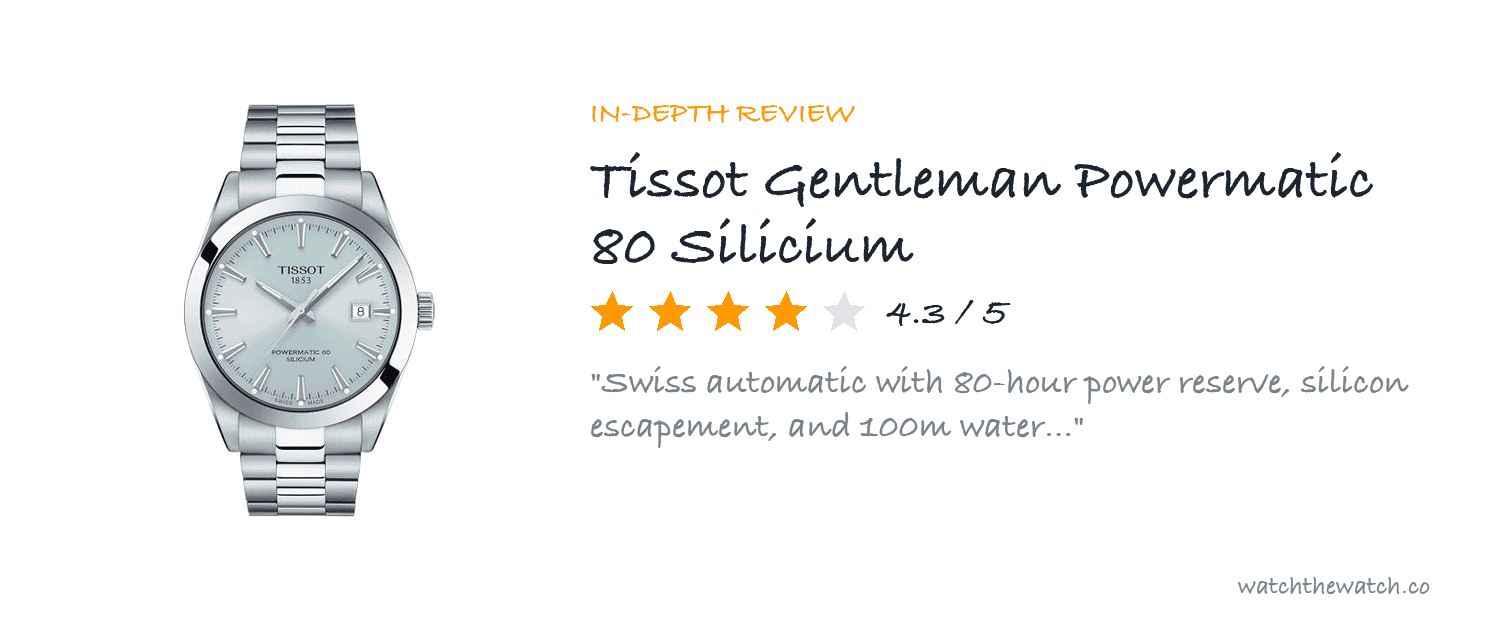
The Tissot Gentleman Powermatic 80 Silicium punches well above its price. You get an 80-hour silicon-equipped Swiss automatic in a 40mm dress-sport case for around $600.
That puts it among the most technically capable Swiss watches under $700. If you’ve been talked out of Swiss because of the cost, this is the watch that changes your mind.
The short version: it handles the office, a dinner out, and a full weekend without asking you to compromise. One watch, three jobs, done well.

Overview
The Gentleman name has been around in various forms for years, repositioned more than once as tastes shifted. This Powermatic 80 Silicium is the cleanest version yet: a sport-elegant Swiss automatic that doesn’t force a choice between dressy and practical.
Tissot files it under the “gentleman’s watch” label, and honestly the tag fits. Professional under a jacket, relaxed on a Saturday, with neither feeling like a stretch.
The word “Silicium” is the part of the name that actually matters. The Powermatic 80 caliber runs a silicon balance spring, and that changes how the movement behaves over years, not just on a spec sheet. More on that below.
Key Specs at a Glance
| Feature | Detail |
|---|---|
| Case diameter | 40mm |
| Case material | Stainless steel |
| Movement | Tissot Powermatic 80 Silicium (automatic) |
| Power reserve | 80 hours |
| Water resistance | 100m / 10 ATM |
| Crystal | Sapphire, double-sided anti-reflective coating |
| Lug width | 20mm |
| Price band | Around $550–$700 depending on variant and retailer |
Design & Dial
The Gentleman sits in a well-defined space between a true dress watch and a sports model. At 40mm with a sensible lug-to-lug, it suits wrists from roughly 6.5 to 8 inches without looking too big or too small.
The case is slim enough to slide under a shirt cuff with no fight. That matters more than it sounds if you wear a watch to a desk every day.
The dial is clean and restrained. Applied indices instead of printed markers, dauphine hands, and none of it tips into fussiness.
Tissot sells the Gentleman in several dial colors, with blue, green, black, and silver the easiest to find. The blue and green have a real following among people who want some character without going casual.
Both read as distinctive at a glance. They also stay safe for the office, which is the whole trick.
Case finishing mixes brushed flanks with polished bevels and crown, and for the money the execution is genuinely good.
Put a loupe on it and the brushed-to-polished transitions aren’t as crisp as on watches costing three or four times more. At arm’s length, where you actually look at a watch, it reads as polished and credible.
The sapphire exhibition caseback shows the rotor and the movement plate underneath. Pretty, if a little plain, which I’ll come back to.
Movement & Accuracy
This is where the Gentleman makes its strongest case. It’s built on an ETA C07.111 base, a respectable Swiss lever movement, but the silicon balance spring isn’t marketing fluff. It changes long-term behavior in three real ways:
- Anti-magnetic: Silicon is inherently non-ferromagnetic, meaning the balance spring is unaffected by the magnetic fields that degrade accuracy in traditional steel hairsprings. Smartphones, laptop speakers, induction cooktops, and magnetic bag clasps are all non-issues.
- 80-hour power reserve: Wind the watch fully on Friday evening, and it will still be running Monday morning without having been worn over the weekend. This is not a marginal gain over a standard 38–42 hour reserve. It changes the practical relationship between the watch and the week.
- Extended service intervals: Silicon requires no lubrication at the escapement. Tissot backs this with a recommended service interval of up to 10 years, compared to the conventional 3–5 year recommendation for a traditionally lubricated lever escapement. That gap represents real long-term cost savings.
Accuracy is rated at about -4/+6 seconds per day, normal for a non-COSC Swiss movement. In practice, owners report around ±4–5 seconds per day, which is chronometer territory at this price.
It isn’t COSC-certified, and a handful of buyers do care about that. In daily use the difference is invisible, and this is a movement built to go the distance.
Low maintenance is a real part of the appeal. If you’re wondering how long automatics actually last, a silicon escapement is exactly the sort of thing that helps.
On the Wrist
The enthusiast read on the Gentleman is that it wears lighter than its spec sheet suggests. Owners call it a reliable daily piece, light for a steel automatic, with a footprint that doesn’t sprawl past the wrist.
It moves from professional to casual without you having to think about it. That’s exactly the job at this price.
The 100m water resistance means it goes where you go: handwashing, rain, swimming, beach days, all well inside the rating.
On the forums, owners say they never feel the need to take it off short of scuba diving. You stop babying it, which is the point.
The sapphire crystal shrugs off the light scratches that pile up on mineral glass. After months of daily wear, owners flag this as a genuine quality-of-life difference.
Strap swapping comes up constantly in long-term owner accounts. The 20mm lug width opens up a huge aftermarket.
On the three-link steel bracelet that ships with some variants, it reads as a polished everyday watch. Put it on a slim leather strap, cordovan or calfskin, and it leans properly dressy.
What gets me is how hard it is to make this watch look wrong. Owners try all sorts of combinations and basically none of them miss.
Pros
- 80-hour power reserve: a real lifestyle advantage, not a spec-sheet number
- Silicon escapement delivers anti-magnetic performance and up to 10-year service intervals
- Sapphire crystal with double-sided anti-reflective coating
- 100m water resistance: safe for swimming, not just hand-washing
- Versatile 40mm case size works in professional and casual contexts equally
- Exhibition caseback lets you observe the movement
- Strong brand recognition and solid resale liquidity within the Tissot lineup
Cons
- Movement has no decorative finishing: no Geneva stripes, perlage, or beveled bridges visible through the caseback
- Not COSC-certified, which matters to some buyers even when real-world accuracy is competitive
- Bracelet quality is solid but not exceptional, and some owners upgrade straps within the first year
- Date-only complication, no day display
- Conservative design language may read as plain to buyers who want a bolder aesthetic statement
Who It’s For
The Gentleman is built for the buyer who wants one Swiss automatic that does almost everything. It fits especially well for:
- First-time Swiss automatic buyers who want modern movement technology at an accessible price
- Office wearers who need a watch that reads as professional without requiring a separate casual option
- Buyers prioritizing long-term reliability and low maintenance over decorative movement display
- Anyone moving from quartz who wants the upgrade path to make practical sense from day one
It’s the wrong watch if you’re chasing in-house movement cachet, elaborate dial art, or something that shouts across a room. This one whispers.
Curious why Tissot earns steady respect at the affordable end of Swiss watchmaking? Our take on whether Tissot is a good watch brand digs into the manufacturing depth and value behind it.
Alternatives to Consider
Three names come up again and again when people cross-shop the Gentleman:
Tissot PRX Powermatic 80. Same movement, but wrapped in an integrated-bracelet design that nods to 1970s sport-elegant style. If you like the Genta-influenced look more than a round case with standard lugs, the PRX is the obvious in-house alternative. Same silicon escapement and 80-hour reserve, just a different vibe.
Seiko Presage SPB series. Seiko’s in-house automatics bring better movement finishing and often fancier dial work at similar money. Wondering whether Seiko is worth it? Their best models make a strong case.
Real-world accuracy is comparable, but you lose both the silicon escapement and the 80-hour reserve. It’s craft versus technology. For a full side-by-side on value, accuracy, and longevity, see our Tissot vs Seiko comparison.
Hamilton Jazzmaster Automatic. A solid dress-leaning pick in the same price band, ETA-based, with a more distinctive design identity. Water resistance is usually lower at 50m, and there’s no silicon escapement. Pick it if design character matters to you more than the technical spec list.
Here’s the thing: no alternative on this list bundles the 80-hour reserve, silicon escapement, and 100m water resistance together at this price. If those three features are your deal-breakers, the comparison ends fast.
Verdict
The Gentleman doesn’t try to wow you with drama. Clean case, restrained dial, and a movement that’s genuinely modern but never performs for the audience.
What it does instead is just work, day after day, without getting in your way. That’s rarer than it sounds.
For around $600, you get Swiss automatic pedigree, a silicon escapement, an 80-hour reserve, sapphire crystal, and 100m water resistance. No competitor really matches that bundle at the price.
The Gentleman earns its name through considered engineering, not flair. That brief is harder to pull off than it looks, and Tissot pulls it off.
Frequently Asked Questions
What movement does the Tissot Gentleman Powermatic 80 Silicium use?
It runs Tissot’s Powermatic 80 caliber, built on an ETA C07.111 base with a silicon balance spring. The silicon escapement makes it anti-magnetic and stretches the recommended service interval to up to 10 years.
How accurate is the Tissot Gentleman Powermatic 80 Silicium?
Tissot rates it at roughly -4/+6 seconds per day. Owner reports across forums and review sites land around ±4–5 seconds per day in real wear.
That’s competitive with COSC-certified chronometers at this price, even without the COSC paperwork.
Can you swim with the Tissot Gentleman Powermatic 80 Silicium?
Yes. It’s rated to 100m (10 ATM), fine for recreational swimming and snorkeling, though not for scuba diving.
Like any water-resistant watch, get the gaskets checked periodically if it sees water regularly.
What is the case size and lug width of the Tissot Gentleman?
The current Gentleman has a 40mm stainless steel case with a 20mm lug width. The 40mm diameter and modest lug-to-lug suit a wide range of wrists.
The 20mm lugs also mean excellent aftermarket strap choice.
How long does the power reserve last on the Tissot Gentleman Powermatic 80?
The power reserve is 80 hours, more than three full days. Wind it fully and it runs through the whole weekend untouched.
That’s handy if you rotate between several watches or just go bare-wristed on weekends.

Daniel Hart is the editor of Watch The Watch. He researches and writes the site’s buying guides, brand comparisons, and explainers, focused on accessible, enthusiast-level watches — affordable automatics, divers, field and dress watches, everyday quartz, and the straps, winders and tools that go with them. The goal is practical, budget-aware advice that helps readers choose the right watch for their wrist and their budget. Recommendations draw on manufacturer specifications and the wider enthusiast community.