Daniel Hart · ·
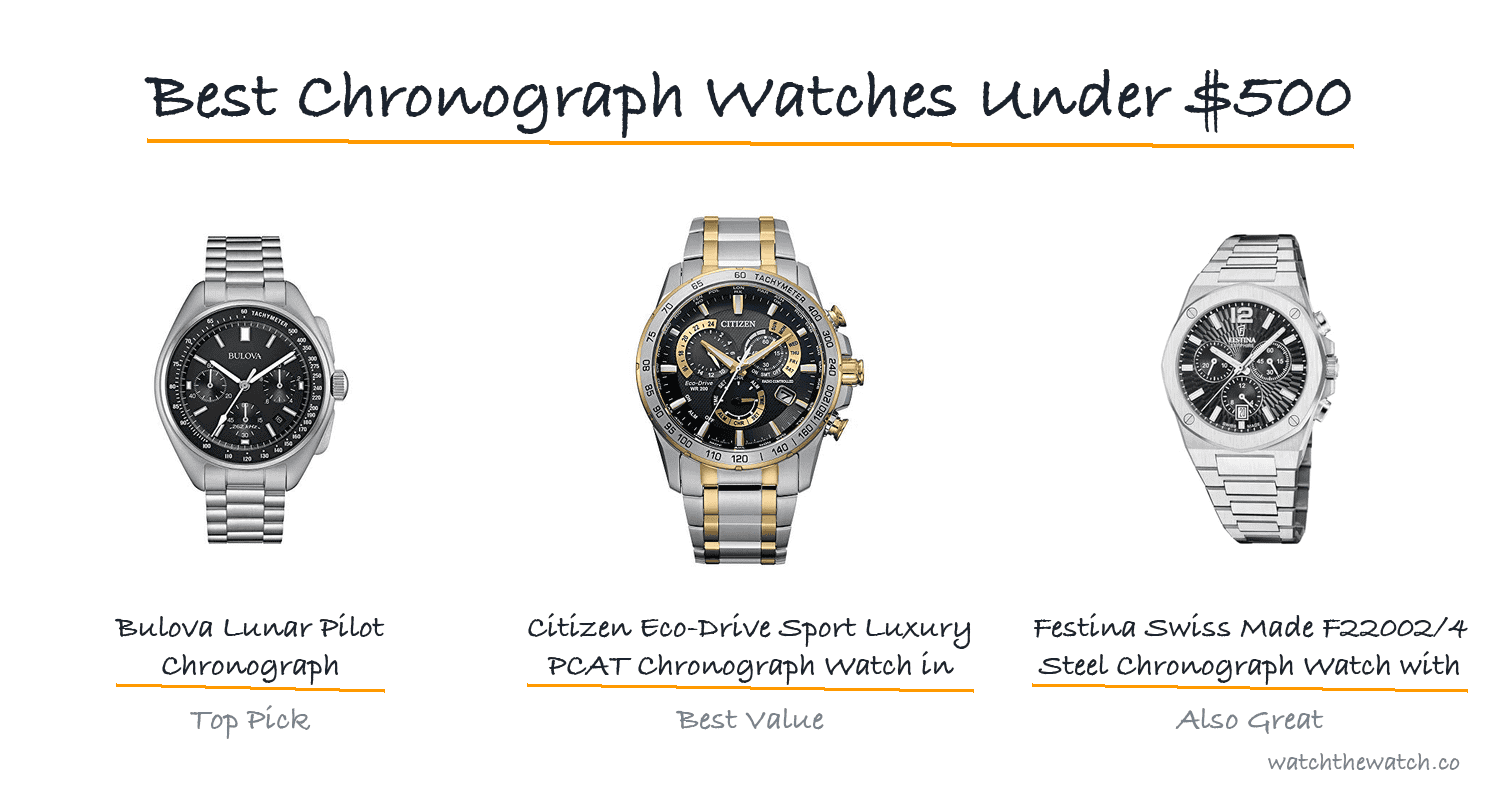
The Bulova Lunar Pilot is the standout pick under $500. It pairs genuine space-program heritage with Bulova’s proprietary 262kHz high-frequency movement, and the accuracy embarrasses watches that cost a lot more.
Want solar power and radio-controlled atomic timekeeping instead? The Citizen Eco-Drive PCAT Chronograph packs the most features at a similar price.
On a tighter budget, the Citizen Brycen and Fossil Grant make the point clearly. A clean, functional chronograph does not have to cost more than $200.
Our top picks at a glance
The standouts from this guide — prices change, so tap through for the current price.
As an Amazon Associate, Watch The Watch earns from qualifying purchases at no extra cost to you. Some links go to other retailers. See our affiliate disclosure.
How We Picked
Three rules decided this list. Each watch is a true chronograph with a dedicated stopwatch, it has to be realistically findable under $500, and it needs a clear reason to pick it over the rest, whether that is movement quality, features, history, or looks.
I left out moonphase and perpetual-calendar models that skip the stopwatch, even when they landed in the same price range. A chronograph needs a stopwatch, otherwise it is something else.
Long-term cost counted too. Solar picks earn credit for never needing a battery.
1. Bulova Lunar Pilot Chronograph — Best Overall
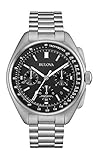
The backstory checks out. Bulova supplied watches to NASA astronauts, and this reissue traces directly to the Apollo 14 mission watch.
Inside is Bulova’s 262kHz high-frequency quartz movement, a technology the brand pioneered in the 1970s. Enthusiasts rate it among the most accurate analog quartz chronographs at any price, at ±15 seconds per year.
The 45mm case is large and purposeful, and the cream-toned dial reads like an instrument, not a fashion piece. What gets me is the pushers: owners report a positive, tactile click instead of the vague action you usually get here.
Water resistance is limited, so treat it as dress-casual, not sport. If you have ever wondered whether Bulova counts as luxury, this watch is the strongest argument for it, and nothing else here matches its history.
2. Citizen Eco-Drive PCAT Chronograph — Best Feature Set

PCAT stands for Perpetual Calendar Atomic Timekeeping. The watch syncs to an atomic time signal on its own and rolls through every month-end and leap year with no manual adjustment.
Add Citizen’s Eco-Drive solar cell, which charges from any light and runs for months in the dark on a full charge, and you have a watch that never needs a battery under normal use. Citizen does this across its range, so it is worth seeing the best Citizen watches if Eco-Drive appeals.
The bracelet and clasp feel a step above the price, and the busy dial reads fast once you learn the subdials. If you want precision and long-term practicality above everything, this is the rational pick.
3. Festina Swiss Made F22002/4 — Best Value Swiss Made

A Swiss Made chronograph under $500 is genuinely unusual. The label requires at least 60% of production costs to happen in Switzerland, movement assembly and casing included.
Festina, a Spanish brand best known for sponsoring pro cycling, hits that mark with the F22002/4. It adds sapphire crystal, far more scratch-resistant than mineral glass, plus a brushed-and-polished steel bracelet that forum regulars say punches above its price.
If Swiss Made provenance matters to you, or you just want a watch that shrugs off desk scratches, the Festina is the clearest value argument here.
Curious where boutique finishing pulls ahead of mass-market? The Kurono Tokyo Toki Chronograph review shows exactly where the gap appears.
4. Citizen Eco-Drive Brycen Chronograph — Best Everyday Chronograph

The Brycen is the “just wear it” pick. Eco-Drive charges from any light, so no battery anxiety, and 100m water resistance covers swimming and the odd accidental dunk.
The clean three-subdial layout works at the office and outdoors equally well. At around $200 it is one of the best-value solar chronographs at any price.
Owners call it genuinely low-maintenance, the kind of watch you stop noticing because it just works. Buying your first chronograph on a budget? Start here.
5. Bulova Marine Star Chronograph — Best Sport Chronograph
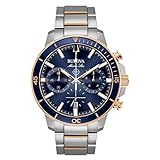
The Marine Star puts Bulova’s high-frequency quartz in a sport-focused package: 100m water resistance, a stainless bracelet built for active wear, and a bolder case than the Lunar Pilot.
You get the same ±15 seconds per year accuracy, plus a notably smooth sweep on the chrono seconds hand. That sweep is usually the first thing non-watch people notice.
It lands between the dressy Fossil Grant and the gadget-heavy Citizen PCAT. That makes it the natural sport pick if you still want something that reads elegantly.
6. Casio Edifice EQB-1000 — Best Connected Chronograph

The Edifice EQB-1000 is for people who want a connected watch that still looks analog, not the screen-first look of a smartwatch.
It pairs to your phone over Bluetooth for automatic time-setting and world time across dozens of cities, has a chronograph alongside the multi-function display, and runs on solar with no battery swaps.
Casio’s build holds up: tight crown, positive pushers, clean lug finishing, all in step with the sport-instrument billing. Travel a lot and want a watch that handles time zones by itself? This is the pragmatic pick.
7. Fossil Grant Chronograph — Best Dress Chronograph Under $200

The Fossil Grant is an honest entry-level dress chronograph: a clean three-subdial layout on a 44mm case, a genuine leather strap, and styling lifted from mid-century Swiss dress watches.
It uses a standard Japanese quartz movement, accurate but unremarkable, behind mineral crystal that will pick up light scratches over years of wear. The 50m rating covers rain and hand-washing, not swimming.
Need something polished enough for the office but cannot justify over $150? The Grant answers that brief directly.
Want to see what mechanical alternatives look like at a similar price? The best skeleton watches under $500 guide shows the step up.
All Seven Chronographs Compared
| Watch | Case | Power | Water Resistance | Stand-out Feature | Approx. Price |
|---|---|---|---|---|---|
| Bulova Lunar Pilot | 45mm steel | High-freq quartz | 30m | NASA heritage, ±15 sec/yr accuracy | ~$350 |
| Citizen PCAT Chrono | ~44mm steel | Solar (Eco-Drive) | 100m | Atomic timekeeping + perpetual cal. | ~$400 |
| Festina Swiss Made F22002/4 | 43mm steel | Swiss quartz | 100m | Swiss Made certification + sapphire | ~$400 |
| Citizen Brycen | 44mm steel | Solar (Eco-Drive) | 100m | Best solar value under $250 | ~$200 |
| Bulova Marine Star | 44mm steel | High-freq quartz | 100m | Sport build, smooth chrono sweep | ~$275 |
| Casio Edifice EQB-1000 | ~44mm steel | Solar + Bluetooth | 100m | Smartphone sync, world time | ~$260 |
| Fossil Grant | 44mm steel | Quartz | 50m | Dress aesthetic under $150 | ~$145 |
What to Look for in a Chronograph Under $500
Quartz vs. automatic movement
Under $500, almost every chronograph is quartz, not automatic. That is not a compromise here.
Quartz chronographs are more accurate (roughly ±15 seconds per year against ±5 seconds per day for a mechanical), they start reliably every time you hit the pusher, and they ask for nothing beyond an eventual battery change. A mechanical at this tier usually runs an inexpensive ETA derivative or a proprietary caliber that is less accurate than good quartz.
The tradeoff only matters if you specifically want the feel of a mechanical, in which case you are really shopping the $600-plus bracket. It is also worth knowing how long automatics actually last before you pay more for one.
Solar vs. battery power
Citizen’s Eco-Drive picks, the PCAT and Brycen, never need a battery under normal wear, and the Casio Edifice stacks Bluetooth on top of solar. For a daily watch, solar is a real long-term edge: no 3-to-5-year battery service, no resetting the time afterward.
The battery-powered picks (Bulova, Fossil, Festina) are just as reliable day to day, they just want occasional attention over the years.
Crystal hardness
Mineral crystal is standard at this price and will collect light scratches over years of wear.
The Festina Swiss Made F22002/4 is the only pick here with sapphire, which is far harder than mineral glass and effectively scratch-proof in normal use. If your watch never leaves your wrist, that is worth prioritizing.
Water resistance for sport use
For swimming or water sports, you want at least 100m water resistance. The Fossil Grant’s 50m covers rain and hand-washing, not swimming.
The Bulova Lunar Pilot looks rugged but also has limited water resistance, so treat it as dress-casual. Every other pick here is rated to 100m.
- Best for everyday wear: Citizen Brycen — solar, 100m, clean design
- Best for formal occasions: Fossil Grant — leather strap, dress aesthetic
- Best for sport: Bulova Marine Star — 100m, stainless sport bracelet
- Best for frequent travelers: Casio Edifice EQB-1000 — world time, automatic time sync
- Best for watch enthusiasts: Bulova Lunar Pilot — NASA heritage, high-frequency accuracy
Frequently Asked Questions
What is the most accurate chronograph under $500?
The Bulova Lunar Pilot and Marine Star share the 262kHz high-frequency quartz movement, rated to ±15 seconds per year, among the most accurate analog quartz at any price.
The Citizen PCAT matches or beats that with radio-controlled atomic timekeeping, which syncs to an official atomic clock signal automatically. Both are far ahead of a standard quartz movement (around ±15 seconds per month) or a typical mechanical chronograph.
Is there a Swiss Made chronograph available under $500?
Yes. The Festina Swiss Made F22002/4 carries a genuine Swiss Made certification: the movement is assembled and cased in Switzerland, with at least 60% of production costs incurred there.
It usually sells around $400 and throws in sapphire crystal, which makes it a real anomaly at this price. Most Swiss Made chronographs from other brands start at $600 or more.
Do I actually need a chronograph, or will a standard watch do?
A chronograph earns its keep if you actually time things, laps, cooking, events, presentations, and want to do it one-handed without reaching for a phone. If you rarely touch a stopwatch, a three-hand watch at the same price gives you better legibility and a cleaner look.
Buy the chronograph because you will use it, not just because it looks more technical.
What is the difference between a chronograph and a chronometer?
A chronograph is a watch with a built-in stopwatch. A chronometer is a watch that has passed a strict accuracy certification, most often the Swiss COSC standard, which holds mechanical movements to within ±4 seconds per day.
People mix the two up constantly. None of these picks are COSC-certified, yet Bulova’s 262kHz quartz and the Citizen PCAT’s atomic sync both beat the COSC standard in practice.
Which Bulova chronograph should I choose — Lunar Pilot or Marine Star?
Go Lunar Pilot for the NASA heritage, the distinctive 45mm pilot-style case, and only if you are fine with limited water resistance.
Go Marine Star for better water resistance, a sport bracelet, and a more versatile everyday profile at a slightly lower price. Both run the same high-frequency quartz, so accuracy and chronograph performance are basically identical.

Daniel Hart is the editor of Watch The Watch. He researches and writes the site’s buying guides, brand comparisons, and explainers, focused on accessible, enthusiast-level watches — affordable automatics, divers, field and dress watches, everyday quartz, and the straps, winders and tools that go with them. The goal is practical, budget-aware advice that helps readers choose the right watch for their wrist and their budget. Recommendations draw on manufacturer specifications and the wider enthusiast community.