
Daniel Hart · ·
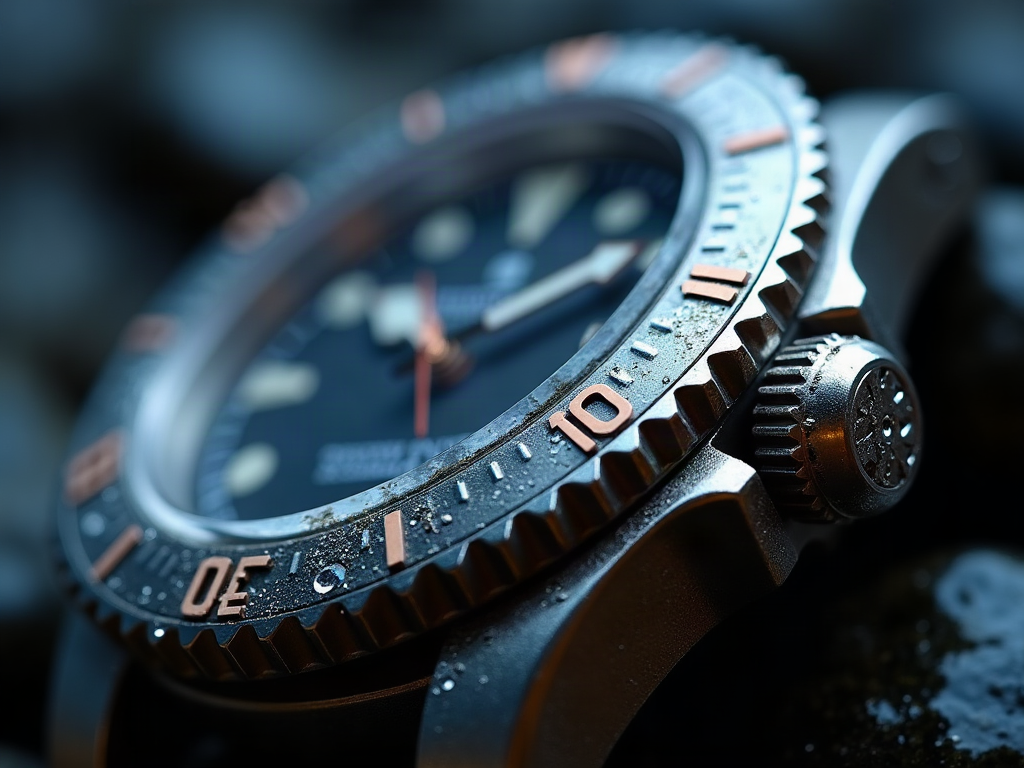
A dive watch bezel is the rotating ring around the edge of the dial, marked with a scale of 60 minutes. Its whole job is to track how much time has passed since you started something — a dive, a parking meter, a pot on the stove — without any digital screen or mental arithmetic.
The method is simpler than it looks. You line up the bezel’s starting mark with the minute hand, then read the elapsed minutes straight off the ring as the hand sweeps forward. The bezel does the subtraction for you, which is exactly why it has survived as a tool for more than seventy years.
Below is the step-by-step, plus the reason it only turns one direction — and a few everyday uses that have nothing to do with the ocean.
How to set and read the bezel, step by step
Every dive bezel has a clear reference point at the 12 o’clock position, usually a triangle, an arrow, or a luminous dot called the “pip.” That pip is your zero. Everything you measure is counted from the pip forward.
The sequence is the same every time:
- Note the minute hand. The moment you want to start timing, look at where the minute hand is pointing.
- Rotate the bezel until the pip sits under the minute hand. The zero marker and the minute hand now share the same spot.
- Let time pass. The minute hand keeps moving around the dial as normal; the bezel stays put.
- Read the elapsed time. Look at which number on the bezel the minute hand is now pointing at. That number is how many minutes have gone by.
An example makes it obvious. Say you start at 10:10, so the minute hand is on the “2” of the dial. You spin the pip to that spot. When the minute hand later reaches the “5” on the dial, the bezel scale beneath it reads 15. Fifteen minutes have elapsed — no clock-watching, no math.
Why the bezel only turns one way
A proper dive bezel is unidirectional: it rotates counter-clockwise only and locks against turning the other way. This is a deliberate safety feature, not a manufacturing quirk. If the bezel gets knocked while you are timing, it can only move in the direction that makes your remaining time look shorter, never longer.
For a diver tracking breathable air, that distinction matters. Imagine the bezel could spin freely both ways and got bumped backward — it would show that less time had passed than reality, tempting the diver to stay down longer than their air supply allows. The unidirectional design removes that failure mode entirely.
Older and dressier “skin diver” watches sometimes used bidirectional bezels, and you will still see them on non-dive sport watches. They are fine for casual timing, but for anything where over-running the clock has real consequences, one-way is the safer standard and is required under the ISO 6425 dive-watch specification.
The two ways to use the scale
The same bezel reads in two directions depending on what you need. Most people only ever learn the first, but the second is just as useful.
- Counting up (elapsed time): Set the pip to the minute hand at the start. Read the growing number under the hand to see how long you have been doing something. This is the everyday mode.
- Counting down (a deadline): Suppose you have 20 minutes until you must leave. Set the bezel’s “20” marker to the current minute-hand position. As the hand creeps toward the pip, the remaining minutes shrink. When the hand reaches the pip, your time is up.
The count-down trick is the one that surprises people. You are essentially turning the bezel into a kitchen timer that never beeps but never needs a battery either.
Practical timing uses beyond diving
Very few owners of dive watches ever dive. That is fine — the bezel is a general-purpose timer that happens to be strapped to your wrist. Once the habit clicks, you reach for it constantly.
A few realistic examples:
| Situation | How the bezel helps |
|---|---|
| Parking meter | Set the pip at arrival; glance later to see minutes used against what you paid for. |
| Cooking or steeping tea | Count down to the finish without unlocking your phone. |
| Workout intervals | Track rest periods between sets at a glance. |
| Boarding or transit | Know how long until a train or gate without doing time-of-day math. |
| Phone calls and meetings | See how long you have been talking — useful for billable time or staying on schedule. |
The appeal is the same in every case: one glance, no device, no calculation. You are reading a duration directly instead of subtracting two clock times in your head. That small friction-saver is why divers, pilots, cooks, and commuters have all leaned on the humble rotating ring.
A couple of practical cautions
The bezel times intervals up to 60 minutes cleanly. For anything longer you have to track full hours separately, since the scale simply repeats. It is a minute timer, not a stopwatch with hours built in.
Also remember the bezel measures from when you set it, not from any fixed event. If you forget to align the pip at the start, there is no way to recover the elapsed time after the fact — the watch only knows what you told it. Make setting the pip the first thing you do, before the activity begins.
Straps that suit the watch
A dive watch on the wrong strap is a dress watch that happens to be waterproof.


As an Amazon Associate, Watch The Watch earns from qualifying purchases at no extra cost to you. See our affiliate disclosure.
Frequently asked questions
Do I use the minute hand or the hour hand to read the bezel?
Always the minute hand. The bezel scale runs 0 to 60 minutes, which matches the path of the minute hand around the dial. The hour hand is irrelevant to bezel timing.
What is the little triangle or dot at the top of the bezel?
That is the zero marker, often called the pip. It is usually luminous so it glows in the dark. You align it with the minute hand to mark your starting point.
Why won’t my bezel turn clockwise?
Because a true dive bezel is unidirectional by design — it only turns counter-clockwise as a safety measure, so an accidental knock can never make your elapsed time read shorter than reality. That is normal and intended, not a fault.
Can I use the bezel as a countdown timer?
Yes. Instead of setting the pip to the minute hand, set the marker for your target number of minutes to the minute hand’s current position. When the hand reaches the pip, your time is up. Two related guides on this site: what actually makes a watch a dive watch and the best dive watches under $1,000. If you are not sure the watch is a real diver, our dive watch checker works through the standard with you.

Daniel Hart is the editor of Watch The Watch. He researches and writes the site’s buying guides, brand comparisons, and explainers, focused on accessible, enthusiast-level watches — affordable automatics, divers, field and dress watches, everyday quartz, and the straps, winders and tools that go with them. The goal is practical, budget-aware advice that helps readers choose the right watch for their wrist and their budget. Recommendations draw on manufacturer specifications and the wider enthusiast community.

Pingback: Guide to Dive Watches: What is a Dive Watch? - WatchTheWatch.co
Pingback: Best Affordable Dive Watches: Top Picks from Cheap to Expensive - WatchTheWatch.co