
Daniel Hart · ·
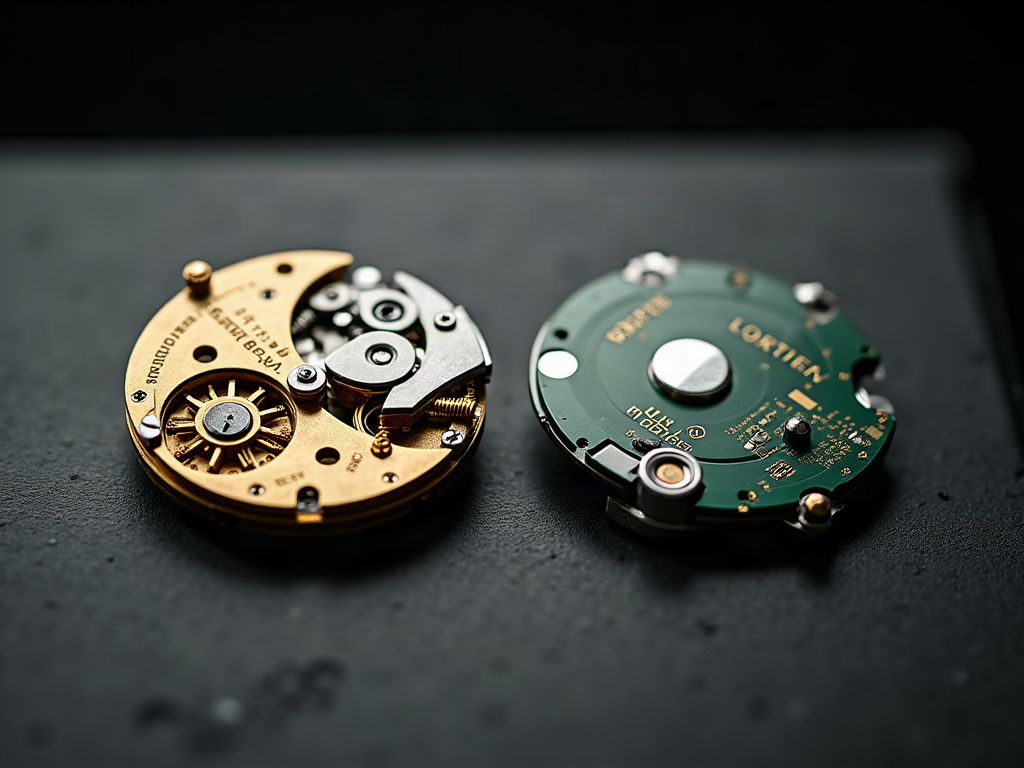
This is the first question almost everyone asks, and most of the answers online are tribal rather than useful.
Enthusiasts will tell you quartz is soulless. Sceptics will tell you mechanical watches are expensive jewellery that keep worse time than a phone. Both are describing preferences as though they were facts.
Here is what actually differs, what does not, and how to tell which one is in front of you.
The short answer
One note on wording. Mechanical covers both automatic and hand-wound watches, since both run on a mainspring and an escapement. Automatics are simply the common case, because almost nobody buys a hand-wound watch as a first mechanical watch, so most of what follows uses the two words interchangeably.
How each one actually keeps time
A mechanical watch stores energy in a coiled mainspring and releases it in tiny regulated steps through an escapement and a balance wheel. The balance swings back and forth several times a second, and counting those swings is how the watch knows what time it is. An automatic simply adds a weighted rotor that winds that mainspring as your arm moves.
A quartz watch runs a small current through a quartz crystal, which vibrates at a very precise frequency. A circuit counts those vibrations and pulses a stepper motor once a second. The crystal vibrates 32,768 times per second, against roughly six to eight swings per second in a mechanical watch, and that gap is the entire accuracy story.
The Federation of the Swiss Watch Industry sets out the two principles side by side in its mechanical and quartz explainer.
What the difference costs you
Accuracy is not close. A decent quartz watch drifts by a few seconds a month. A good automatic drifts by a few seconds a day, and even a chronometer-certified one is allowed to run four seconds slow to six seconds fast every day.
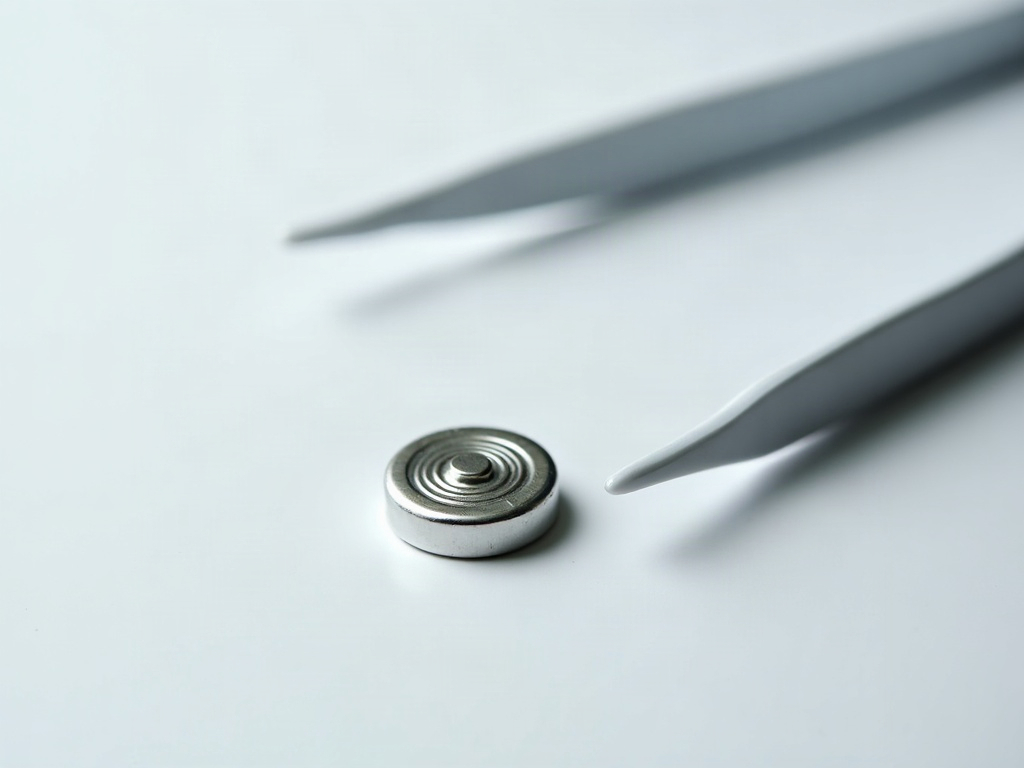
Maintenance runs the other way. A quartz watch needs a battery every few years and a mechanical watch needs a service every several years, and the service costs many times the battery. Against that, a well-kept mechanical movement can be repaired essentially forever, while a dead quartz circuit is usually replaced rather than fixed.
Price at the low end favours quartz enormously. Below about a hundred dollars, quartz is simply better made for the money, and our NH35 explainer covers what the cheapest credible automatic movement actually offers.
| Automatic | Quartz | |
|---|---|---|
| Power source | Mainspring wound by wrist motion | Battery |
| Typical accuracy | Seconds per day | Seconds per month |
| Runs when not worn | 38 to 80 hours, then stops | Until the battery dies |
| Routine cost | Service every several years | Battery every few years |
| Seconds hand | Sweeps in small steps | Ticks once per second |
| Repairable long term | Yes, indefinitely | Circuit usually replaced |
One of each, to make it concrete
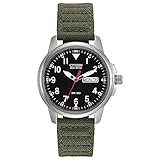
Two watches that sit either side of the line, both long-serving and widely owned.
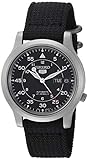
As an Amazon Associate, Watch The Watch earns from qualifying purchases at no extra cost to you. See our affiliate disclosure.
How to tell them apart in three seconds
Watch the seconds hand. A quartz hand jumps once per second with a visible pause between steps. A mechanical hand sweeps, moving in six or eight much smaller steps that the eye reads as continuous motion.
That is the reliable test, and it works through a shop window. A display caseback is the other giveaway: if you can see gears and a swinging balance wheel, it is mechanical.
One case defeats the test. Meca-quartz chronographs keep time with quartz but drive the chronograph with a mechanical module, so the chronograph seconds hand behaves unexpectedly. Our guide to chronographs under $500 covers where that hybrid turns up.
Which one you should actually buy
Buy quartz if the watch will be worn occasionally, if you want it to be right without thinking about it, or if the budget is genuinely tight. A watch that is dead when you reach for it is the most common real-world failure, and quartz almost never does that. Our solar watches guide covers the light-powered version that does not even need a battery change.
Buy automatic if you want the object as much as the function. The appeal is genuine and worth saying plainly: a mechanical watch is a small machine running on your wrist, and that is the whole point of it.
Do not buy automatic because you think it keeps better time, because it does not. And do not pay several hundred dollars for quartz without knowing that is what you are doing. Our watch finder quiz weighs the movement against everything else that decides a watch.
Frequently asked questions
Is an automatic watch better than a quartz watch?
Not on accuracy, where quartz wins by a wide margin. Automatic watches win on longevity, repairability and on being mechanically interesting. Which matters more is a preference, not a fact.
How accurate is a quartz watch compared to an automatic?
A typical quartz watch drifts a few seconds per month. A good automatic drifts a few seconds per day, and even chronometer certification allows minus four to plus six seconds daily.
How can I tell if a watch is quartz or automatic?
Watch the seconds hand. A quartz hand jumps once per second with a clear pause. A mechanical hand sweeps in six or eight tiny steps per second that read as smooth motion.
Do automatic watches need winding?
They wind themselves from wrist motion while worn. Left off the wrist they run for roughly 38 to 80 hours depending on the movement, then stop and need resetting.
Which is cheaper to own, quartz or automatic?
Quartz, clearly. A battery every few years costs a fraction of a mechanical service every several years. A mechanical watch can be repaired indefinitely, though, which quartz generally cannot.
The verdict
The honest summary is that quartz is the better instrument and mechanical is the better object, and almost every argument online is really about which of those the speaker values.
Pick by how often the watch will be worn. Daily wear suits an automatic; a drawer suits quartz. That single question settles it more reliably than any specification comparison. Our running fast diagnostic separates magnetism from a genuine fault on either kind.

Daniel Hart is the editor of Watch The Watch. He researches and writes the site’s buying guides, brand comparisons, and explainers, focused on accessible, enthusiast-level watches — affordable automatics, divers, field and dress watches, everyday quartz, and the straps, winders and tools that go with them. The goal is practical, budget-aware advice that helps readers choose the right watch for their wrist and their budget. Recommendations draw on manufacturer specifications and the wider enthusiast community.

