
Daniel Hart · ·
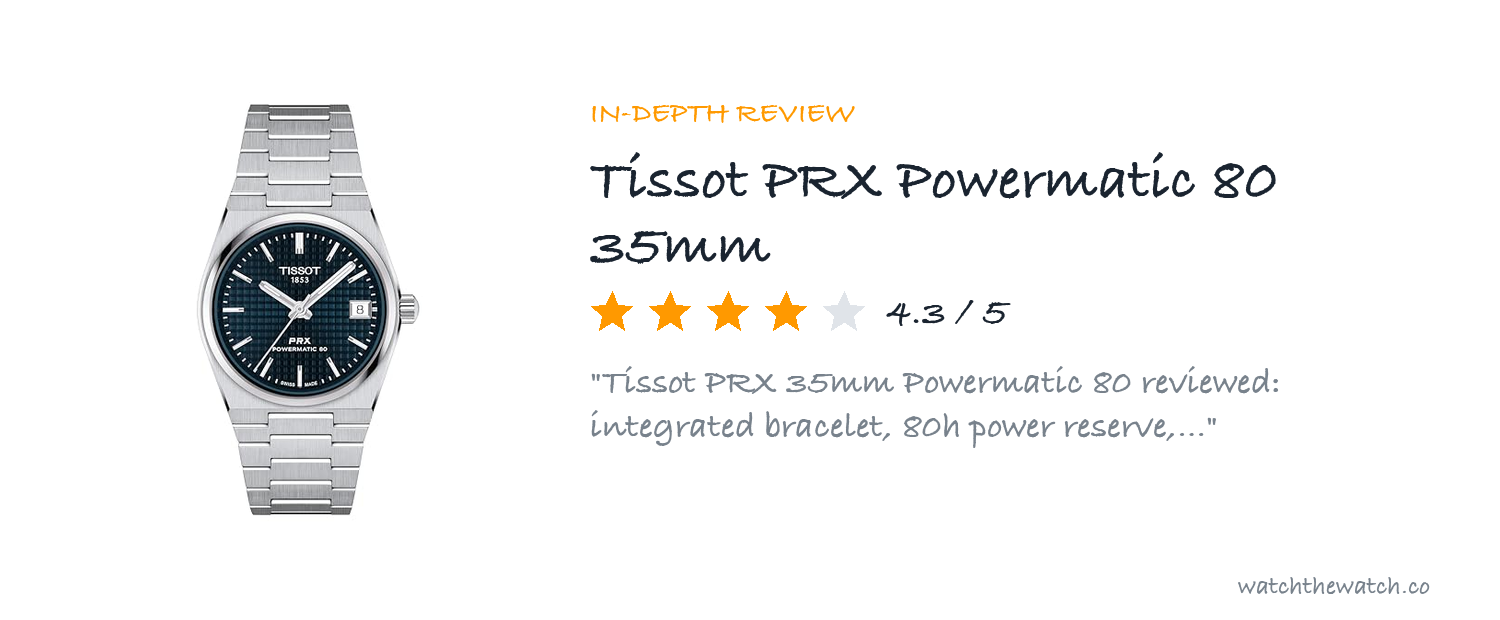
The Tissot PRX Powermatic 80 35mm is one of the most convincing integrated-bracelet automatics under $800. You get a 1970s steel bracelet, an angular case, an 80-hour power reserve, and a sapphire crystal. At the price, most rivals look either overpriced or under-built.
At 35mm it sits in real unisex territory. Slim and proportionate on smaller wrists, but detailed enough for enthusiasts who value restraint over size.

Overview: Why the PRX 35mm Exists
Tissot first launched the PRX, short for Precise, Robust, and Water-Resistant, in 1978. That was the peak of the integrated-bracelet era Gerald Genta’s Royal Oak had kicked off six years earlier.
The design language is unmistakable. An angular H-link bracelet flows into a stepped bezel, flat lugs, a dial that sits flush with the case. Tissot shelved it, then revived the line in 2021.
The 35mm Powermatic 80 rounds out a lineup that also includes a 40mm automatic and quartz versions at both sizes. This is not a shrunken ladies’ model wearing a unisex label. The case proportions and bracelet taper were drawn for the 35mm format specifically.
If you’re trying to work out whether Tissot is a good watch brand, the PRX is the clearest single answer I can point to.
Specifications at a Glance
| Specification | Detail |
|---|---|
| Case diameter | 35mm |
| Case material | Stainless steel, polished/satin finish |
| Bracelet | Integrated stainless steel H-link, folding clasp |
| Crystal | Sapphire with anti-reflective coating |
| Movement | Tissot Powermatic 80 (ETA-based automatic) |
| Power reserve | 80 hours |
| Frequency | 21,600 vph (3 Hz) |
| Water resistance | 100m / 10 ATM |
| Dial options | Silver, blue, and additional colourways |
| Price band | Around $700–$750 (retail) |
Design and Dial
The 35mm wears the same visual DNA as the 40mm, just scaled with discipline. Polished centre links alternate with brushed outer links, and Tissot pulls this off cleanly at the price. No “all shiny or all matte” shortcut here.
The bracelet tapers toward a slim folding clasp. It sits flush against the wrist with no bulk underneath.
The stepped bezel is the detail that separates the PRX from generic integrated-bracelet pretenders. It frames the dial and ties the case geometry into the bracelet, so the whole thing reads as one object rather than a case with a strap bolted on.
On the silver dial, the applied markers catch light crisply. The blue dial has a sunburst that shifts between grey-blue and true blue depending on the angle.
Legibility is strong for the size. The indices are proportionate, the hands are long enough, and the anti-reflective coating cuts glare without the greasy rainbow you get from cheaper AR.
There’s no date window. That keeps the dial clean and symmetrical, and most enthusiasts agree it’s the right call for this design.
Movement and Accuracy
The Powermatic 80 is Tissot’s branded take on an ETA-based movement, with a modified mainspring that pushes the power reserve to 80 hours. That’s more than three full days off the wrist.
At 21,600 vph the beat rate is lower than a modern high-frequency caliber, so the seconds hand sweeps a touch more deliberately than a 28,800 vph movement. Purists notice. Most wearers never will.
ETA-based movements have been the backbone of Swiss mid-market watchmaking for decades. Parts and serviceability are excellent. An independent watchmaker can service a Powermatic 80 without chasing manufacturer-only components.
That matters more than the spec sheet suggests, and it feeds straight into how long automatic watches last. A movement you can actually get fixed is a movement you keep.
Tissot rates accuracy at +/-1 second per day under ideal conditions. Real-world forum reports land around +/-5 to +/-10 seconds per day depending on position and temperature, which is normal for this movement family.
You can see the movement through the display caseback, though the Powermatic 80 rotor is functional, not decorative.
Hold it next to an in-house caliber from a boutique brand and you’ll spot the gap. At this price, though, that trade-off is fair and out in the open.
On the Wrist: What Owners Report
On forums like WatchUSeek and Reddit’s r/Watches the consensus is consistent. The PRX 35mm fits wrists in the 15–17cm range exceptionally well.
Owners with smaller wrists keep calling it the first automatic that felt sized to them, not shrunk down from a bigger template. The bracelet drapes without going loose, and the clasp range covers day-to-night wrist swing.
Owners above 18cm usually find the 35mm reads small and point to the 40mm instead. No surprise there.
There’s also a crowd that owns both sizes and treats the 35mm as the “office daily” and the 40mm as the weekend piece. That’s the most telling endorsement of the size. It earns wrist time precisely because it’s discreet.
Bracelet comfort gets specific praise. The folding clasp doesn’t dig in during typing or desk work.
Several owners do flag micro-scratches on the polished centre links within the first few months. That’s the finish, not a defect, and it happens to any polished steel bracelet in daily use.
Pros
- Integrated bracelet design that genuinely coheres as a single object, rare below $1,000
- 80-hour power reserve means no winding ritual after a long weekend
- Sapphire crystal with anti-reflective coating at this price is not a given, and this one has it
- 100m water resistance covers swimming, not just hand-washing
- No date complication keeps the dial architecture clean and symmetrical
- Strong parts and service ecosystem via ETA-based movement
- Genuine unisex sizing that works across a wide range of wrist circumferences
Cons
- Polished centre links on the bracelet will show micro-scratches in normal daily wear
- 21,600 vph beat rate produces a less fluid seconds sweep than higher-frequency rivals
- Display caseback reveals a functional, not decorative, rotor — underwhelming for movement enthusiasts
- Bracelet adjustment relies on a pin-and-collar system that some owners find fiddly without a tool
- Limited lug-width flexibility — the integrated bracelet means no strap swapping via standard spring bars
Who It Is For
The PRX 35mm is the right call if you want an integrated-bracelet Swiss automatic with a clean, dateless dial, and your wrist finds the 40mm too assertive.
It works in the office, dresses up or down, and suits anyone starting a first serious collection who wants the integrated-bracelet look without the five-figure price tag the genre usually carries.
It’s also a strong pick if most automatics feel skewed too far toward the masculine end of the spectrum.
The PRX 35mm doesn’t read as a shrunken men’s watch. It reads as a watch that happens to be 35mm.
Alternatives to Consider
Tissot PRX Powermatic 80 40mm. Above 17cm, or if you just want more presence, it runs the same movement and bracelet logic at a comparable price. The design is identical, so this is purely a sizing decision, try both at a boutique if you can.
Tissot PRX 35mm Quartz. Usually under $400, it shares the case and bracelet but drops the exhibition caseback, the power reserve, and the mechanical movement. If you don’t care about the mechanical side it frees real budget, otherwise the Powermatic 80 earns the step up.
Hamilton Jazzmaster Performer Auto. Hamilton’s integrated-bracelet entry sits in a similar price band with a more contemporary case and an in-house-derived H-10 movement, also good for an 80-hour power reserve. The look is less retro and more machine-age than 1970s, and it’s real competition if the PRX’s angles feel too restrained.
Seiko is the other automatic most people cross-shop at this money, and our best Seiko watches in 2026 guide runs through the strongest picks by budget.
Want the wider brand picture? The Tissot vs Seiko comparison breaks down the differences in movement philosophy, design, and value.
Verdict
The Tissot PRX Powermatic 80 35mm earns its recommendation, and it’s not close. No watch at this price is perfect, this one included.
But the package, real integrated-bracelet design, an 80-hour power reserve, sapphire crystal, and 100m water resistance at around $700–$750, is hard to match without spending a lot more or compromising somewhere.
The 35mm size fills a genuine gap: a properly proportioned automatic for smaller wrists that doesn’t water down the design.
If you want the integrated-bracelet look and your budget is under $800, this belongs at the top of your shortlist.
Frequently Asked Questions
Is the Tissot PRX 35mm suitable for men or is it a women’s watch?
The PRX 35mm is designed and marketed as a unisex watch, not a women’s model. It works well on wrists roughly 15–17cm regardless of gender. Men with larger wrists usually prefer the 40mm.
What movement is inside the Tissot PRX Powermatic 80?
The PRX Powermatic 80 uses an ETA-based automatic caliber modified with an extended mainspring to achieve an 80-hour power reserve. It beats at 21,600 vph and is the same movement family used across Tissot’s Powermatic 80 range. ETA-based calibers have excellent parts availability and can be serviced by most qualified independent watchmakers.
Can you change the bracelet on the Tissot PRX 35mm?
The PRX uses an integrated bracelet that attaches straight to the case, with no conventional lug ends or standard spring bars. Swapping to a third-party strap isn’t straightforward. It needs an adapter or a bracelet replacement at the same pin points, so most owners just run the steel bracelet as intended.
How accurate is the Tissot PRX Powermatic 80?
Tissot rates the Powermatic 80 movement to within approximately +/-1 second per day under controlled conditions. Real-world owner reports across watch forums place typical accuracy at roughly +/-5 to +/-10 seconds per day depending on position, temperature, and activity level. That’s standard for a movement in this class and price range.
Is the Tissot PRX 35mm water resistant enough for swimming?
Yes. The PRX 35mm Powermatic 80 is rated to 100m / 10 ATM, which covers recreational swimming and snorkelling, but not scuba diving. Don’t operate the crown underwater, standard advice for any crown at this water resistance level.

Daniel Hart is the editor of Watch The Watch. He researches and writes the site’s buying guides, brand comparisons, and explainers, focused on accessible, enthusiast-level watches — affordable automatics, divers, field and dress watches, everyday quartz, and the straps, winders and tools that go with them. The goal is practical, budget-aware advice that helps readers choose the right watch for their wrist and their budget. Recommendations draw on manufacturer specifications and the wider enthusiast community.

