Daniel Hart · ·
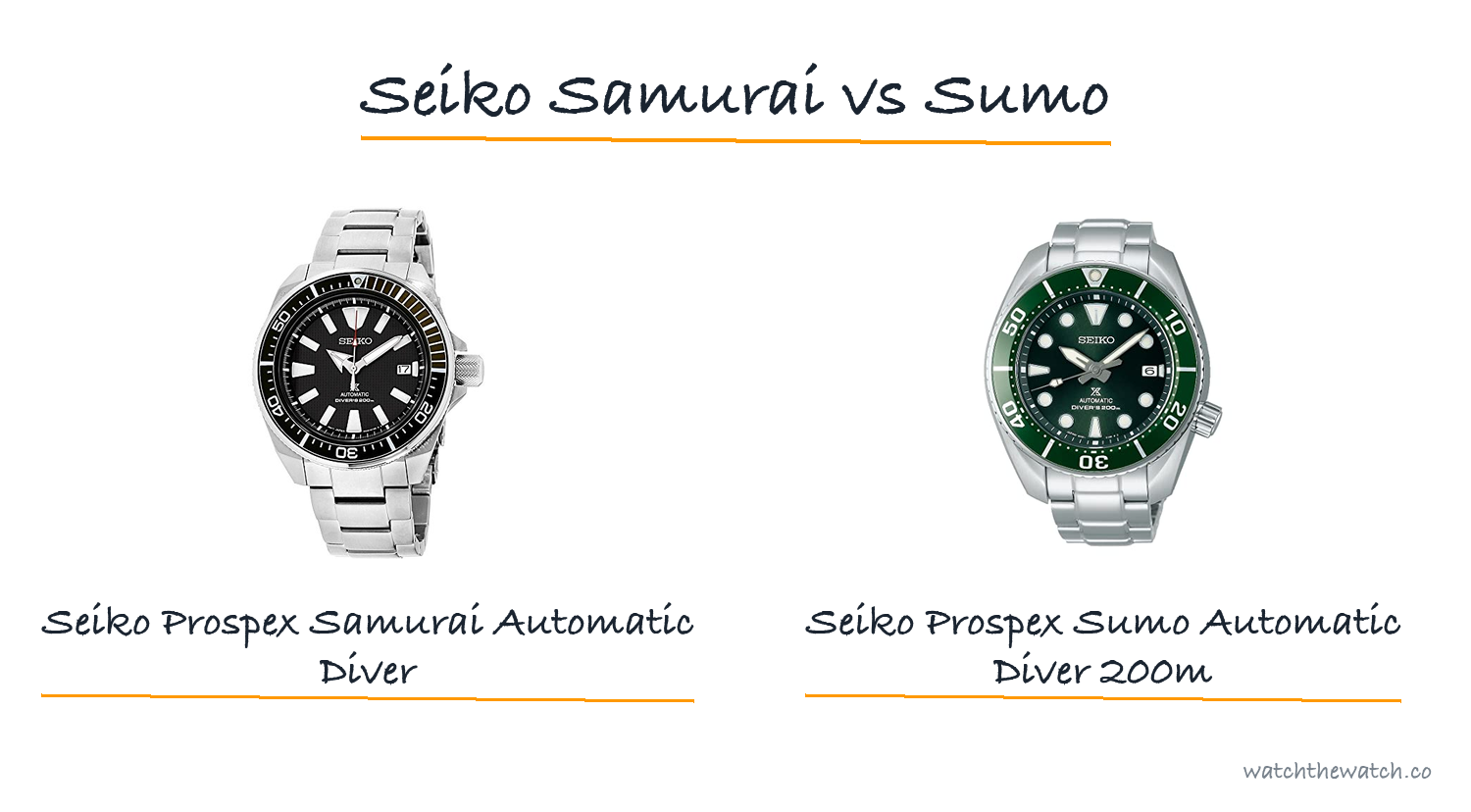
For most buyers, the Samurai is the smarter pick. It works across more wrist sizes, sits slimmer under a cuff, and matches the Sumo on the 200-metre dive rating, the 4R35 automatic, and roughly the price.
The Sumo earns its name. That wide, cushion case makes one of the boldest statements in affordable diving, so buy it if you have the wrist and like the proportions.
Both are genuinely good tool dive watches. The call here comes down to case shape and fit, not specs.
If you’re new to the brand, it helps to know where Seiko actually sits. These are mid-budget Prospex divers, and they punch above their price.

Samurai vs Sumo: Side-by-Side Specs
| Specification | Samurai | Sumo |
|---|---|---|
| Case shape | Angular / faceted | Cushion / barrel |
| Case diameter | ~44 mm | ~47–49 mm |
| Lug width | 22 mm | 20 mm |
| Movement | Seiko 4R35 automatic | Seiko 4R35 automatic |
| Power reserve | ~41 hours | ~41 hours |
| Beat rate | 21,600 bph | 21,600 bph |
| Water resistance | 200 m | 200 m |
| Crystal | Hardlex | Hardlex |
| Typical street price | Around $250–$320 | Around $280–$370 |
Size and Wearability
The Samurai’s angular case runs around 44 mm. That’s sizeable for a daily watch, but it stays manageable across a wide range of wrists, pairing best with wrists between 6.5 and 7.5 inches.
The faceted walls and sharp lugs give it presence well beyond the spec sheet. It looks larger than 44 mm suggests on the wrist.
The 22 mm lug width is a quiet practical win too. It opens up far more strap options at common price points.
The Sumo is a different animal. Its cushion case runs noticeably larger, among the biggest in the Prospex Hardlex tier, and smaller wrists can get overwhelmed by it.
On a wrist of 7.5 inches or more, it fits the way the Samurai never quite will. The wide dial footprint reads as intentional, not excessive.
Here’s the part that catches people out. Despite the wider case, the Sumo’s lug width narrows to 20 mm, so the Samurai still wins on strap variety.
Movement: The 4R35 in Both
On movement, the two are effectively twins. Both run the Seiko 4R35 automatic, and that’s where the real similarity lives.
The 4R35 is a real step up from the older 7S-series in budget-tier Seiko sport watches. It adds manual winding and a hacking seconds hand, which make setting the time far easier. For the deeper calibre breakdown, the Seiko NH35 guide covers the same workhorse family.
Power reserve sits around 41 hours. Real-world accuracy usually lands in the ±10–15 seconds per day range, which matches what owners report in community accuracy tests and forum benchmarks.
Neither watch has a display caseback, and honestly that’s the right call. The 4R35 is a workhorse, not a showpiece.
Want a longer power reserve or nicer finishing? The Seiko Prospex SPB147 steps up to a more refined calibre with a significantly longer reserve.
For most buyers at this price, though, the 4R35 is plenty. It will give you years of reliable daily service, which lines up with how long automatics typically last.
Dial Legibility and Lume
The Samurai’s dial is polarising, in the best way. The faceted hands and geometric markers are instantly recognisable, and it doesn’t look like every other diver out there.
LumiBrite coverage is generous across the hands and indices. Owners rate nighttime readability as very good for the price, and the angular hands throw a distinctive glow that enthusiasts call a feature, not a quirk.
The Sumo puts function first. Larger applied indices, a wide minute track, and the traditional Prospex layout make it easier to read at a glance, especially in choppy water where angular markers can trip up the eye.
Both use the same LumiBrite compound, so in the dark they’re about equal.
The real split is stylistic. The Sumo is an unambiguous tool watch, on land or underwater. The Samurai is a statement piece that also happens to dive.
Value and Pricing
Both sit comfortably under $400. The Samurai usually lands around $250–$320, while the Sumo asks a small premium at around $280–$370 depending on dial variant and retailer.
The Samurai’s bigger catalogue of dial and bracelet combos gives it more entry points at the low end. If you want a wider tour of the lineup, the best Seiko watches for 2026 roundup sorts the range by budget.
The Sumo’s premium is modest. For anyone who specifically wants that cushion case, it’s entirely justified by the wrist presence.
Both also sit below a real crystal upgrade elsewhere in the Prospex family. The Seiko King Samurai (SRPH43) adds a sapphire crystal and a more refined movement for more money, worth it if scratches worry you.
Hardlex is treated mineral glass with decent light-scratch resistance. Over years of daily wear, though, it’s noticeably softer than sapphire.
Choose the Samurai If…
- Your wrist measures under 7.5 inches and you want a diver that wears comfortably as an everyday watch
- You are drawn to a distinctive, angular case design that stands out from the traditional round-diver crowd
- Access to the wider 22 mm aftermarket strap ecosystem matters to you
- You are buying your first serious automatic diver and want the most versatile, broadly wearable option in this price range
Choose the Sumo If…
- Your wrist runs 7.5 inches or larger and you want a case that fills it proportionally
- The bold cushion silhouette appeals to you more than the Samurai’s geometric sharpness
- You prioritise a clean, traditional dive-watch dial layout with maximum at-a-glance legibility
- You want the most visually commanding watch in the Prospex Hardlex tier without stepping up in budget
Verdict
For most buyers, the Samurai takes it. It wears well across more wrist sizes, has one of the most distinctive cases in the affordable diver segment, and matches the Sumo on movement and water resistance.
The 22 mm lug width is the practical kicker. It adds long-term strap flexibility the Sumo can’t match.
The Sumo is no consolation prize, though. On larger wrists its cushion case fits the way the Samurai never will, and the cleaner dial is a real functional edge for diving.
Owner satisfaction is high for both across forums and review platforms, and either will outlast watches at twice the price. Want a different complication instead? The affordable Seiko 5 Sports GMT (SSK003) is worth a look.
Bottom line: these are two of the most reliable ways to spend under $400 on an automatic diver. Pick the silhouette that speaks to you and you won’t regret it.
Frequently Asked Questions
What is the main difference between the Seiko Samurai and Sumo?
It comes down to case shape and size. The Samurai is an angular, faceted case around 44 mm that suits medium wrists; the Sumo is a larger cushion case (around 47–49 mm) that reads bold on bigger wrists. Both share the Seiko 4R35 movement, 200 m water resistance, and Hardlex crystal in standard form.
Which is better for smaller wrists — Samurai or Sumo?
The Samurai, easily. At around 44 mm with more conventional lugs, it wears comfortably under 7 inches. The Sumo’s wide cushion case shows up in owner reviews as overwhelming on slimmer wrists.
Do the Seiko Samurai and Sumo use the same movement?
Yes. Both commonly run the Seiko 4R35 automatic, with manual winding, a hacking seconds hand, roughly 41 hours of power reserve, and a 21,600 bph beat rate. At the calibre level, performance is essentially identical between the two.
Is the Seiko Sumo worth the premium over the Samurai?
If you have larger wrists or simply love the cushion case, yes. The modest price gap is easy to justify on presence and build. If fit or versatility matters more, the Samurai matches it technically at a similar or lower price.
Are the Seiko Samurai and Sumo suitable for actual scuba diving?
Both carry a 200 m water resistance rating, which clears recreational scuba easily (usually done well under 40 m). Neither is ISO 6425 certified in its standard Hardlex configuration, but the dive community treats both as capable, trustworthy sport divers for the water activities most buyers will actually meet.

Daniel Hart is the editor of Watch The Watch. He researches and writes the site’s buying guides, brand comparisons, and explainers, focused on accessible, enthusiast-level watches — affordable automatics, divers, field and dress watches, everyday quartz, and the straps, winders and tools that go with them. The goal is practical, budget-aware advice that helps readers choose the right watch for their wrist and their budget. Recommendations draw on manufacturer specifications and the wider enthusiast community.