
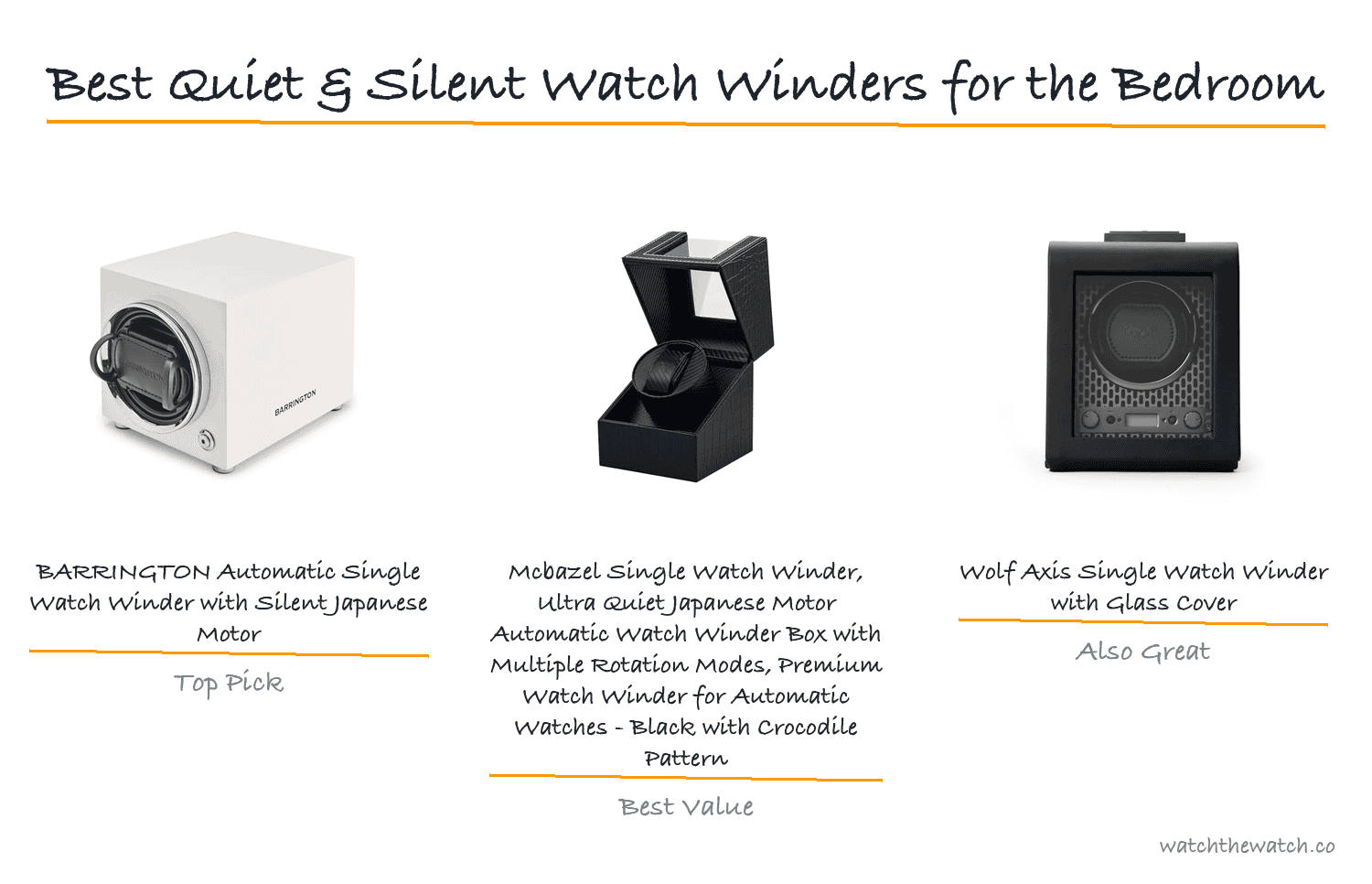
The best quiet watch winder for the bedroom is the Barrington Single with Silent Japanese Motor. It is the only winder in this price class actually built around noise suppression, and owners keep calling it inaudible from across the room.
Want the same silence for less? The Mcbazel Ultra-Quiet gets you most of the way there for around half the price.
Every pick here runs either a Japanese-sourced motor or a direct-drive mechanism. Those are the two choices that kill the 2 a.m. hum and rattle cheaper winders are famous for.
Our top picks at a glance
The standouts from this guide — prices change, so tap through for the current price.
As an Amazon Associate, Watch The Watch earns from qualifying purchases at no extra cost to you. Some links go to other retailers. See our affiliate disclosure.
How We Picked
Bedroom placement is a different problem from desk or safe placement. A winder that measures 35 dB, quiet by industrial standards, is still noticeable in a silent room at night.
So we judged each model against four things that actually matter on a nightstand:
- Motor design: Japanese motors (Mabuchi and equivalents) and direct-drive mechanisms eliminate the belt-slip and gear-mesh noise common in budget winders. Every pick here uses one or the other.
- Vibration isolation: A quiet motor mounted on a hard surface still transmits vibration to the furniture. We prioritized winders with rubber feet or padded bases.
- Rotation settings: A winder that can’t match your watch’s TPD (turns per day) requirement runs continuously, and a noisy winder running all night is worse than a slightly louder one that cycles off. All picks offer CW, CCW, and bi-directional modes with adjustable TPD.
- Pillow fit: A loose watch rattles against the winder drum. All picks include adjustable pillows sized for 38–52 mm cases.
- Price context: Silence is achievable from around $35. Above $150, you are mostly paying for materials and aesthetics, not meaningfully better noise performance.
Want the broader picture beyond noise? Our full guide to the best watch winders for automatic watches (2026) covers the specs noise alone misses.
The Best Quiet Watch Winders for the Bedroom
1. Barrington Single — The Benchmark for Silent Operation

Barrington built this winder around one goal: silence. The Japanese motor sits on vibration-dampening supports, and the case is lined to stop resonance before it starts.
Here’s what sells me on it. Forum owners keep naming the Barrington as the winder they switched to after a noisier model woke them up, and the consensus is it’s effectively silent from normal sleeping distance.
Rotation direction and TPD are fully configurable. That covers Rolex, Omega, TAG Heuer, and most other popular automatics without the motor running when it doesn’t need to.
2. Mcbazel Single — Ultra-Quiet Japanese Motor at a Budget Price
The Mcbazel earns its “ultra-quiet” label with the same Japanese motor spec as the Barrington, just in a smaller, lower-cost shell.
The feature I’d actually use is dual power. It runs on AC or batteries, so it can sit on a nightstand without a cable across the room.
Twelve rotation modes cover the full TPD range, and the crocodile-pattern exterior looks pricier than it is. If you want silence without spending over $50, this is the one.
3. Wolf Axis Single — Premium Build, Whisper-Quiet Motor

Wolf is one of the few winder brands collectors treat as a real quality signal. It has the years on the market to back that up.
The Axis uses Wolf’s proprietary winding program, a timed cycle that matches most mainstream automatics without over-winding. The motor is among the quietest Wolf makes.
The glass cover shows the watch off while keeping dust out, so it doubles as a display piece. If your bedroom look matters as much as your watch-care routine, this is the buy.
4. MOZSLY Single — Quiet Motor, Clean Looks, Minimal Price

The MOZSLY is the cheapest genuine quiet-motor winder here. For a second watch or a guest room, it’s hard to beat at around $35.
You get 12 rotation modes, CW, CCW, and bi-directional cycles, and a clean black leather exterior that doesn’t look cheap on a nightstand. The motor hum is there, but it sits below what most sleepers notice.
It’s not an heirloom. It is a capable, genuinely quiet daily driver.
5. Versa Single — Direct-Drive Motor Eliminates Belt Noise

Most budget winders run a belt between motor and drum, and that belt eventually slips, stretches, or vibrates. Versa skips it and connects the motor straight to the winding shaft, so there’s no belt to wear or hum.
What you get is clean, consistent rotation with no harmonic whine. Touch controls make switching the 12 settings easy, and the built-in display light saves you turning on a lamp.
At around $120 it sits mid-pack on price but punches above it on design.
6. Heiden Quad — Four Watches, Surprisingly Quiet

Four motors in one box usually means four times the noise, which is why most quad winders never make it onto a nightstand. The Heiden beats its price class here: each motor is mounted separately, and the black leather shell soaks up enough vibration that forum owners call it their go-to bedroom quad.
Every slot has its own rotation setting, so a Rolex Submariner and a Seiko with a different TPD can wind at the same time, no compromise.
For anyone rotating a small collection without a dedicated watch room, this is the practical answer. If you’re still deciding which pieces deserve winder time, our roundup of the best Seiko watches in 2026 is a good starting point.
Comparison: All Six Picks at a Glance
| Winder | Capacity | Motor Type | Rotation Modes | Power | Approx. Price |
|---|---|---|---|---|---|
| Barrington Single | 1 | Silent Japanese | CW / CCW / Bi-dir | AC | ~$65 |
| Mcbazel Single | 1 | Ultra-quiet Japanese | 12 modes | AC + Battery | ~$45 |
| Wolf Axis Single | 1 | Wolf proprietary | Wolf winding program | AC | ~$220 |
| MOZSLY Single | 1 | Quiet motor | 12 modes | AC | ~$35 |
| Versa Single | 1 | Direct-drive | 12 settings | AC | ~$120 |
| Heiden Quad | 4 | Quiet motor (×4) | Individual per slot | AC | ~$130 |
What to Look for in a Bedroom Watch Winder
Japanese Motor vs. Generic Motor
The most reliable noise predictor in a winder comes down to motor origin. Japanese-sourced motors, made to tighter tolerances, produce less vibration and less hum than generic ones at the same RPM.
When a listing names the Japanese motor, you can check the claim. A generic “quiet motor” with no source named is a coin flip.
Both the Barrington and Mcbazel put the Japanese motor front and center, which is why they top this list.
Direct-Drive vs. Belt-Driven
Belt-driven winders use a rubber or silicone belt to pass motor rotation to the drum. It’s cheaper to build and easier on the motor, but the belt brings its own noise: a faint rhythmic sound, and a real hum once it ages or sits loose.
Direct-drive designs like the Versa Single skip all that by coupling the motor shaft straight to the drum. Fewer moving parts means less noise and longer life.
The catch is cost. That’s why direct-drive winders usually start around $100.
TPD Settings and Unnecessary Runtime
A winder that can’t match your watch’s TPD will either over-wind (motor running against an already-coiled mainspring, which adds friction noise) or under-wind (watch stops). Neither is what you want.
Most modern automatics need between 650 and 1,000 TPD. Rolex’s Perpetual rotor winds efficiently and sits at the lower end of that range.
Check your watch’s spec before buying. Every pick here handles the common range, but a winder set too high just runs more and hums more all night.
Vibration Isolation
Even a near-silent motor passes vibration through its housing into whatever it sits on. A wooden nightstand can act like a resonance chamber, turning a barely-there vibration into an audible hum.
Look for rubber feet or a soft base pad. If yours has neither, a thin silicone mat under the winder kills most surface noise for under $5.
Single vs. Multi-Watch for the Bedroom
Every motor you add to a multi-watch winder is another noise source. Two quiet motors run louder than one, and you can measurably hear the difference.
For the bedroom, a single winder is almost always the quieter pick. If you rotate a collection, keep a single for your daily wearer and put the multi-watch unit elsewhere, in the closet or across the room.
The Heiden Quad is the exception that earns nightstand space. Even so, it still sits above the best singles on noise floor.
Frequently Asked Questions
Are watch winders actually quiet enough for a bedroom?
Quality winders with Japanese motors or direct-drive typically measure under 30 dB at one meter, quieter than a fridge hum. Switch from a budget unit to a purpose-built quiet one and most people stop noticing it during sleep.
Every winder here lands in the category I’d call inaudible in practice, based on consistent owner reports across forums and retail reviews.
What makes a watch winder noisy?
Three things, usually. A low-tolerance generic motor that hums at its operating frequency, a belt drive that adds rhythmic vibration as it cycles, and poor isolation that lets the motor’s movement travel into the furniture.
Cheap winders often have all three. The fix is a Japanese motor, direct-drive or a properly tensioned belt, and proper rubber-isolated mounting.
Should I leave a watch winder running all night?
Yes, for most automatics. That’s the whole point. Modern movements are built to handle continuous winding through the rotor, and a winder matched to the watch’s TPD parks the rotor against the mainspring’s click spring (a passive stop) instead of forcing an over-wind.
The motor pauses briefly, then runs another cycle. None of this shortens the movement’s life, and if you’re curious how long automatic watches last, winding isn’t the limiting factor.
The one caveat: match TPD to your specific watch. Running a winder flat-out for a watch that only needs 650 TPD just adds runtime for nothing.
Do I need a watch winder for a Rolex?
You don’t need one. Plenty of Rolex owners use one anyway, mostly to skip resetting date and time on GMT and Day-Date models after a day or two off the wrist.
Rolex’s Perpetual rotor winds quickly during wear, so any winder set to roughly 650-800 TPD bi-directional keeps a Rolex fully wound. The Barrington, Wolf Axis, and Versa Single all handle Rolex without fuss.
What is the difference between a $35 and a $220 watch winder?
On the things that matter, noise and winding reliability, a good $35-$65 winder with a Japanese motor performs about the same as a $200+ unit. That surprises people.
What you pay up for is materials (lacquered wood and glass vs. faux leather), longevity (metal internals vs. plastic), brand support, and looks. The Wolf Axis at around $220 is the nicer object and will probably last longer.
But it won’t wind your watch any more accurately or quietly than the Barrington at a third of the price. Buy up for display, entry-level for function.

Daniel Hart is the editor of Watch The Watch. He researches and writes the site’s buying guides, brand comparisons, and explainers, focused on accessible, enthusiast-level watches — affordable automatics, divers, field and dress watches, everyday quartz, and the straps, winders and tools that go with them. The goal is practical, budget-aware advice that helps readers choose the right watch for their wrist and their budget. Recommendations draw on manufacturer specifications and the wider enthusiast community.