
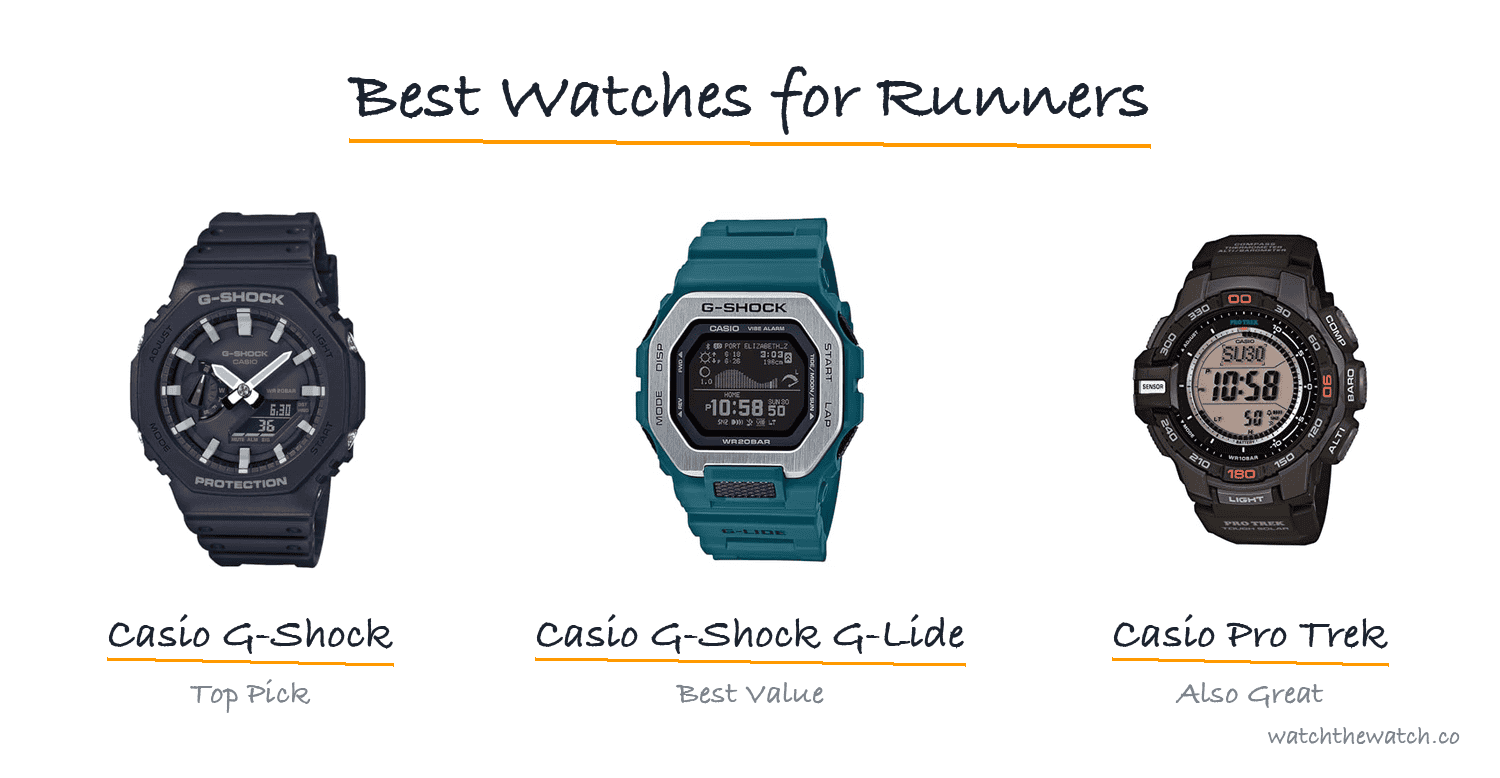
If you want toughness over a GPS dashboard, the watch to beat is the Casio G-Shock GA-2100 (CasiOak). It is slim, shockproof, 200m water-resistant, and light enough at around 51g that you forget it is on your wrist by mile two.
Trail runners who want altitude, weather, and compass data should go straight to the Pro Trek PRW-2500R. It packs a full sensor suite and solar charging for around $180, which is a lot of watch for the money.
Every pick here comes from Casio’s G-Shock and Pro Trek lines, and that is deliberate. These are the watches I trust to handle sweat, mud, and pavement drops without a fragile GPS antenna or a recurring subscription fee.
New to the brand? If you are still weighing whether Casio is a good watch brand, the short version is that it is hard to beat for abuse like this.
Our top picks at a glance
The standouts from this guide — prices change, so tap through for the current price.
As an Amazon Associate, Watch The Watch earns from qualifying purchases at no extra cost to you. Some links go to other retailers. See our affiliate disclosure.
How We Picked
A few running-specific criteria shaped every pick:
- Weight and wrist profile — heavy or bulky watches bounce and chafe over long distances
- Shock and water resistance — runs end in falls, rain, and stream crossings
- Running-relevant functions — stopwatch, countdown timer, lap memory; for trails: altimeter, barometer, compass
- Mid-run readability — large or high-contrast displays beat tiny dials when your arms are pumping
- Value — all picks sit under $700, with the strongest options under $200
None of these have GPS, and that is on purpose. A GPS watch tracks pace, cadence, and route mapping. A G-Shock or Pro Trek handles impact, submersion, and daily abuse for far less money.
Plenty of runners use both. A GPS unit for structured workouts, and a G-Shock for easy days, travel, and races where durability matters more than data.
The Best Watches for Runners
1. Casio G-Shock GA-2100 (CasiOak) — Best All-Around Runner’s Watch

The GA-2100 is one of the slimmest G-Shocks ever made, around 11.8mm thick and 51g on the wrist. Those numbers matter the second you start running. Forum owners keep calling it the G-Shock that disappears under a sleeve, and it does not bounce at tempo the way bulkier models do.
The analog-digital face gives you glanceable time with no LCD menu to parse, and the stopwatch and countdown timer cover every practical training function. At around $99, there is no better entry point into running with a G-Shock.
2. Casio G-Shock G-Lide — Best for Beach and Active-Sport Runners

The G-Lide was built for board sports like surfing and snowboarding, and it carries over to running because the priorities are the same. You get lightweight construction and a softer band than standard G-Shock resin, plus a watch that treats water as normal rather than an emergency.
If you train near the coast, the tide-graph and moon-phase data are a nice bonus. What actually sells it for distance, though, is the strap: reviewers rate the comfort a step above most G-Shocks for long wear.
3. Casio Pro Trek PRW-2500R — Best for Trail Runners

Trail running needs data GPS cannot always give you. A dropping barometer warns of incoming weather before the clouds show up, and altitude readings help with pacing and acclimatization on mountain routes. This is where the triple-sensor watch earns its keep.
The PRW-2500R packs an altimeter, barometer, digital compass, and thermometer into a solar-charged, atomic-synced case for around $180. That is strong value by any measure.
Hiking and trail-running communities rate it among the best non-GPS outdoor watches you can buy. The Multiband 6 atomic sync also means your race start time is always accurate without you touching a thing.
4. Casio G-Shock Rangeman — Best for Extreme-Condition Runners

The Rangeman is G-Shock’s military-spec outdoor model: mud-resistant port covers, a raised bezel guarding the crystal, and the same triple-sensor suite as the Pro Trek in a much tougher shell.
It is heavier than the GA-2100, and yes, you feel the larger case on your wrist while you run. But ultra-marathoners and adventure racers happily take that trade for a near-indestructible build.
If your running involves deep mud, river crossings, or search-and-rescue training, the weight is a price worth paying. For pavement and a 10k, it is overkill, and I would skip it.
5. Casio G-Shock MT-G MTG-B3000 — Best Premium Running Watch

The MTG-B3000 sits at the top of the accessible G-Shock range. Its hybrid carbon-fiber-reinforced resin and metal case is lighter than it looks and a clear step up from standard G-Shock plastic.
Bluetooth pairs it with the G-Shock app for automatic timezone and time correction. Owners also say the strap and bracelet hold position better during movement than entry-level models, which helps at running pace.
If you want one watch for the morning track session and the office afterward, this covers both. The catch is the price, and at around $600 it is a want, not a need.
6. Casio G-Shock X-Large Display Stealth — Best Budget Running Watch
The X-Large Stealth does one thing very well for runners: it is readable at pace. The oversized LCD is easy to check without breaking stride, and the case brings standard G-Shock shockproofing.
At this price, trail scratches and gym lockers stop being a worry. Stopwatch, countdown timer, and multiple alarms cover every practical running function, which makes it the easy budget pick.
Comparison: All 6 Watches at a Glance
| Watch | Weight Class | Key Running Feature | Water Resistance | Bluetooth | Est. Price |
|---|---|---|---|---|---|
| GA-2100 CasiOak | Light (~51g) | Slim profile, analog-digital | 200m | No | ~$99 |
| G-Lide | Light, flexible band | Sport build, tide/moon data | 200m | No | ~$110 |
| Pro Trek PRW-2500R | Mid-size | Triple sensor, solar, atomic | 100m | No | ~$180 |
| Rangeman | Heavy (~80g+) | Triple sensor, mud-resistant ports | 200m | No | ~$350 |
| MTG-B3000 | Mid (hybrid) | Bluetooth, refined construction | 200m | Yes | ~$600 |
| G-Shock Stealth XL | Standard | Max readability, lowest price | 200m | No | ~$60 |
What to Look for in a Running Watch
Weight and Wrist Profile
Weight matters more for runners than for almost any other use. A watch that feels fine in the store gets distracting by mile eight.
G-Shock’s lineup runs from around 51g (GA-2100) to over 80g (Rangeman and the heavier outdoor models). For road running, lighter is nearly always better.
For extreme terrain or ultra-distance events, where durability beats comfort, the heavier models earn their place. That is the one time I would take bulk over grams.
GPS vs. Non-GPS
If pace data, heart rate zones, and route maps drive your training, a dedicated GPS watch should be your primary device. No G-Shock replaces that, and I would not pretend otherwise.
The watches here play a different role: durable daily timepieces that shrug off running conditions without battery anxiety or fragile GPS hardware.
The common pattern is to own both and switch by workout: GPS for intervals, G-Shock for everything else.
One more thing: these are solar and quartz, not mechanical, so upkeep is basically nothing. If you want the contrast, here is how long automatic watches last and what they ask of you in return.
Sensors for Trail Runners
Road runners get everything they need from a basic stopwatch. Trails are where extra sensors start to matter.
An altimeter tracks elevation gain and current height, a barometer warns of weather changes before the clouds arrive, and a digital compass keeps you oriented when GPS signal or battery is gone. That trio is genuinely useful off-road, not marketing filler.
The Pro Trek PRW-2500R and the Rangeman both carry all three sensors. For anyone running off-road regularly, those two are the obvious choices.
Readability and Display
Checking your watch mid-run is harder than it sounds. Arms are moving, light keeps changing, and the pause itself breaks your pace, so legibility matters more than it should.
Large digital displays (the Stealth XL), high-contrast LCDs (most G-Shocks), and clear analog hands (GA-2100) each solve this differently. For low-light runs, look for EL backlight, which is standard on most G-Shock models.
If you run with gloves in winter, a large display area is a real advantage over small multi-function watches.
Frequently Asked Questions
Do I need a GPS watch for running?
No. GPS is handy for pace and route data, but millions of runners train fine on perceived effort and a stopwatch.
A non-GPS watch like the GA-2100 covers every timing function, survives any weather, and holds its charge for ages. GPS earns its place for structured intervals or navigating unfamiliar terrain.
Are G-Shock watches good for running?
Yes, especially if you want one watch for training and everyday wear. G-Shocks are shockproof, water-resistant to 200m on most models, and built to take years of active use.
The tradeoffs versus dedicated running watches are no GPS pace tracking and no heart rate. Those matter for structured training, not for every runner. If you want choices outside this lineup, our roundup of the best Casio watches beyond the G-Shock is a good next stop.
Which G-Shock is lightest for running?
The GA-2100 (CasiOak), at around 51g with its resin band. It is one of the lightest G-Shocks you can buy.
Its slim case, roughly 11.8mm thick, also sits lower than most G-Shocks and cuts the bounce that taller cases produce at pace. Owners who have cycled through several models keep coming back to it for long athletic wear.
Can I swim with these running watches?
Most picks carry 200m (20 ATM) water resistance, so casual lap swimming and open-water crossings are fine.
The Pro Trek PRW-2500R is rated lower, 100m on most configurations, which is plenty for rain and stream crossings. Check the exact model’s spec before any extended pool use.
None of the sensor-equipped models are rated for scuba diving or rapid depth changes.
What watch do trail runners typically recommend?
The community consensus lands on the Pro Trek PRW-2500R as the best-value trail watch here: solar-powered, atomic-synced, with altimeter, barometer, digital compass, and thermometer for around $180.
For harsher or more remote terrain, runners step up to the Rangeman for its extra mud-resistance and military-grade shell at around $350. Either way, both outlast almost any GPS device in daily durability.

Daniel Hart is the editor of Watch The Watch. He researches and writes the site’s buying guides, brand comparisons, and explainers, focused on accessible, enthusiast-level watches — affordable automatics, divers, field and dress watches, everyday quartz, and the straps, winders and tools that go with them. The goal is practical, budget-aware advice that helps readers choose the right watch for their wrist and their budget. Recommendations draw on manufacturer specifications and the wider enthusiast community.