
Daniel Hart ·
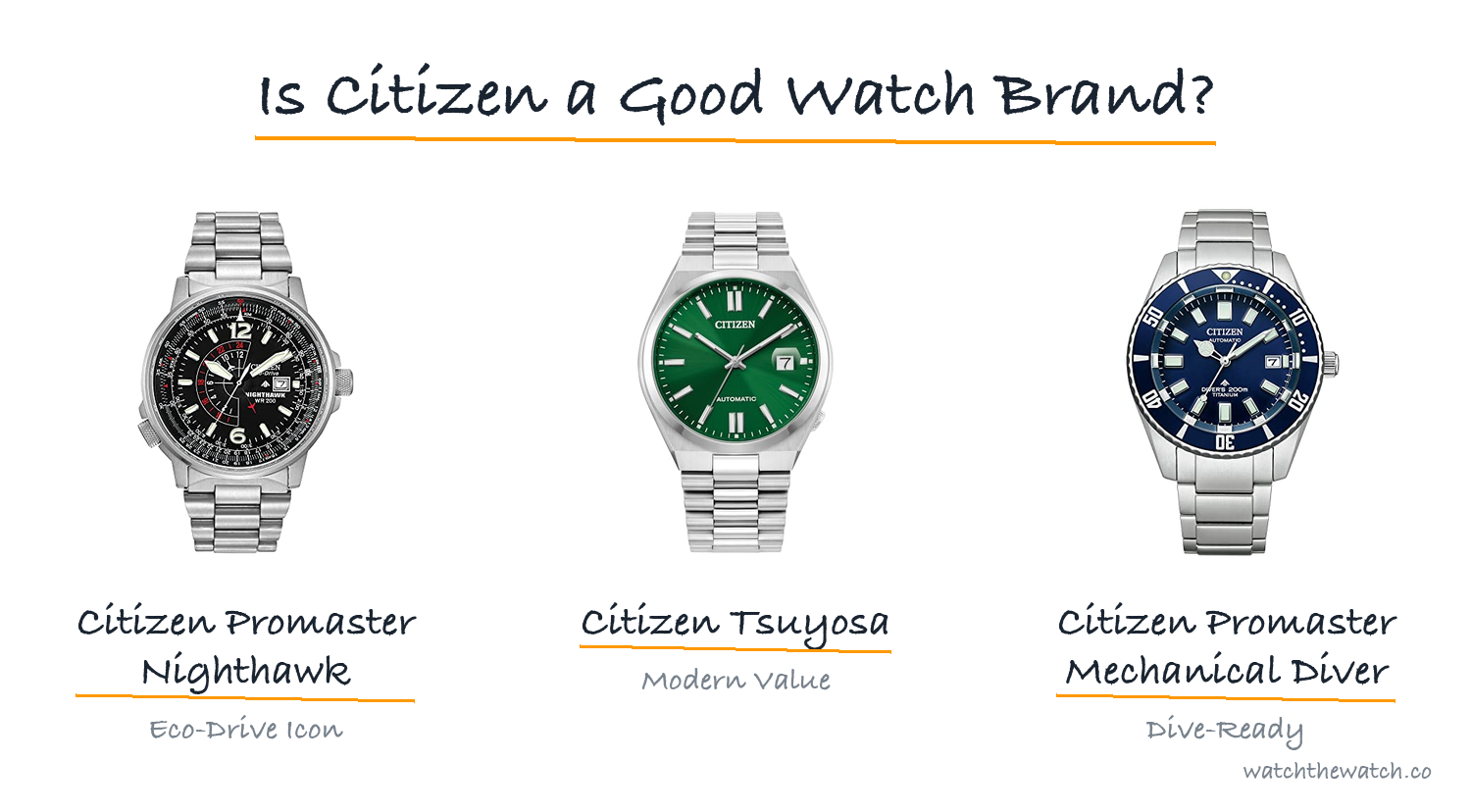
Yes, Citizen is a good watch brand, and for most buyers it ranks among the safest choices under $500. It has built watches in Japan since 1918 and supplies movement technology to much of the industry. Strong value, not a luxury label.
Consider Citizen if you want a watch that looks sharp and lasts for years without much fuss. The brand suits first-time buyers and seasoned collectors who like solid engineering at a fair price. Best for low-maintenance daily wear.
A quick history of Citizen
Citizen Watch Co. started in Tokyo in 1918 and took its name from a pocket watch sold as the Citizen. Today it stands as one of the largest watch groups in the world. A century of Japanese watchmaking.
The group owns Miyota, the movement maker that supplies mechanical and quartz calibers to countless other brands. So when you buy a microbrand automatic, there is a fair chance a Citizen-owned factory built the engine. Citizen powers half the industry.
Citizen also owns Bulova, Frederique Constant, Alpina, and Arnold & Son. That spread runs from budget quartz all the way up to genuine high-end mechanical work. A brand family with real range.
That ownership web is the quiet reason Citizen feels like it is everywhere at once. The same group can sell you a $90 quartz or a five-figure Arnold & Son. Reach few rivals can match.
What Citizen is known for
The headline technology is Eco-Drive, a light-powered movement that charges from any light and never needs a battery change. Citizen introduced the idea in 1976 and pushed it mainstream from 1995. No battery changes, ever.
Eco-Drive matters because the worst part of owning a quartz watch is the dead battery and the trip to a shop. A full charge can keep one running for months in the dark. Set it and forget it.
On the sport side, the Promaster line covers dive and pilot watches built to take a beating. The Aqualand dive computer and the Promaster diver are long-running favorites. Tool watches that earn their name.
The Nighthawk is the cult pilot watch in the range, with a slide-rule bezel and Eco-Drive inside. Owners report it punches well above its price for build and presence. A pilot icon under $300.
At the top, Citizen makes Satellite Wave GPS models and The Citizen, a high-accuracy line that aims for a few seconds of drift per year. These show the brand can chase real precision when it wants to. Quartz accuracy most brands cannot match.
More recently the Tsuyosa brought an affordable automatic with an integrated bracelet, and the Series 8 pushed Citizen into dressier sport territory. Both landed well with the enthusiast crowd. Fresh designs that won fans.
Citizen at a glance
| Feature | Detail |
|---|---|
| Founded | 1918, Tokyo, Japan |
| Owns / owned by | Independent group; also owns Bulova, Frederique Constant, Alpina, Arnold & Son |
| Known for | Eco-Drive solar tech, Promaster sport line, everyday value |
| Signature tech | Eco-Drive light power, Satellite Wave GPS, The Citizen accuracy |
| Movement source | In-house plus Citizen-owned Miyota |
| Price range | Roughly $100 to $700 mainstream |
| vs Seiko | Citizen leans solar and accuracy; Seiko leans mechanical and heritage |
Citizen vs Seiko
The natural rival is Seiko, the other great value-driven Japanese maker. Both offer in-house movements and durable cases across a deep catalog at fair prices. Two giants, similar philosophy.
The rough split goes like this. Citizen leans into solar quartz and accuracy, while Seiko leans into mechanical heritage and its famous automatics. Citizen for solar, Seiko for mechanical.
Neither is a true luxury house, though Seiko stretches higher with Grand Seiko. If you are weighing the two, our take on whether Seiko counts as luxury covers that gap. Pick on tech, not prestige.
The honest pros and cons
Here is the honest balance, drawn from what owners and reviewers have said over the years. No brand is perfect.
What Citizen does well
- Eco-Drive removes battery changes for years at a time
- Strong case build and honest water resistance for the money
- Trusted in-house and Citizen-owned Miyota movements
- Huge catalog, from $100 field watches to GPS and high-accuracy models
- Easy to service, with parts that are simple to find
Where it falls short
- Not a status or investment brand, so resale value stays modest
- Some dials and date windows look busy or dated
- Lume and bracelet finishing can trail pricier rivals
- Eco-Drive cells do eventually need replacement after many years
- The lineup is so large it can overwhelm a new buyer
Who should buy a Citizen
The first-time buyer is the clearest fit. You get a watch that looks the part at work or on the weekend, with no servicing drama for a long stretch. An easy first real watch.
Frequent travelers do well here too, since a Satellite Wave model resets to local time from a GPS signal. Pilots and outdoors types lean on the Promaster range for the same kind of reliability. Built for people on the move.
Collectors who already own a few mechanical pieces often keep a Citizen as the grab-and-go. It takes knocks without the worry that comes with a pricier watch. The watch you never baby.
If your budget tops out around $300, Citizen gives you more finished watch than most rivals at that price. The competition gets thin once you also want solar power and a real warranty. Hard to beat near $300.
Things to know before you buy
If you choose an automatic like the Tsuyosa or the Promaster mechanical diver, remember it runs on a mainspring, not light. A self-winding movement keeps time only while you wear it regularly. Automatics need wrist time.
Cared for well, these movements run for decades, and a service every few years keeps them healthy. We dig into the lifespan question in our guide to how long automatic watches last. Good movements age gracefully.
If a Promaster diver tempts you, check the rating first, because 200m means real water resistance for swimming and diving. Our explainer on what a dive watch is spells out what the numbers mean. 200m handles real water sports.
One habit is worth keeping with any Eco-Drive: give it regular light, even through a sleeve or a window. A drawer for months will drain it, though a short charge brings it right back. Light is the only upkeep.
Where to start with Citizen
If you want a first Citizen, these three cover the brand’s best ideas without overspending. Each is a signature piece rather than a generic dress watch. Three ways into the brand.


Want to go deeper before buying? Our Citizen NB1060 review breaks down one of the brand’s sharpest integrated-bracelet pieces. A closer look helps.
And if you are curious how high the brand can climb, the most expensive Citizen watches show a side of the company most buyers never see. The halo pieces surprise people.
Whichever model you pick, set a realistic budget and buy from a seller with proper warranty coverage. Grey-market deals can save a little but may skip Citizen’s own support. Warranty beats a small discount.
Frequently asked questions
Is Citizen a luxury watch brand?
No. Citizen is a mainstream value brand, not a luxury house like Rolex or Omega. Most of its catalog sits between $100 and $700, with a few halo models priced higher. Great value, not luxury.
Do Citizen Eco-Drive watches need batteries?
Not in the usual sense. Eco-Drive runs on a rechargeable cell that the dial charges from light, so you avoid battery swaps entirely. That cell can last many years before any service. Light replaces the battery.
Is Citizen better than Seiko?
Neither wins outright, it depends on what you want. Citizen is the stronger pick for solar quartz and pinpoint accuracy, while Seiko leads on mechanical character and dive heritage. Different strengths, both excellent.
Where are Citizen watches made?
Citizen is a Japanese company, and its higher-end pieces are made in Japan. Some mainstream models are assembled in other countries using Citizen-owned movements. Japanese brand, mixed assembly.
Are Citizen watches a good investment?
Buy a Citizen to wear it, not to flip it. Most models hold practical and sentimental value rather than rising in price the way a few luxury watches do. Buy to enjoy, not resell.

Daniel Hart is the editor of Watch The Watch. He researches and writes the site’s buying guides, brand comparisons, and explainers, focused on accessible, enthusiast-level watches — affordable automatics, divers, field and dress watches, everyday quartz, and the straps, winders and tools that go with them. The goal is practical, budget-aware advice that helps readers choose the right watch for their wrist and their budget. Recommendations draw on manufacturer specifications and the wider enthusiast community.
