
Daniel Hart · ·
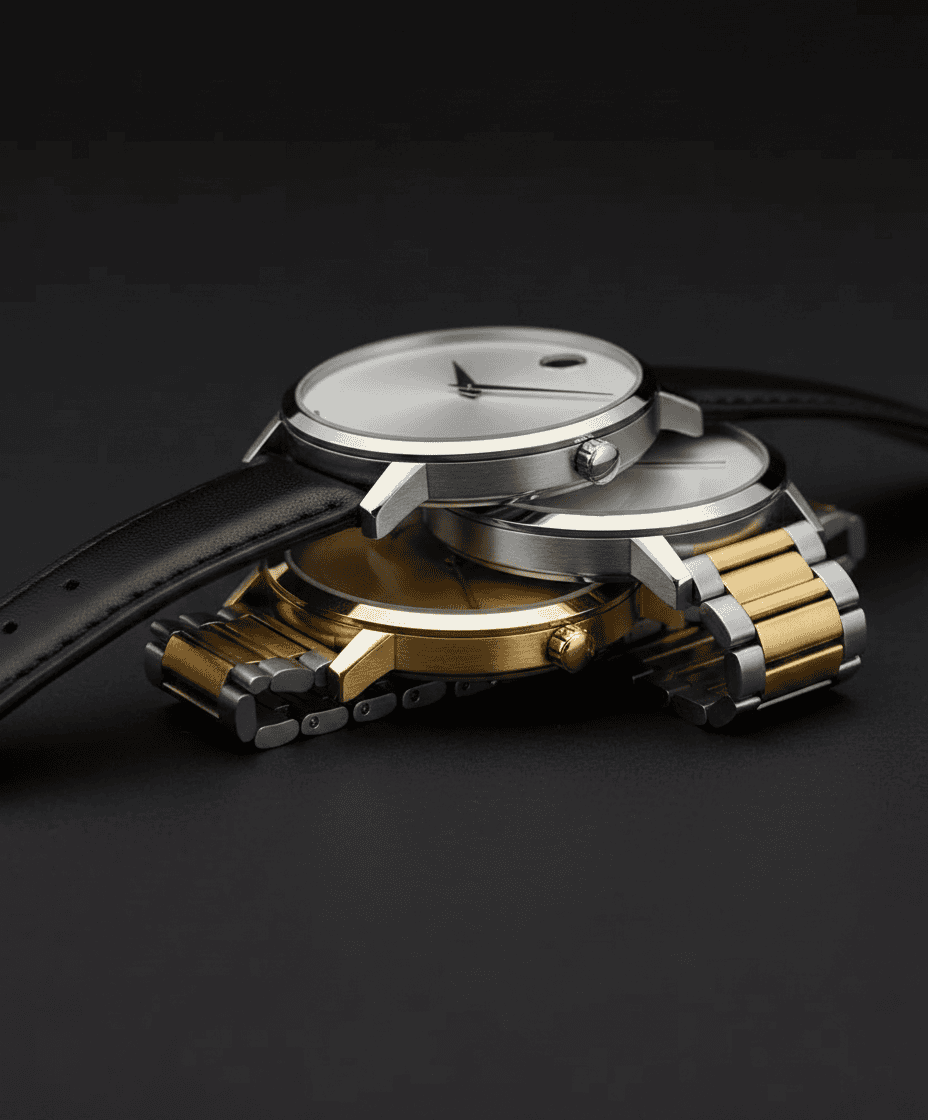
Movado is the only brand in this comparison where the correct question is not about the movement.
The Museum dial was designed in 1947 by Nathan George Horwitt, a Bauhaus-influenced American designer. He removed every numeral and marker and left a single dot at twelve, standing for the sun at high noon.
In 1960 it became the first watch dial accepted into the permanent collection of the Museum of Modern Art, and it is still there. That fact decides how the rest of this should be read.
The short answer
The dial is the product
Horwitt’s design is held by MoMA as an object in its own right, catalogued as a wristwatch face from 1947. It now appears in more than twenty art institutions.
That is a genuinely unusual thing to be able to wear. No other watch on sale at any price has this particular provenance, and the design has aged better than almost anything else from the period because there was nothing on it to date.
It is also why the usual enthusiast objection misses. Complaining that a Museum Classic has a quartz movement is a little like complaining that a print of a famous poster is not an oil painting. The mechanism was never the argument.
What you actually get for the money
Swiss quartz across the collections that matter, in well-finished steel and plated cases, with sapphire on most current references. The Museum Classic sits around $650 for men and near $995 for the women’s models, and the Bold line runs a little higher.
Judged as watchmaking, that is a lot of money for a battery movement, and it would be dishonest to pretend otherwise. Judged as a design object with museum provenance, it is priced roughly where a good piece of mid-century design sits, which is a different and fairer comparison.
There is also a corporate detail worth knowing. Movado Group owns MVMT, the direct-to-consumer brand it acquired in 2018, so the minimalist fashion watch and the minimalist design icon now share a parent.
| Model | Movement | What you are buying | Price |
|---|---|---|---|
| Museum Classic (men’s) | Swiss quartz | The 1947 Horwitt dial, in its purest form | About $650 |
| Bold Evolution 2.0 | Swiss quartz | A modern reinterpretation with more presence | About $750 |
| Museum Classic (women’s) | Swiss quartz | The same design in smaller proportions | About $995 |
Where Movado stops being good value
The moment you want something other than the dot. Movado’s chronographs and its more decorated lines compete on price with mechanical Swiss watches, and against that comparison they lose plainly.
The same authorised-dealer caution applies here as elsewhere in this bracket, though with less at stake. A quartz watch that needs a battery every few years is a lower warranty risk than a mechanical movement, so grey-market buying costs you less here than it would on a Tudor or an Oris.
And if the appeal is minimalism rather than provenance specifically, cheaper brands do minimal dials well. Our guide to Skagen covers that end, at a fifth of the price.
Who Movado is for
Buy one if the Museum dial appeals to you specifically. It is the only place to get it, the design is genuinely important, and a watch you look at with pleasure every day has done its job.
It also makes an unusually good formal watch. Nothing disappears under a cuff quite like a dial with nothing on it, and it reads as considered rather than expensive.
Skip it if you want mechanical watchmaking at this budget, because the same money buys a great deal more of it. For a first automatic, Tissot or Seiko is the honest answer, and both cost less.
Three Movado watches worth knowing
The range is wide, but only one design matters. These are the ways to get it.


As an Amazon Associate, Watch The Watch earns from qualifying purchases at no extra cost to you. See our affiliate disclosure. Our dress watches under $1,000 guide covers what the same money buys when the dial is not the whole proposition.
Frequently asked questions
Is Movado a good watch brand?
As a design proposition, yes and uniquely so. As watchmaking, it is expensive quartz. Which answer matters depends entirely on whether you are buying the Museum dial or a movement.
Why is the Movado dial in a museum?
Nathan George Horwitt designed it in 1947 with a single dot at twelve representing the sun at noon, and in 1960 it became the first watch dial accepted into the permanent collection of the Museum of Modern Art in New York.
Are Movado watches quartz or automatic?
The Museum Classic and Bold lines are Swiss quartz. Movado does make some automatic references, but the collections the brand is known for are battery powered.
Is Movado worth the money?
If you want the Museum dial, yes, because nothing else offers it. If you are comparing movements, no, because the same budget buys a Swiss or Japanese automatic with a real mechanical specification.
Does Movado own MVMT?
Yes. Movado Group acquired MVMT in 2018 in a deal reported at more than one hundred million dollars, so both brands now sit under the same parent company.
The verdict
Movado is the one brand in this group that should be judged as design rather than as engineering, and on those terms it is genuinely distinguished. A dial in the permanent collection of MoMA is not a marketing claim.
Buy the Museum Classic and know exactly what you are buying. A quartz movement behind an important piece of twentieth-century design, which is a perfectly good reason to wear a watch.

Daniel Hart is the editor of Watch The Watch. He researches and writes the site’s buying guides, brand comparisons, and explainers, focused on accessible, enthusiast-level watches — affordable automatics, divers, field and dress watches, everyday quartz, and the straps, winders and tools that go with them. The goal is practical, budget-aware advice that helps readers choose the right watch for their wrist and their budget. Recommendations draw on manufacturer specifications and the wider enthusiast community.
