Daniel Hart · ·
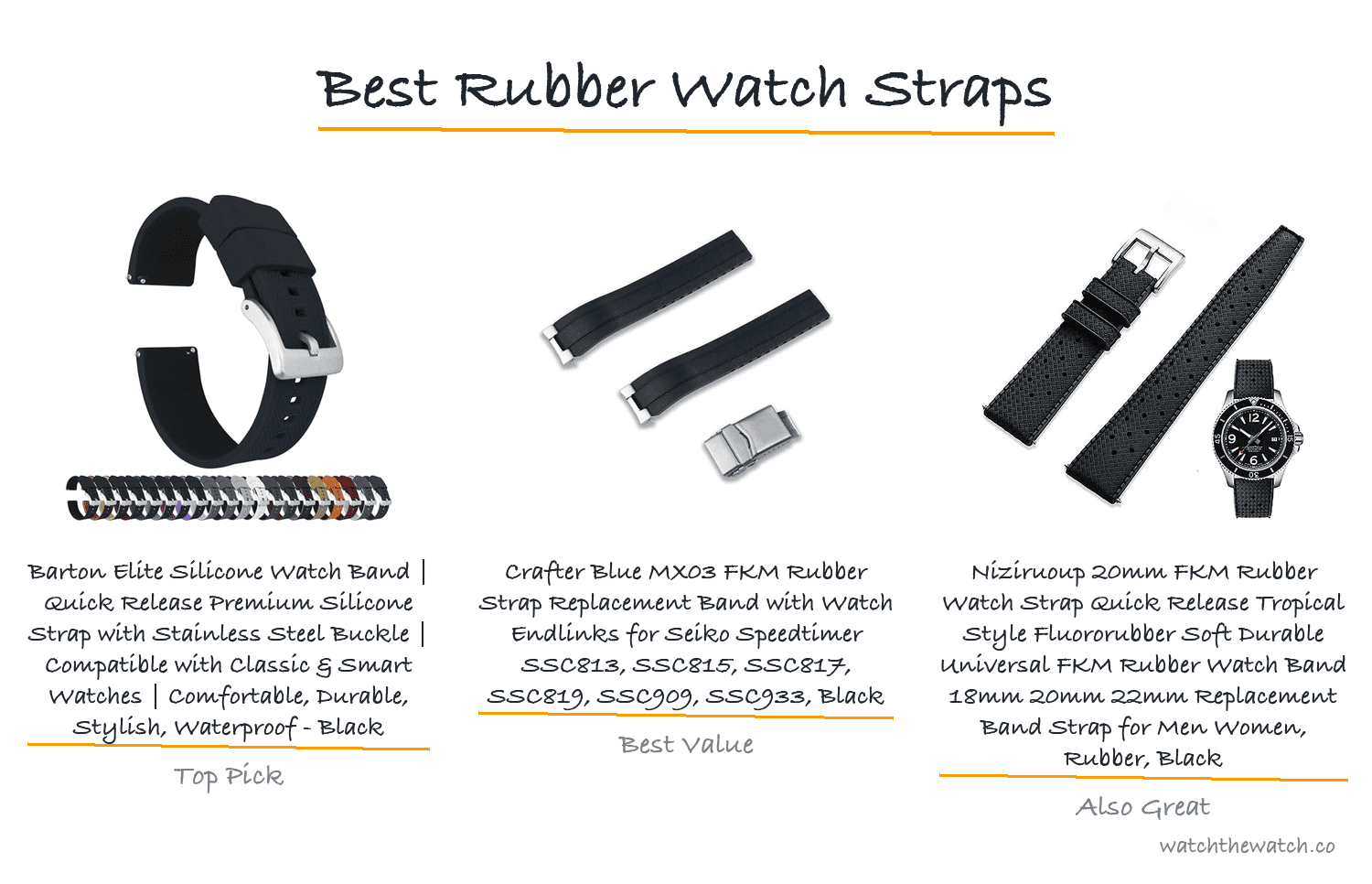
For most wrists in 2026, the rubber strap I’d hand someone first is the Barton Elite Silicone Band. It fits virtually any quick-release 20mm watch, swaps tool-free in seconds, and holds up to sweat, salt water, and chlorine. No clammy feel, which is where cheaper silicone falls apart.
Want a material step up? FKM fluorocarbon rubber is the enthusiast upgrade worth knowing. It’s denser, more UV-stable, and more resistant to oils and sunscreen than standard silicone.
Below are six picks: universal replacement straps plus a couple of purpose-built rubber-strapped watches, ranked best overall down to best sport value.
Our top picks at a glance
The standouts from this guide — prices change, so tap through for the current price.
As an Amazon Associate, Watch The Watch earns from qualifying purchases at no extra cost to you. Some links go to other retailers. See our affiliate disclosure.
How We Picked
Not all rubber straps are equal, and between a $10 silicone band and a $50 FKM strap the gap is real. Here’s what shaped these picks:
- Material grade: FKM fluorocarbon rubber outperforms standard silicone in UV resistance, chemical tolerance, and long-term shape retention. Silicone is softer and gentler on sensitive skin. Resin (as used in integrated sport watch bands) is optimized for impact absorption over raw comfort.
- Fit and hardware: Quick-release spring bars allow tool-free swaps in seconds. Integrated endlinks — present on model-specific straps — close the gap between the strap shoulder and a curved or angular case lug. Stainless steel buckles and clasps prevent rust marks on the wrist.
- Lug width accuracy: An undersized strap gaps visibly; an oversized one won’t seat. We favored straps offering multiple size options with accurate listed measurements.
- Water and sweat resistance: Rubber is inherently water-tolerant, but hardware quality determines whether the full package survives regular immersion.
- Community reception: Verified buyer reviews, commentary on r/watchstraps and WatchUSeek forums, and enthusiast consensus across watch communities informed every ranking.
The 6 Best Rubber Watch Straps for 2026
1. Barton Elite Silicone Watch Band — Best Overall

The Barton Elite is the default recommendation on r/watchstraps, and it earns it. The medical-grade silicone is noticeably softer than budget alternatives, and the quick-release spring bars pop out with thumb pressure alone. No tools, no scratched case backs.
Owners report the stainless steel buckle resists rust even after months of pool and ocean exposure. The strap also keeps its profile instead of flattening out over time.
It comes in 20mm and other widths, and pairs as happily with a Seiko SKX as it does a Tissot Seastar or a casual smartwatch. That versatility is the whole point.
- Pros: Tool-free quick release, wide color range, soft on skin, competitive price point
- Cons: Silicone is less UV-stable than FKM over multi-year heavy use; no model-specific endlinks
2. Crafter Blue MX03 FKM Rubber Strap — Best Premium (Seiko Speedtimer Fit)

FKM fluorocarbon rubber is the same polymer class used in aerospace valve seals. It shrugs off motor oil, sunscreen, and UV far better than silicone, and stays supple without going tacky in heat.
The Crafter Blue MX03 wraps that material around precisely machined stainless steel endlinks cut for the Seiko Speedtimer case family (SSC813, SSC815, SSC817, SSC819, SSC909, and SSC933). Those endlinks are the whole reason to buy.
Here’s what they fix: the visible gap between the strap tail and the curved case lugs that universal cuts leave behind. The WatchUSeek crowd is unanimous that integrated endlinks transform a sports watch.
Own any of those Seiko references? This is the upgrade the watch was waiting for, assuming you actually wear it hard enough to justify the spend.
- Pros: Superior FKM durability, flush endlink fit, purpose-built for specific Seiko references
- Cons: Model-specific — no universal fit; higher price than silicone alternatives
3. Niziruoup FKM Rubber Tropical Style — Best Vintage Aesthetic

The “tropical” strap is a grid-perforated design lifted from vintage Rolex and Heuer racing watches of the 1960s and 1970s. It’s now one of the defining affordable-strap looks.
Niziruoup builds its version in genuine FKM fluorocarbon rubber with quick-release spring bars. So you get the vintage look plus real material performance, a combo the cheap silicone tropicals miss.
It comes in 18mm, 20mm, and 22mm, so it sits naturally on vintage-style chronographs and dive watches in that range. The texture is a quiet bonus: it hides sweat marks better than smooth rubber.
- Pros: On-trend tropical look, genuine FKM construction, multiple widths, quick release
- Cons: Less widely reviewed than Barton; color selection is more limited
4. Boache Silicone Watch Band Curved End — Best Universal No-Gap Fit

The usual knock on universal rubber straps is the gap between the strap shoulder and the case. It’s a dead giveaway the band wasn’t made for the watch.
Boache fights that with curved ends that follow the case profile across a lot of watches, in 18mm, 19mm, 20mm, 21mm, and 22mm. The curve is what closes the gap.
The silicone is softer than FKM, so it’s kind to sensitive skin and fine for all-day wear, and it’s still fully waterproof and hypoallergenic. Owners report a noticeably cleaner look than flat-end straps at the same price.
- Pros: Curved ends minimize gap, wide size range, hypoallergenic silicone, affordable
- Cons: Silicone rather than FKM; no quick-release lever noted
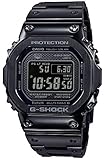
5. G-Shock GMW-B5000GD-1 — Best Premium Rubber-Strapped Watch
On a G-Shock the rubber strap isn’t an accessory. It’s structural.
The GMW-B5000 series pairs a full stainless steel case with G-Shock’s layered rubber band, where different durometers of rubber team up to isolate the movement from shock. One rubber alone couldn’t absorb those impacts.
Solar charging and multi-band radio sync keep accuracy handled automatically. You set it and forget it.
For the money you’re getting the most thoroughly engineered rubber strap system on a production watch, with a military-grade drop-test pedigree behind every part. Whether you need that much watch is a separate question.
- Pros: Industry-leading shock protection, solar and radio accuracy, full stainless case
- Cons: Premium investment; large profile; integrated strap limits aftermarket swap options
6. Timex Ironman Triathlon Classic 100 — Best Budget Rubber Sport Watch

The Timex Ironman has ridden triathlete wrists since the 1980s, and the Classic 100 leaves the format alone on purpose. You get a 44mm resin case, a strap narrow enough to slide under a wetsuit sleeve, and 100-lap memory for intervals.
The resin band is grippy, not slippery. It stays put during open-water swims and track sessions where smoother silicone slides around.
Owners report the band surviving years of daily sport use through chlorine, salt water, and direct sun. At around $55, it’s the cheapest way into a real sport watch with a track record measured in decades.
- Pros: Sub-$60 price, proven long-term reliability, grippy resin strap, Indiglo backlight, 100-lap memory
- Cons: No smartwatch features; sport-only aesthetic; integrated strap not interchangeable
Quick Comparison: All Six Picks
| Pick | Material | Lug Width | Fit Type | Best For | Approx. Price |
|---|---|---|---|---|---|
| Barton Elite Silicone | Medical-grade silicone | 20mm (multi) | Universal / quick-release | Everyday replacement | ~$18 |
| Crafter Blue MX03 FKM | FKM fluorocarbon | Seiko Speedtimer-specific | Integrated endlinks | Seiko SSC-series upgrade | ~$50 |
| Niziruoup FKM Tropical | FKM fluorocarbon | 18 / 20 / 22mm | Universal / quick-release | Vintage/racing aesthetic | ~$25 |
| Boache Curved Silicone | Silicone | 18–22mm | Curved-end universal | No-gap fit on most cases | ~$18 |
| G-Shock GMW-B5000GD-1 | Layered rubber (integrated) | Proprietary | Watch system | Premium shock-proof sport | ~$550+ |
| Timex Ironman Classic 100 | Resin / rubber (integrated) | Proprietary | Watch system | Budget triathlon / sport | ~$55 |
What to Look For in a Rubber Watch Strap
Material: FKM vs Silicone vs Resin
FKM (fluorocarbon rubber) is the performance pick. Developed for aerospace seals, it handles oils, sunscreen, solvents, and UV with far less degradation than silicone.
It’s stiffer than silicone when new, then softens as you wear it. Expect to pay around $25–$55 for genuine FKM versus $10–$20 for silicone, and you can feel where that money went.
Silicone is comfortable from the first wear. That makes it the better call for sensitive skin or all-day desk-to-gym use.
It’s less chemically resistant than FKM over the long haul, but it handles sweat and water fine. At the Barton Elite level, the price-to-quality ratio is hard to argue with.
Resin is the integrated-sport-band material, the stuff on G-Shocks, Timex Ironmans, and the like, where case and band are engineered together as one shock-absorption system.
It’s harder than silicone and tuned for grip and durability under athletic use, not for wrist comfort. Know that going in.
Fit System: Quick-Release, Standard Spring Bar, or Endlinks
Quick-release straps put a small lever on the spring bar, so swaps take seconds with no tools. That’s the one to get if you rotate leather, rubber, and metal on the same watch.
Standard spring bars need a spring bar tool to remove. A minor hassle, but perfectly reliable.
Endlinks are machined pieces that fill the gap between strap and a curved or angular lug. They cost more and look far better on sports watches with integrated lug profiles.
Lug Width: Measure Before You Buy
Lug width is the distance between the two case lugs where the spring bar sits. It’s usually stamped on the case back or listed on the spec sheet.
Common sizes run 18mm to 22mm in 1mm steps. Digital calipers give the most accurate read, and a 1mm error means a visible gap or a strap that won’t seat, no adjusting your way out of it.
Buckle and Hardware Quality
Cheap buckles corrode and leave rust marks on your skin. Look for 316L stainless steel hardware, which better listings will spell out.
Deployant buckles (hinged, no removable pin) are more secure for high-activity use. Standard pin buckles are simpler but dependable for everyday wear.
One hard rule: avoid nickel-plated brass on anything that sees regular water.
Frequently Asked Questions
What is the difference between FKM rubber and silicone for watch straps?
FKM (fluorocarbon rubber) is denser and more chemically resistant than silicone, so it shrugs off oils, sunscreen, and UV with less degradation. Silicone is softer, more flexible from day one, and gentler on sensitive skin.
For sport and dive use, FKM is the performance choice; for daily comfort, silicone usually wins. FKM straps typically run $25–$60 versus $10–$20 for comparable silicone.
Are rubber watch straps fully waterproof?
The rubber or silicone itself is waterproof. The hardware is what fails first: cheap buckles rust, and any textile or stitched bits trap moisture and rot faster.
A rubber strap with solid stainless steel hardware and no textile is fine for swimming, surfing, and showering. The catch: the watch itself needs enough water resistance for what you’re doing.
How do I measure lug width to buy the correct rubber strap?
Lug width is the gap between the two lugs where the spring bar passes through. Digital calipers give the most accurate reading; a ruler works but is fiddlier to line up.
You can also pull the spec from the maker’s materials or from Watchbase.com, which documents lug widths for most production watches. When two sizes both look right, round down, since a slightly loose strap beats one that won’t seat.
How long does a rubber watch strap last?
FKM owners commonly report two to five years of daily wear before any real degradation. Silicone in regular rotation usually lasts one to three years, with heavy UV and chemicals (sunscreen, chlorine) speeding things up.
Replacing a rubber strap is one of the cheapest upgrades in this hobby, with most quality replacements under $30. Honestly, rotating straps beats wearing one to failure.
Can rubber or silicone straps cause skin irritation?
Medical-grade silicone is hypoallergenic for almost everyone. FKM is similarly inert and rarely triggers reactions, since it’s a synthetic fluoropolymer, not natural latex.
Most irritation people blame on rubber straps actually comes from moisture trapped under a too-tight band over long wear, not the material. It’s a fit problem, not a material one.
Loosening the fit a touch and drying the wrist during long sessions clears up most of it. If latex allergies worry you, both FKM and medical silicone are safe.

Daniel Hart is the editor of Watch The Watch. He researches and writes the site’s buying guides, brand comparisons, and explainers, focused on accessible, enthusiast-level watches — affordable automatics, divers, field and dress watches, everyday quartz, and the straps, winders and tools that go with them. The goal is practical, budget-aware advice that helps readers choose the right watch for their wrist and their budget. Recommendations draw on manufacturer specifications and the wider enthusiast community.