Daniel Hart · ·
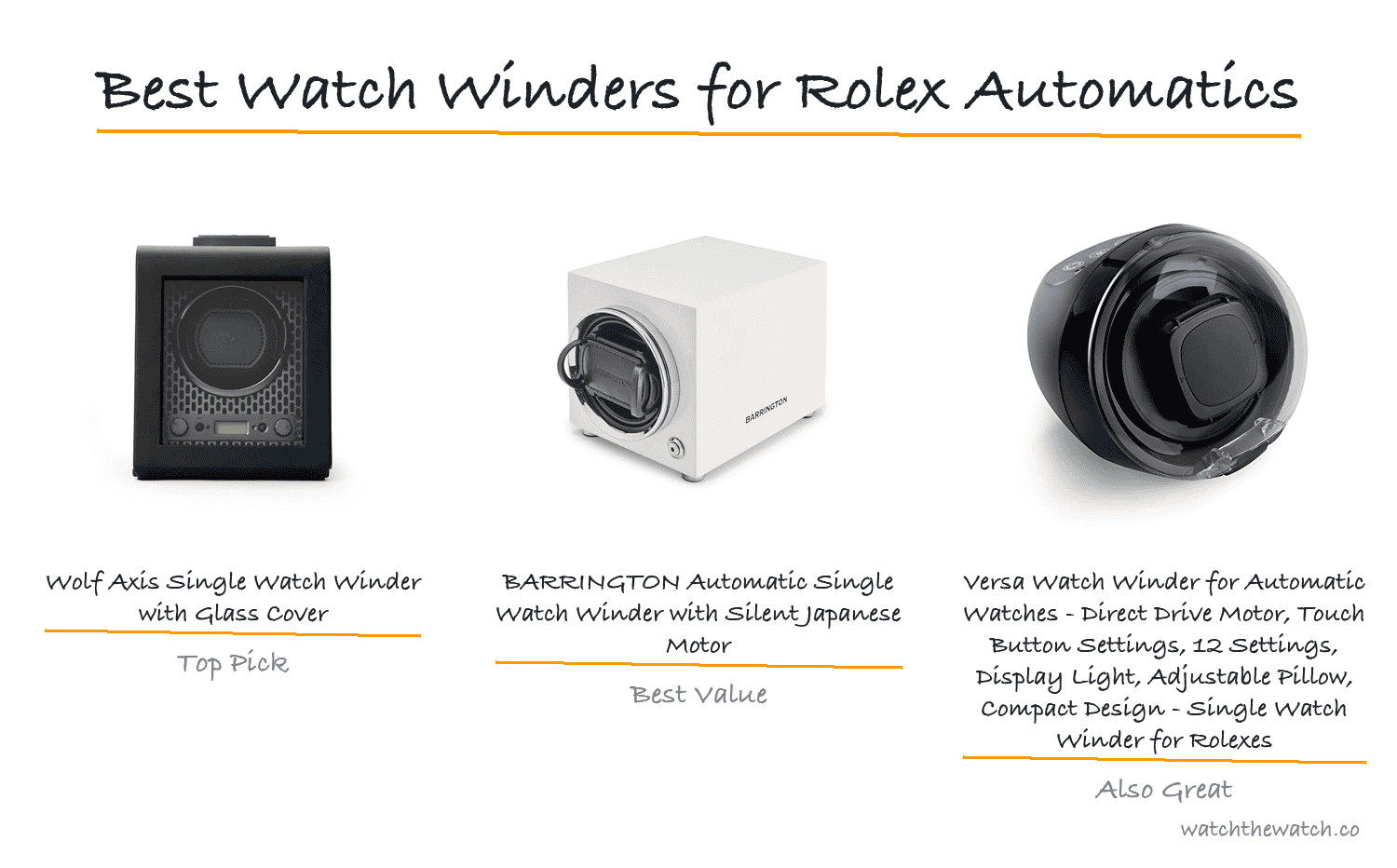
If you want one winder for a single Rolex, the Wolf Axis is the pick. Glass showcase lid, selectable rotation modes, and Wolf’s reliably quiet motor in a unit small enough for a nightstand or an office shelf.
Running three or more pieces? The Billstone Northcraft 6 is the grown-up answer, with fingerprint biometric security and six slots.
All six picks below do the things a Rolex actually needs: bidirectional rotation, a near-silent motor, and pillows sized to hold an Oyster bracelet case without slipping. Price, honestly, matters less than getting those three right.
Our top picks at a glance
The standouts from this guide — prices change, so tap through for the current price.
As an Amazon Associate, Watch The Watch earns from qualifying purchases at no extra cost to you. Some links go to other retailers. See our affiliate disclosure.
How We Picked
Rolex calibers wind through a bidirectional rotor. That covers the workhorse Cal. 3135 in older Submariners and Datejusts, and the Cal. 3235 in current production. So any winder set to clockwise, counter-clockwise, or bidirectional will keep them charged.
What actually separates a good Rolex winder from a bad one comes down to four things:
- TPD range and rotation modes: Enthusiast consensus puts the sweet spot for most Rolex calibers at 650–900 turns per day. A winder locked at an extreme TPD with no mode selection is a liability. Bidirectional is the most efficient setting for any Rolex rotor.
- Motor noise: Winders usually live on nightstands or in bedroom closets. Japanese-sourced motors, Mabuchi and equivalents, are the accepted benchmark for near-silent, consistent operation. That spec is verifiable; “ultra-quiet” in marketing copy is not.
- Pillow fit: Modern Rolex sport cases (Submariner, GMT-Master II, Explorer II) run 40–41mm and carry the bulk of an Oyster bracelet. The pillow has to grip the crown-side firmly and stop the watch shifting during rotation. Adjustable or swappable pillows are a real advantage.
- Build integrity: A winder holding a five-figure watch should not rattle, vibrate, or feel flimsy. Leather-wrapped exteriors, glass lids, and solid hinges tend to track with better internals. For peace of mind, pairing your winder with proper Rolex watch insurance is worth thinking about too.
Price was a secondary filter. A $45 winder with a reliable Japanese motor is a perfectly rational home for a $12,000 Submariner. Reliability and correct settings matter more than the box’s price tag.
The 6 Best Watch Winders for Rolex Automatics
1. Wolf Axis — Best Single Winder for a Display-Worthy Rolex

Wolf sits at the top of the winder market because its motors have a long reputation for quiet, steady running. The Axis pairs that with a glass cover that turns the winder into a tiny display case.
A Day-Date on a shelf or a Submariner on a desk looks intentional here, not parked. Owners say the motor stays inaudible overnight, and the mode selection covers every current Rolex caliber without guesswork.
Enthusiast forums keep calling it a “buy once” unit at the premium single-winder price.
2. Barrington Single Watch Winder — Best Midrange Silent Winder

The Barrington is one of the most recommended sub-$100 winders in Rolex circles, mostly for its whisper-quiet Japanese motor. That matters a lot when the winder sits near where you sleep.
Multiple rotation programs handle bidirectional winding without compromise, and the pillow grips Oyster bracelets firmly. Owners say the build punches well above its price class, with a clean finish that looks at home next to a decent watch roll.
3. Versa Single Watch Winder — Best Budget Pick Designed for Rolex

The Versa is one of the few units in this price tier actually designed with Rolex automatics in mind, and its 12 rotation settings give you more TPD control than most budget rivals.
The touch-button interface beats the usual dials, and the built-in display light is more useful than it sounds in a dark closet.
For a first winder or a second unit for a travel watch, the Versa’s Rolex-specific calibration and sub-$75 price make it the easy entry-tier call. Our broader guide to automatic watch winders has more comparisons across price tiers if you want to cross-shop.
4. Billstone Northcraft 6 — Best for Rolex Collectors

Once your collection hits three or more automatics, a Submariner, a Datejust, and a GMT-Master II is a common trio, the Billstone Northcraft 6 is the serious answer.
The fingerprint biometric lock is the headline: no combination to memorize, no key to lose, and a real deterrent for opportunistic hands.
The cabinet-style build reads more like display furniture than a gadget, which counts when it lives in a walk-in closet or on a dedicated shelf. Owners with mixed collections note that per-slot settings let all six positions run different rotation programs at once.
5. Heiden Quad Watch Winder — Best Quad Option for a Growing Rolex Collection

The Heiden Quad fills the gap between single winders and premium six-slot cabinets, aimed at the two-to-four Rolex household.
Black leather wrapping gives it a deliberate, professional look, and Heiden’s motors have a steady reputation for quiet, multi-year reliability. Owners regularly mention units still running fine after three to five years of daily use.
Each slot runs independently, so a Day-Date and a Submariner can use different rotation programs without compromise. At around $150–200, it badly undercuts multi-watch Wolf and Orbita options while doing the same job.
6. Mcbazel Single Watch Winder — Most Affordable with a Japanese Motor
At under $50, the Mcbazel is the rational pick when budget is the hard constraint.
The Japanese motor keeps earning praise for low noise, the standout trait at this price, and the AC-plus-battery dual power is genuinely handy for a closet with no nearby outlet or for travel.
The crocodile-pattern leather reads pricier than it is. Rotation modes cover Rolex’s needs, and the adjustable pillow holds 40mm+ sport cases without much movement.
Long-term durability is the trade-off here. As a first winder or a gift, though, the value per dollar is hard to argue with.
Side-by-Side Comparison
| Model | Capacity | Motor | Rotation Modes | Power | Est. Price | Best For |
|---|---|---|---|---|---|---|
| Wolf Axis | 1 watch | Wolf proprietary | CW / CCW / Bidirectional | AC | ~$175–220 | Display + daily driver Rolex |
| Barrington Single | 1 watch | Silent Japanese | Multiple programs | AC | ~$75–100 | Best midrange value |
| Versa Single | 1 watch | Direct drive | 12 settings | AC | ~$50–75 | Budget, Rolex-tuned |
| Billstone Northcraft 6 | 6 watches | Quiet motor | Per-slot settings | AC | ~$400+ | Collectors, biometric security |
| Heiden Quad | 4 watches | Quiet motor | Independent per slot | AC | ~$150–200 | Growing collection (2–4 watches) |
| Mcbazel Single | 1 watch | Japanese | Multiple modes | AC + Battery | ~$35–50 | Budget / travel-ready option |
What to Look For When Buying a Winder for a Rolex
Rotation Direction and TPD
Rolex calibers use a bidirectional rotor, so the mainspring charges whether the rotor swings left or right. Clockwise-only, counter-clockwise-only, and bidirectional all work.
Bidirectional is the most efficient in practice, since no rotation gets wasted against the rotor’s freewheeling direction. For turns per day, enthusiast consensus and watchmaker guidance land on 650–900 TPD for modern Rolex movements.
Skip winders locked at very high fixed TPD with no adjustment. Over-winding won’t hurt the movement thanks to its slip clutch, but pointlessly high rotation just wears out the winder motor.
Motor Quality Is the Most Important Spec
Japanese-sourced motors, with Mabuchi the name that comes up most in enthusiast threads, are the reference standard for quiet, consistent running. A good one is inaudible from across the room while it’s working.
“Ultra-quiet” in a product title is marketing and unverifiable; “Japanese motor” is a specific, checkable claim that tracks with actual low noise. If a listing leaves out the motor origin, treat that as a yellow flag.
Pillow Compatibility with Oyster Cases
Modern Rolex sport watches (Submariner, GMT-Master II, Explorer II) are big and heavy, especially on an Oyster bracelet. The pillow has to grip the crown-side firmly and stop any slapping against the housing during rotation.
Most reputable units include adjustable or interchangeable pillows for exactly this. Own a vintage Rolex in a 34–36mm case? Confirm the pillow shrinks small enough to hold it without play.
Single vs. Multi-Watch Winders
Single winders make sense if you own one automatic, or switch between a Rolex and a quartz that needs no winding. Once you’ve got two or more automatics, a quad or six-slot unit costs less per position and kills the cable clutter.
A multi-watch winder really should offer independent per-slot settings. Without them, you’re compromising one caliber’s rotation program to suit another.
This matters most with mixed collections, a Rolex sitting next to a Seiko or an ETA-based piece, rather than an all-Rolex shelf. If that Seiko has you wondering where it sits on the value ladder, my honest take on whether Seiko counts as luxury is worth a read.
And if you’re shopping for that second automatic, our roundup of the best Seiko watches for 2026 covers every budget.
Frequently Asked Questions
Do Rolex watches actually need a watch winder?
No. A Rolex automatic is perfectly safe sitting unwound in a watch box, and the movement won’t degrade from lack of motion.
A winder is pure convenience: it keeps the watch at the right time and date so you can grab it and go. On models with date or day-date complications, skipping the daily reset is a more tangible win than on a plain three-hander.
What TPD setting should I use for a Rolex?
Enthusiast consensus and watchmaker guidance point to 650–900 turns per day for modern Rolex calibers, including the Cal. 3135, Cal. 3235, and Cal. 3186. Bidirectional at around 800 TPD is the usual default.
If your winder only offers fixed presets, pick the one closest to 750–900 TPD in bidirectional or clockwise mode.
Can a watch winder damage a Rolex movement?
Modern Rolex movements have a mainspring slip clutch that prevents over-winding no matter how many rotations the winder runs. The movement just stops tensioning once it’s fully wound, so a quality winder won’t hurt it mechanically.
Cheap winders carry a different risk. Poor motor construction can cause vibration that, over years, may stress delicate components, which is the real case for a reputable motor over the cheapest box on the shelf.
How long can a Rolex run without a winder or wrist wear?
Most current Rolex movements give roughly 48–70 hours of power reserve when fully wound. Older calibers like the Cal. 3135 sit at the 48-hour end.
The newer Cal. 3235, introduced around 2015 in updated Submariner and Datejust models, stretches that to about 70 hours. Wear it daily and normal wrist motion keeps it charged, no winder required. If you’re curious about how long automatics actually last in general, that’s its own deeper question.
Is bidirectional the right winder mode for all Rolex models?
For all modern Rolex automatics, yes. Their rotors wind the mainspring on the swing in both directions, so bidirectional is the correct and most efficient mode.
Clockwise-only and counter-clockwise-only modes both work, they just need more total rotations for the same wind. If bidirectional is on the menu, use it.
The one historical exception is a small number of vintage Rolex calibers with unidirectional rotors. Own a vintage piece? Check the caliber spec before you set the mode.

Daniel Hart is the editor of Watch The Watch. He researches and writes the site’s buying guides, brand comparisons, and explainers, focused on accessible, enthusiast-level watches — affordable automatics, divers, field and dress watches, everyday quartz, and the straps, winders and tools that go with them. The goal is practical, budget-aware advice that helps readers choose the right watch for their wrist and their budget. Recommendations draw on manufacturer specifications and the wider enthusiast community.