Daniel Hart · ·
Engineers tend to judge a watch the way they judge everything else. It has to be legible, tough, and accurate, no second-guessing required.
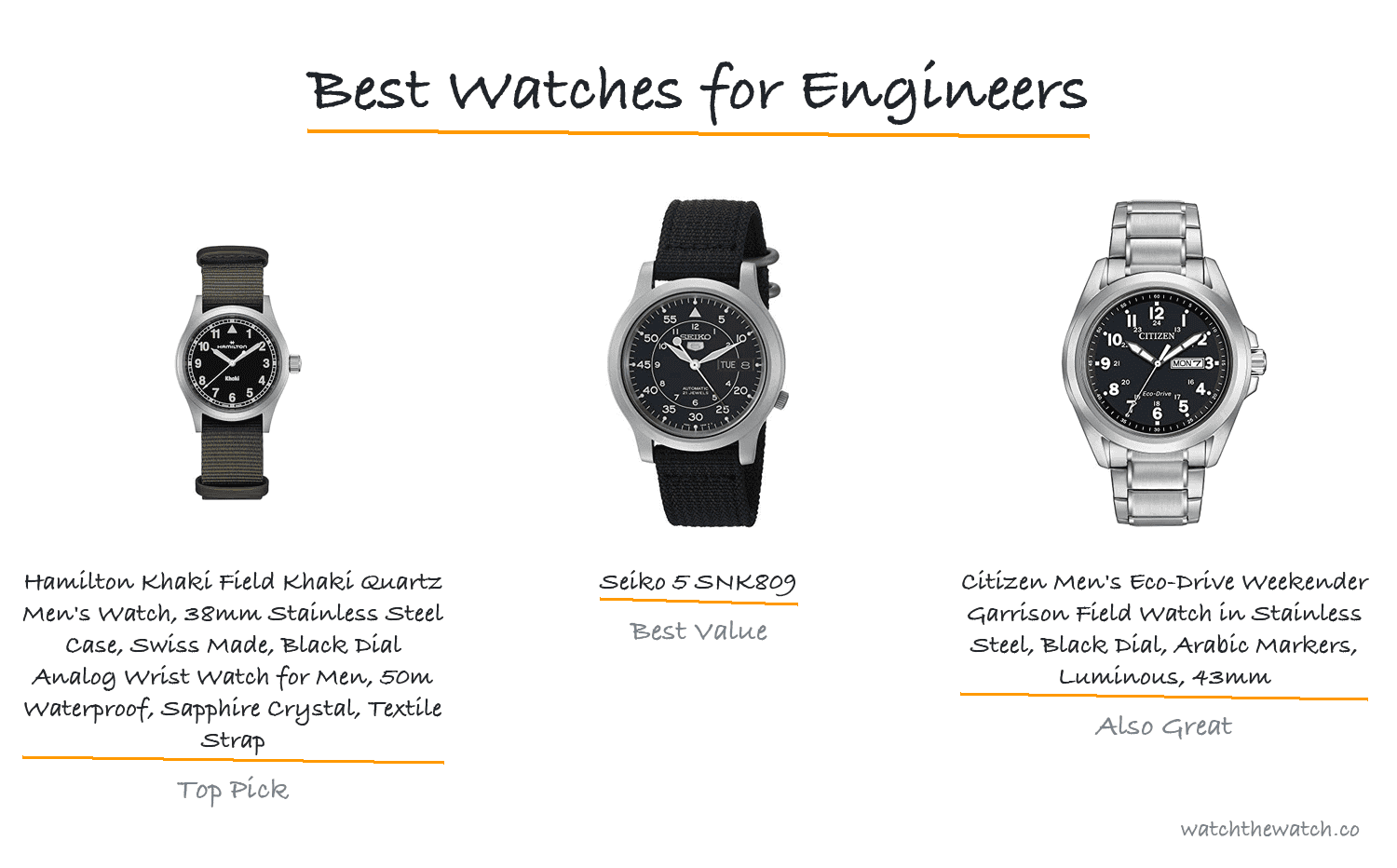
My top pick is the Hamilton Khaki Field Quartz. Swiss movement, sapphire crystal, and a field dial you can read in a single glance, which is most of what matters here.
Prefer something mechanical? The Seiko 5 SNK809 is a proven self-winding automatic for under $100, with a reputation built over decades of daily wear.
Our top picks at a glance
The standouts from this guide — prices change, so tap through for the current price.
As an Amazon Associate, Watch The Watch earns from qualifying purchases at no extra cost to you. Some links go to other retailers. See our affiliate disclosure.
How We Selected These Watches
Engineering work happens at a desk, on site, and around machinery, so a watch has to cover all three. I weighted five things, and spec-sheet bragging wasn’t one of them.
Those five: legibility, durability, movement reliability, practical features like day/date or solar, and honest value at each price. Value had to be real, not just a low number next to a famous logo.
Anything that looked great on paper but couldn’t earn credibility in the wider enthusiast world got cut. That means real owner reviews and forums like WatchUSeek, r/Watches, and long-term wear reports, not marketing copy.
1. Hamilton Khaki Field Quartz — Best Overall for Engineers

This is the benchmark field watch for anyone who wants Swiss precision without the fuss of a mechanical movement. The quartz caliber holds accuracy within seconds per month, and the sapphire crystal shrugs off the scratches that mineral glass picks up in a single working week.
The dial is clean Arabic numerals, easy to read in dim light. Owners keep calling it a set-it-and-forget-it tool watch, and that’s exactly the appeal.
Textile strap, 50m water resistance, 38mm case that clears a shirt cuff and slides under PPE without snagging. At roughly $300–350, it lands right between fashion-watch pricing and genuine Swiss quality.
- Pros: Sapphire crystal, Swiss quartz accuracy, highly legible field dial, reliable 50m WR, low maintenance
- Cons: Quartz movement won’t satisfy those seeking mechanical complexity; battery replacement every few years
2. Seiko 5 SNK809 — Best Automatic Under $100
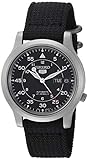
Few watches at any price match the SNK809’s credibility-to-cost ratio. The 7S26 movement is self-winding, so no battery, no solar, just the motion of wearing it.
If you’ve ever wondered whether Seiko counts as luxury, that’s a separate debate. At this price, what you’re buying is reliability, not prestige.
One quirk: the 7S26 doesn’t hand-wind by design, so desk-bound engineers can’t just top it up with the crown. A few wrist shakes before you put it on solves it, and that’s a known trait, not a defect.
Owners report accuracy around ±15 seconds per day after a little regulation, which is genuinely respectable for an automatic this cheap. The 37mm case reads as a real tool watch, and the hardlex crystal scratches easier than sapphire but polishes out if you bother.
- Pros: Automatic movement with no battery, iconic value, compact 37mm, strong enthusiast community support
- Cons: No hand-winding or hacking seconds, hardlex crystal, 30m WR limits water exposure
3. Citizen Eco-Drive Weekender Garrison — Best Solar-Powered Option

Eco-Drive is basically the engineer’s quartz. It turns any light, office fluorescents, daylight, even indirect window glow, into a charge that runs for months in the dark.
The Garrison’s 43mm case runs large, which actually helps here. Bigger numerals and longer lume mean excellent low-light legibility.
At around $130–160 it badly undercuts the Swiss options while keeping a steel case and 50m water resistance. Eco-Drive is also about as trouble-free as quartz gets, no dead batteries at bad moments, no daily winding to remember.
- Pros: Zero battery maintenance ever, 50m WR, large legible dial, stainless steel case, strong value
- Cons: 43mm case is large for smaller wrists; mineral crystal accumulates scratches over time
4. Hamilton Khaki Navy Automatic — Best Premium Mechanical

The Field Quartz wins on simple precision. The Navy Automatic wins on the part engineers actually nerd out over: a mechanical movement you can appreciate as engineering.
Swiss automatic, solid daily accuracy, and finishing that clearly steps up over Japanese watches at the same money. You can feel the difference in hand.
Owners describe it as built to last a career, and the Khaki line has genuine field and military-adjacent service history behind it. That heritage is earned, not styled on.
At around $400–500 this is an investment piece. It holds residual value better than most watches in the $100–250 range.
- Pros: Swiss automatic movement, sapphire crystal, premium build quality, strong long-term value retention
- Cons: Higher price point; all mechanical watches require periodic servicing every 5–7 years
5. Timex Expedition North Field Post Solar — Best Modern Solar Field Watch

The Expedition North takes the old field-watch template and makes it modern. Solar charging, an INDIGLO backlight that lights the whole dial at a button press, and a look that works on a job site or at a desk.
The 12/24-hour markings help if you switch between formats, and the canvas-texture strap stays utilitarian without a metal bracelet’s weight. It’s the kind of watch you forget you’re wearing.
On active sites, solar means one fewer thing to manage during a busy week. At roughly $100–120, it’s the most feature-forward field watch at this budget.
- Pros: Solar powered, INDIGLO full-dial backlight, 12/24h markings, 50m WR, genuinely affordable
- Cons: Mineral crystal, case construction is not full stainless, less refined finishing than Hamilton
6. Citizen Garrison Eco-Drive Nylon — Best Day/Date Utility Watch

If you want the day of the week and date at a glance, useful for shift rotations and site schedules, this Garrison adds both without cluttering the dial.
It’s the same charge-from-light Eco-Drive as the Weekender above, just on a lighter nylon strap. That makes it better for warm-weather fieldwork, or anywhere a metal bracelet gets sweaty and annoying.
Owners say the nylon breathes well in summer and the buckle takes daily abuse, while the Arabic markers stay clear in any light. A solid, no-drama daily driver.
- Pros: Day/date display, solar Eco-Drive (no battery), breathable nylon strap, clean legible dial
- Cons: Nylon strap preference is personal; mineral crystal; no hacking seconds
All Six Picks Compared
| Watch | Movement | Case Size | Crystal | Water Resistance | Price Range |
|---|---|---|---|---|---|
| Hamilton Khaki Field Quartz | Swiss Quartz | 38mm | Sapphire | 50m | ~$300–350 |
| Seiko 5 SNK809 | Automatic (7S26) | 37mm | Hardlex | 30m | ~$65–85 |
| Citizen Weekender Garrison | Eco-Drive Solar | 43mm | Mineral | 50m | ~$130–160 |
| Hamilton Khaki Navy Auto | Swiss Automatic | ~40mm | Sapphire | 50m | ~$400–500 |
| Timex Expedition North Solar | Solar Quartz | ~40mm | Mineral | 50m | ~$100–120 |
| Citizen Garrison Eco-Drive Nylon | Eco-Drive Solar | ~40mm | Mineral | 50m | ~$130–150 |
What to Look for When Buying a Watch as an Engineer
Crystal Quality Matters More Than You Might Expect
Crystal choice matters more than people expect in an engineer’s day. Sapphire (Mohs hardness 9) shrugs off scratches from tools and rough surfaces far better than mineral glass (Mohs ~5) or hardlex, Seiko’s hardened mineral variant.
Spend time around metal, concrete, or worksites and sapphire pays for itself fast in fewer cosmetic scratches. Both Hamilton picks here use it.
The Citizen and Timex options use mineral crystal. It’s more chip-resistant, but it shows surface scratches faster in demanding settings.
Movement Type: Quartz vs Automatic vs Solar
Quartz, battery-powered, holds ±15 seconds per month and asks almost nothing of you beyond the occasional battery swap. Solar Eco-Drive goes one better: no battery to replace, ever.
Automatics are the most interesting mechanically, and enthusiasts usually love them, but they run ±10–20 seconds per day and need servicing every 5–7 years. If you’re curious how long automatics last, the short answer is decades with care.
For pure practicality, solar wins. For the plain pleasure of wearing a self-contained mechanical thing on your wrist, automatic is hard to beat.
Water Resistance: Know What the Numbers Mean
Most picks here are 50m (5 ATM), which covers rain, sweat, splashes, and a quick rinse at the sink. It is not for swimming or submersion, the crown seals and gaskets aren’t built for it.
The Seiko SNK809’s 30m rating is fine for office and light outdoor use, but I wouldn’t shower in it regularly. If your job means real water contact, target 100m or higher.
Dial Legibility: Why Arabic Numerals Win
All six picks use Arabic numerals, not Roman numerals or baton indices, and that’s on purpose. In poor light or under time pressure, Arabic numerals read fastest.
High-contrast dials, black on white or white on black, plus lume on the hands and markers, make reading the time instinctive. If single-glance reading matters on the job, skip cluttered sub-dials.
Frequently Asked Questions
What type of watch is best for engineers?
Field and tool watches fit best: clean Arabic dials, durable steel cases, real water resistance, sensible straps. Hamilton, Seiko, and Citizen all make purpose-built options in the $70–500 range. Solar Eco-Drive in particular gets praised for hands-off, zero-maintenance reliability.
Is a quartz or automatic movement better for an engineer?
Quartz is more accurate (±15 seconds per month vs ±10–20 seconds per day for most automatics) and needs almost no upkeep. Solar quartz splits the difference: quartz accuracy, zero battery management.
Automatics are more engaging and appeal to engineers who like well-built systems, but they want servicing every 5–7 years. Most practicality-first engineers lean quartz or solar; the mechanically curious go automatic.
Do engineers need a sapphire crystal watch?
Not strictly, but sapphire is a meaningful upgrade for hands-on work. It resists scratches from metal and concrete far better than mineral or hardlex.
Above $300, sapphire is usually standard; under $200, mineral is common and can be polished if it scratches. If your work is mostly desk-based, mineral is perfectly fine.
What is the best budget watch for engineers?
The Seiko 5 SNK809 at around $65–85 is my top entry-budget pick: a real automatic, a legible field dial, and the long-term reliability Seiko owners document across decades. It’s a regular on most best Seiko watches shortlists too.
If you want solar instead, the Timex Expedition North Field Post Solar at around $100–120 is the best budget solar option, adding INDIGLO and 12/24h markings the SNK809 lacks.
What water resistance is sufficient for engineering work?
50m (5 ATM) is the practical floor for everyday engineering: rain, sweat, splashes, a quick sink rinse, all fine. The Seiko SNK809’s 30m handles office and light outdoor use but isn’t for wet conditions.
If water is a regular part of the job, field monitoring, construction near water, infrastructure inspection, aim for 100m or more, not 50m.

Daniel Hart is the editor of Watch The Watch. He researches and writes the site’s buying guides, brand comparisons, and explainers, focused on accessible, enthusiast-level watches — affordable automatics, divers, field and dress watches, everyday quartz, and the straps, winders and tools that go with them. The goal is practical, budget-aware advice that helps readers choose the right watch for their wrist and their budget. Recommendations draw on manufacturer specifications and the wider enthusiast community.