Daniel Hart · ·
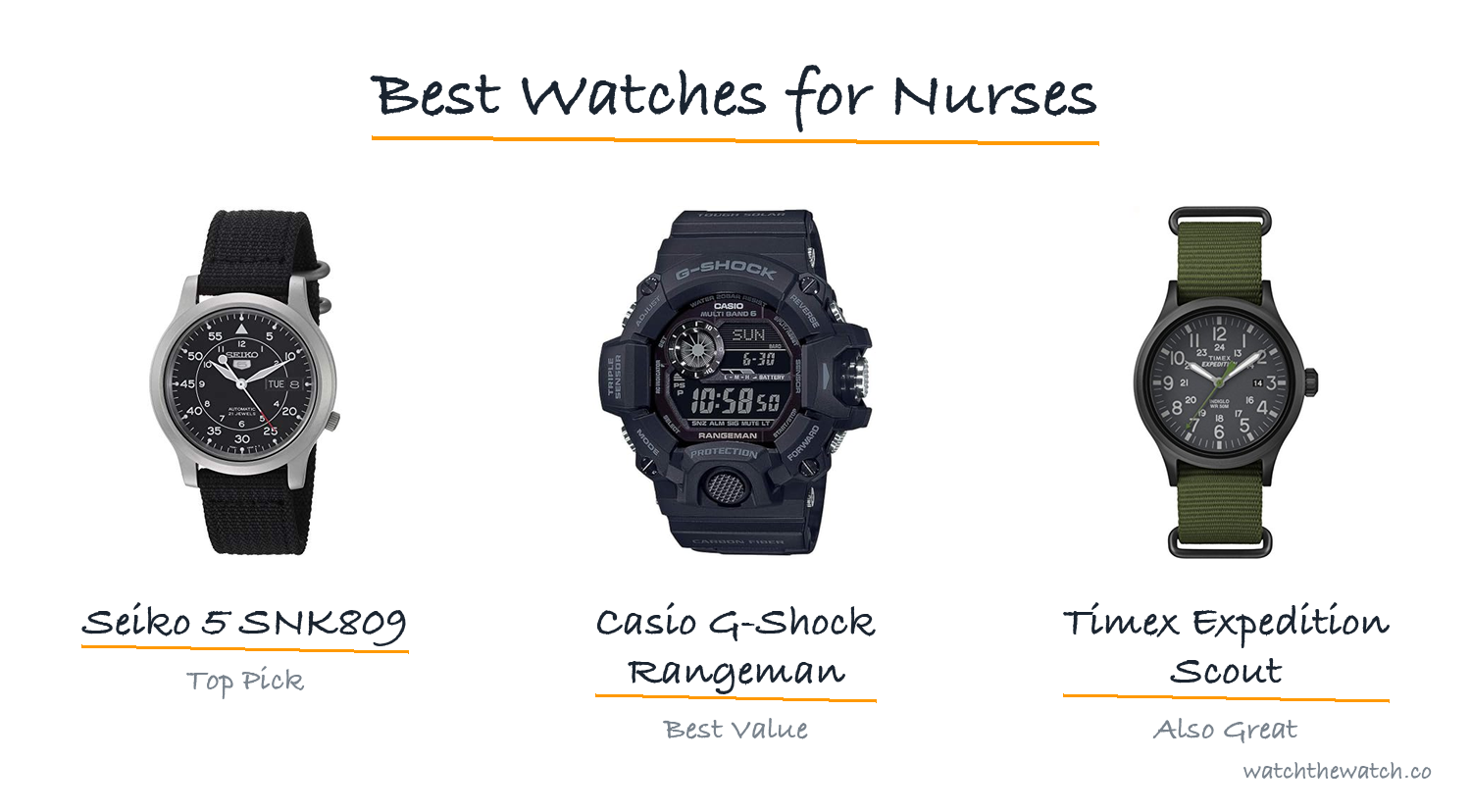
The Seiko 5 SNK809 is my top pick for nurses, and it’s not a close call. You get a 37mm automatic with a sweep seconds hand for pulse timing, a day/date display, and a price well under $100.
Need something genuinely indestructible? The Casio G-Shock Rangeman adds solar charging, shock resistance, and 200m water resistance.
The six picks below cover the full range of priorities, whether you’re after a $40 expendable or a shift-proof tank.
Our top picks at a glance
The standouts from this guide — prices change, so tap through for the current price.
As an Amazon Associate, Watch The Watch earns from qualifying purchases at no extra cost to you. Some links go to other retailers. See our affiliate disclosure.
How We Picked
Five practical requirements knock out most fashion watches the second you step onto a clinical shift:
- Running seconds display — nurses count pulse and respiratory rates; without a visible seconds hand or digital seconds counter, a watch has no clinical utility
- At least 30m water resistance — sufficient for frequent handwashing and sanitizer splash; 50m or higher is preferable in trauma or ICU settings
- Case size of roughly 36–42mm — large enough to read quickly, small enough to clear gloves and not snag on bedding or lines
- Easy-clean strap — leather traps bacteria; nylon NATO straps, silicone bands, and stainless bracelets are the practical alternatives in clinical environments
- Low-maintenance timekeeping — automatic and solar movements eliminate the dead-battery-mid-shift problem that plagues quartz watches
All six picks are on Amazon, priced between roughly $40 and $200. That’s realistic money for a watch that’s going to take daily abuse on the ward.
1. Seiko 5 SNK809 — The Nurse’s Workhorse
The SNK809 has been the enthusiast community’s go-to budget automatic for over a decade, and it earns that reputation on the ward too. The 37mm case slips under gloves without snagging, and the sweep seconds hand makes pulse and respiration counting easy at a glance.
The aftermarket strap selection for this watch is enormous. Swapping the stock strap for a wipeable nylon alternative takes about five minutes and solves the hygiene question entirely. If you’re wondering whether Seiko is worth it at this price, the answer in clinical use is an easy yes.
The day and date complications add documentation utility, and the 21-jewel automatic keeps time within ±20 seconds per day. That’s more than enough for clinical timing.
2. Casio G-Shock Rangeman — The Bulletproof Option

No watch in this price class absorbs more punishment than the G-Shock Rangeman. Solar charging kills battery replacement for good, and 200m water resistance handles a quick handwash or an accidental dunk without complaint.
The shock-resistant build shrugs off bed rails, equipment carts, and hard floors, which nurses meet daily. The resin case and band wipe clean instantly with a damp cloth or alcohol swab.
The digital display shows seconds prominently, and the multi-alarm functions map neatly onto medication scheduling. Among nurses who put durability first, the Rangeman comes up again and again as a long-term workhorse.
3. Timex Expedition Scout — Best Budget Pick
The Timex Expedition Scout earns its spot almost entirely on the Indiglo backlight. That full-dial green glow makes the watch readable in a dim patient room or during a bedside check on night shift.
At around $40, it’s genuinely expendable in a way a $200 watch never is. That matters when watches get scratched, sanitizer-soaked, and occasionally dropped.
The quartz movement keeps accurate time with a continuous seconds hand, and water resistance covers daily handwashing fine. Many variants ship on a nylon strap that wipes clean, which makes this the rational starting point for new nurses or anyone working where a watch is likely to get wrecked.
4. Seiko SNKP27 — More Spec, More Presence

The SNKP27 steps up from the SNK809 with 50m water resistance and a green dial that reads clearly under fluorescent hospital lighting. The 41-hour power reserve covers a double shift plus time off the wrist without winding down.
The day/date window is large and easy to read on the move. The catch is the stock leather strap, which is worth swapping early.
Seiko’s 20mm lug width is one of the most common sizes out there, so nylon and rubber alternatives are cheap and everywhere. If you want more water resistance and a bit of visual character without leaving the budget-automatic world, the SNKP27 delivers.
5. Casio Pro Trek PRW-2500R-1CR — Solar Atomic Reliability

The Pro Trek’s atomic timekeeping is its headline feature for shift workers. It syncs to radio time signals on its own, staying accurate without any input from you across years of daily wear.
Solar charging handles the power side just as permanently. The result is a watch that simply runs, always accurate and always charged, which suits nurses on irregular rotations who have zero interest in babysitting a watch.
The stopwatch and multi-alarm functions slot into shift planning and medication reminders, and like the G-Shock the resin sanitizes easily. It reads as a technical outdoor instrument rather than a clinical one, but in emergency or urgent-care settings where function leads, it makes a credible case.
6. Timex Marlin Sub-Dial — The Polished Option
Most nurses treat a watch as pure tool, but some want something that looks polished during patient interactions and professional presentations. The Timex Marlin Sub-Dial pulls off that balance.
The 39mm stainless case reads as a clean dress watch, while the sub-seconds dial at 6 o’clock gives you a dedicated seconds reference for pulse and respiration counting. The automatic movement keeps reliable time and the proportions stay comfortable all day.
The brown leather strap is the clinical compromise here, so swap it for a mesh bracelet or rubber band early if cleaning matters. At around $180 it’s the priciest pick, but it carries a level of polish that patient-facing nurses tend to appreciate.
Comparison: All Six Picks at a Glance
| Watch | Case Size | Water Resistance | Movement | Key Nurse Feature | Approx. Price |
|---|---|---|---|---|---|
| Seiko 5 SNK809 | 37mm | 30m | Automatic | Sweep seconds, compact size | ~$65 |
| G-Shock Rangeman | Large/bulky | 200m | Solar/Digital | Solar, shock-proof, alarms | ~$170 |
| Timex Expedition Scout | 40mm | Water-resistant | Quartz | Indiglo backlight, low price | ~$40 |
| Seiko SNKP27 | 41mm | 50m | Automatic | Higher WR, day/date window | ~$95 |
| Casio Pro Trek PRW-2500R | Large | 100m | Solar/Atomic | Atomic accuracy, solar power | ~$150 |
| Timex Marlin Sub-Dial | 39mm | 30m | Automatic | Sub-seconds dial, dressy look | ~$180 |
What to Look for in a Nurse’s Watch
A Visible Seconds Display
This one’s non-negotiable. Counting a radial pulse or checking respiratory rate needs a running seconds reference, either a sweep hand or a clear digital seconds counter.
Any watch without it is useless for clinical timing, however good it looks otherwise. Sub-seconds dials like the Marlin’s are a workable alternative if you prefer analog.
Water Resistance That Matches the Environment
A 30m rating handles routine handwashing and splash, and that’s the minimum worth considering. In trauma, ICU, or surgical settings, 50m or higher earns its keep.
Worth knowing: alcohol-based hand sanitizer degrades leather straps and some case finishes faster than water does. That’s one more reason to start with silicone, nylon, or stainless.
Case Profile and Glove Compatibility
A 37–40mm case with a low profile beats a 45mm diver with a thick rotating bezel every time here. Slimmer cases sit closer to the wrist and snag less on gloves, bedding, and IV lines.
If you regularly wear disposable gloves, physically test the watch before committing to anything bulkier. Honestly, dialing in how tight a watch should be matters more than you’d expect over a 12-hour shift.
Strap Hygiene Is a Clinical Decision
Leather soaks up moisture and bacteria and won’t reliably sanitize with alcohol. In a clinical setting, nylon NATO straps, silicone bands, and stainless bracelets are the practical choices, since all three wipe or wash clean without falling apart.
Most watches ship on leather but take standard-width alternatives. Changing a strap takes minutes and costs under $15 for a decent nylon NATO.
Battery-Free Movements Are Worth the Slight Premium
Automatics wind from your wrist movement; solar watches charge from ambient light. Either one kills the dead-battery-mid-shift problem, and if you’re curious how long automatic watches last, the short answer is decades with basic care.
Quartz is more precise but needs a battery swap now and then. If you go quartz, stash a spare in your work bag and change it once a year out of habit, rather than waiting for the watch to die on shift.
Frequently Asked Questions
What features does a nurse’s watch need?
At a minimum: a running seconds hand or digital seconds display for pulse and respiration timing, at least 30m water resistance for frequent handwashing, and a strap you can clean or quickly replace.
A date window helps with documentation, and a backlight earns its keep on night shifts. Battery-free movements, automatic or solar, remove one more maintenance variable from a busy schedule.
Can nurses wear automatic watches at work?
Yes, and plenty prefer them. An automatic never needs a battery, and an active nursing shift throws off more than enough wrist movement to keep the rotor spinning and the mainspring wound.
The one caveat: a standard automatic can gain or lose up to ±20 seconds per day. That’s fine for clinical timing, where you’re counting a pulse over 15 or 30 second windows, not chasing split-second precision.
What is the most hygienic watch strap for nurses?
Stainless bracelets and silicone bands clean up easiest with soap, water, or alcohol sanitizer. Nylon NATO straps can go in the wash and dry fast.
Leather absorbs liquids and won’t reliably sanitize, so it’s the worst option for clinical work and should be swapped off any watch that ships with it. Most watches use standard lug widths, so replacement is cheap and easy.
Is the Seiko 5 SNK809 good for nurses?
It’s one of the most consistently recommended nurse’s watches at its price. The 37mm case clears gloves, the sweep seconds hand supports clinical timing, and the day/date is legible at a glance.
Its sub-$100 price means wearing it through long, brutal shifts carries no financial anxiety, and the huge strap aftermarket makes it easy to set up for hygiene. The enthusiast take is that it punches well above its price class.
What is the best nurse’s watch under $50?
The Timex Expedition Scout is the strongest pick under $50. You get a reliable quartz movement, a visible sweep seconds hand, and the Indiglo backlight for low-light reading, all for around $40 depending on the variant.
It handles daily handwashing, runs accurately with no upkeep, and is cheap enough to replace without stress if a shift wrecks it. For nurses just starting out, it’s the obvious first watch.

Daniel Hart is the editor of Watch The Watch. He researches and writes the site’s buying guides, brand comparisons, and explainers, focused on accessible, enthusiast-level watches — affordable automatics, divers, field and dress watches, everyday quartz, and the straps, winders and tools that go with them. The goal is practical, budget-aware advice that helps readers choose the right watch for their wrist and their budget. Recommendations draw on manufacturer specifications and the wider enthusiast community.