
Daniel Hart · ·
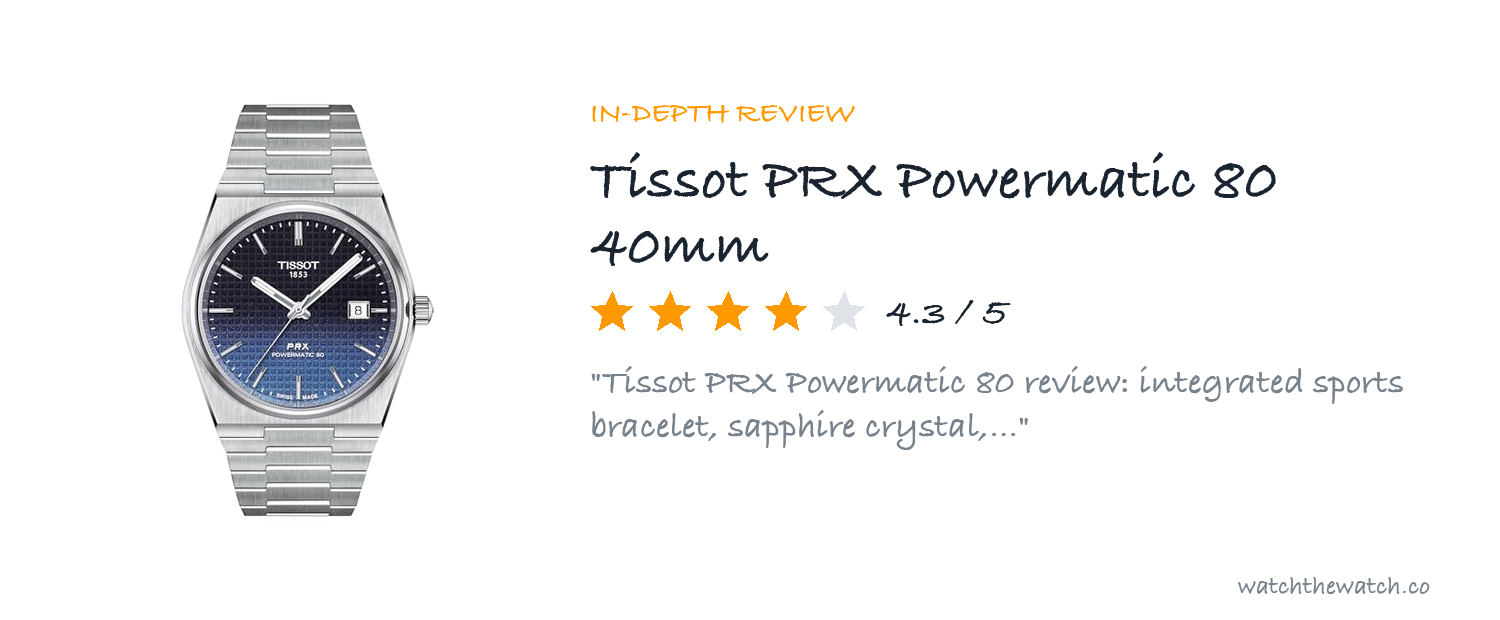
The Tissot PRX Powermatic 80 is the best integrated-bracelet automatic under $700. That’s a big claim. It earns it.
It pairs a clean 1970s-inspired dial with an 80-hour power reserve, sapphire crystal, and 100m water resistance. Street price sits around $595–$650, which puts the Royal Oak-adjacent look within reach.
If the integrated-bracelet sports watch is the style you want, this is the benchmark to beat.

Overview: A 1978 Icon, Reborn
The PRX name traces back to 1978. The initials stood for Précision, Robustesse, and eXtuple-waterproofing, a nod to its original six-ATM water resistance.
Tissot revived the lineage in 2021 with a quartz version, then added the automatic Powermatic 80 variant, reference T137.407.
Like the original, the new PRX wears its integrated bracelet as the whole point. Case and bracelet flow together in one line, a look made aspirational by watches that cost many times more.
Tissot sits inside the Swatch Group. That buys it in-house movement manufacturing, Swatch Group’s sapphire-cutting capacity, and a global service network.
All of that arrives at a price that would have seemed impossible for this level of finishing a decade ago. If you’re new to the brand and wondering whether Tissot is a good watch brand, that guide covers the full value picture.
Specifications at a Glance
| Spec | Detail |
|---|---|
| Case diameter | 40mm |
| Case material | Stainless steel |
| Case thickness | ~11mm |
| Movement | Tissot Powermatic 80.111 (automatic, self-winding) |
| Power reserve | 80 hours |
| Water resistance | 100m / 10 ATM |
| Crystal | Sapphire (anti-reflective coated) |
| Bracelet | Integrated stainless steel |
| Dial colors available | Blue, silver/grey, black, green (market dependent) |
| Price band | ~$595–$650 USD |
Design and Dial
The defining feature is the integrated bracelet. The case sides step straight into the links, so the whole thing reads as one piece of metal rather than a watch on a strap.
The angular case and stepped bezel give it real 1970s sports-watch geometry. That sets it apart from the round-case-on-bracelet formula most brands default to at this price.
Dial finishing is clean and honest, no gimmicks. The blue variant is the one with the cult following, and I get why.
A subtle sunburst gives the dial depth without tipping into flashy. Markers are applied indices, the dauphine hands are well-proportioned, and Tissot keeps the printed text restrained.
The sapphire crystal is flat with an anti-reflective coating. It helps legibility in awkward light, and it’s a real step up from the mineral glass you usually get at this price.
The bracelet is a constant talking point, and deservedly so. The links feel substantial and the clasp operates smoothly for the money.
One catch: the integrated design means off-the-shelf NATO or leather straps won’t fit without a dedicated adapter. Third-party solutions exist if you want to vary the look, but it’s an extra step.
Movement and Accuracy
The Powermatic 80.111 is the real reason to pick this over the quartz PRX. It’s a proper automatic movement.
The 80-hour power reserve comes from a more efficient lever escapement and a twin-barrel layout. In plain terms, it runs through a full weekend off the wrist without a manual wind.
That matters day to day, especially if you rotate watches. If you’re wondering how long automatic watches last in general, that’s a separate question from the reserve, and worth reading up on before you buy.
The movement beats at 3 Hz (21,600 vph). That’s slower than ETA 2824-based calibers at 28,800 vph, and you’ll notice it in the seconds hand.
Owner reports put real-world accuracy around +4 to -2 seconds per day out of the box. That’s respectable, but it isn’t COSC chronometer territory.
A display caseback shows the movement. Finishing is functional, a decorated rotor and plain bridges, so don’t expect it to wow you.
Weighing Tissot against the other big value name? Our Tissot vs Seiko comparison digs into the movement and build-quality trade-offs.
On the Wrist: What Owners Report
A few themes come up again and again across forums. The big one: the 40mm case wears like a 38–39mm watch.
The integrated bracelet shortens the visual footprint, which catches out buyers expecting more presence. Worth knowing if you like a watch that reads large.
Owners in the 6.5–7.5 inch wrist range report an excellent fit. Very small or very large wrists may need careful link removal to land in the right spot.
The steel bracelet adds real heft. Most owners read that as a quality cue, and only a few find it tiring, though it’s worth handling one if you prefer light watches.
Versatility is the recurring win. The PRX sits fine under a suit cuff and just as well with weekend clothes.
The 100m water resistance covers hand-washing and recreational swimming without worry. Tissot doesn’t rate it for diving or high-pressure water sport, so keep it out of those.
A small but vocal group flags the clasp’s micro-adjustment range as narrower than ideal. If your wrist falls between half-link sizes, you’ll feel it.
Getting links removed at an authorised dealer at purchase is standard practice. It’s usually included in the sale, so ask.
Pros
- 80-hour power reserve is exceptional at this price bracket
- Sapphire crystal — a meaningful upgrade over mineral glass common at this level
- Integrated bracelet delivers a design language that costs many multiples more from prestige brands
- 100m water resistance for genuine daily wear without worry
- Blue and grey dial sunburst finish punch well above the price point
- Backed by Swatch Group manufacturing quality and a global authorised service network
Cons
- Integrated bracelet limits strap versatility without third-party adapters
- Movement finishing is functional, not decorative — the caseback view will not impress movement enthusiasts
- 3 Hz beat rate means the sweeping seconds hand is slightly less fluid than higher-frequency competitors
- Bracelet sizing requires link removal — no quick micro-adjust clasp on all variants
- Not COSC-certified: accuracy is solid, but buyers who want a chronometer need to look at a different tier
Who It Is For
This is a one-watch-does-it-all pick. You want serious presence, a real automatic movement, and an integrated bracelet design that has stayed aspirational since the 1970s.
It’s ideal if you’re stepping up from your first automatic. It holds its own at a business dinner and on weekend errands, no strap swap needed.
It’s a worse fit if you love swapping straps, if you care more about movement decoration than power reserve, or if you need a genuinely thin dress watch. If a travel complication matters more than the integrated look, an affordable option like the Seiko 5 Sports GMT is worth a look instead.
Alternatives to Consider
Tissot PRX 35mm Automatic: The same watch in a 35mm case if 40mm feels too big. The integrated bracelet changes how each size wears, so try both in person before you commit.
Tissot PRX Quartz: Around $375–$425, the quartz sibling gives you the same case and bracelet with battery accuracy. Pick it if you want the look without paying the automatic premium.
Longines HydroConquest: Another Swatch Group integrated-bracelet watch with strong water resistance and a solid movement, usually around $1,000–$1,200. A natural step up if the budget stretches and you want a sportier, diver-adjacent look.
Hamilton Khaki Field Mechanical or Khaki King: A completely different look, field-watch heritage with no integrated bracelet. It’s competitive on movement quality and value in a similar price range if you’re not sold on the sport-bracelet style.
Verdict
The PRX Powermatic 80 earns its reputation as the benchmark integrated-bracelet automatic under $700. The reputation isn’t hype.
At roughly $595–$650 you get an 80-hour automatic movement, a sapphire crystal, 100m water resistance, and a design enthusiasts have rated above its price since launch.
The compromises are real but minor: strap limitations, a modest beat rate, basic movement finishing. None of them change the verdict.
Short answer to the title question: yes. For most buyers at this price who want an integrated sports watch with real mechanical substance, this is the one to buy.
You’d have to jump into the $1,500–$3,500 range to find a meaningfully better mix of design, specs, and Swiss-made pedigree. That’s a big leap for a small gain.
Frequently Asked Questions
Is the Tissot PRX Powermatic 80 worth buying in 2026?
Yes. It’s still one of the strongest value buys in the sub-$700 automatic market. An 80-hour power reserve, sapphire crystal, integrated steel bracelet, and Swiss manufacture is hard to match here, and the design has only gotten more popular since it launched in 2021.
What is the water resistance of the Tissot PRX Powermatic 80?
It’s rated to 100 metres (10 ATM). That covers swimming and everyday water exposure, showering included, but not scuba diving or high-pressure water sports.
How accurate is the Tissot Powermatic 80 movement?
It isn’t COSC-certified, but owner reports put real-world accuracy around +4 to -2 seconds per day. That’s solid for a non-chronometer movement at this price. If you need chronometer-grade precision, you’ll have to spend more on a COSC-certified watch.
Can you change the strap on the Tissot PRX Powermatic 80?
Not easily, no. The integrated bracelet means standard spring-bar straps won’t attach without a dedicated adapter. Aftermarket adapters exist and Tissot offers rubber straps for select PRX variants, but most owners stick with the steel bracelet.
What is the difference between the Tissot PRX quartz and the PRX Powermatic 80?
The quartz PRX runs on a battery and costs around $375–$425. The Powermatic 80 adds an automatic movement with an 80-hour power reserve, a display caseback, and a higher price around $595–$650. Quartz wins on second-to-second accuracy, but the Powermatic 80 is the pick if you want a mechanical watch that winds itself as you wear it.

Daniel Hart is the editor of Watch The Watch. He researches and writes the site’s buying guides, brand comparisons, and explainers, focused on accessible, enthusiast-level watches — affordable automatics, divers, field and dress watches, everyday quartz, and the straps, winders and tools that go with them. The goal is practical, budget-aware advice that helps readers choose the right watch for their wrist and their budget. Recommendations draw on manufacturer specifications and the wider enthusiast community.

