
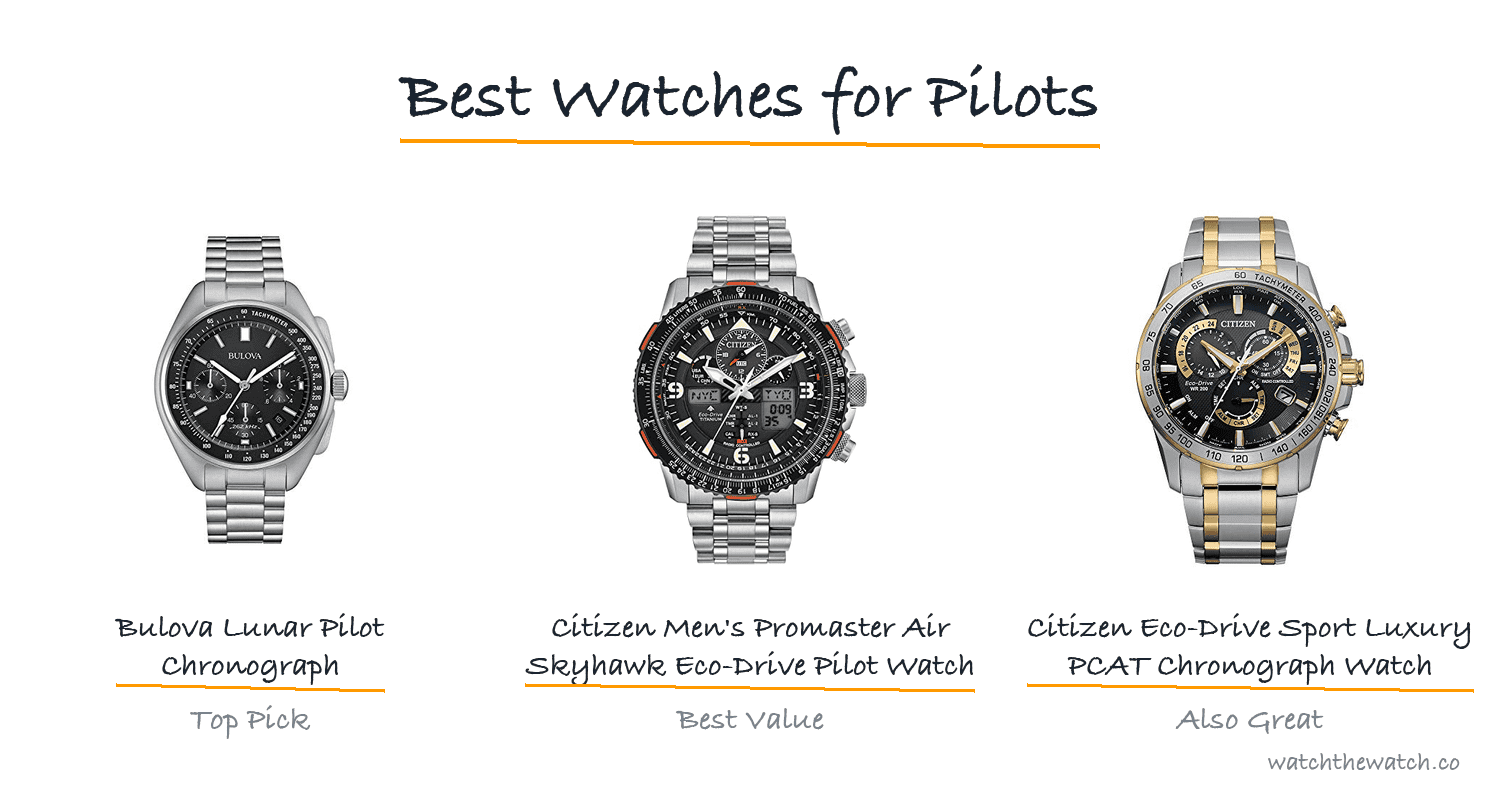
The best all-around pilot watch in 2026 is the Bulova Lunar Pilot Chronograph. It carries genuine astronaut heritage, runs a Swiss automatic movement, and gives you the bold dial legibility cockpit work demands.
Want the most accurate option instead? The Citizen Promaster Air Skyhawk Eco-Drive edges ahead on raw accuracy, with radio-controlled timekeeping and a functional slide rule bezel.
Commercial ATP or weekend VFR flyer, the picks below are chosen for what actually matters on the flight deck: legibility, precision, chronograph utility, and durability that survives real use.
Our top picks at a glance
The standouts from this guide — prices change, so tap through for the current price.
As an Amazon Associate, Watch The Watch earns from qualifying purchases at no extra cost to you. Some links go to other retailers. See our affiliate disclosure.
How We Picked
Pilot watches sit in a specific functional niche. A dress watch lives on aesthetics, a dive watch on its water rating. A genuine pilot watch earns its place by performing under pressure.
The enthusiast and aviation-community consensus on what a cockpit-worthy watch needs comes down to five core criteria:
- Dial legibility: High-contrast layout, uncluttered indices, and generous luminous coating for low-light conditions. A quick glance should give you the time, full stop.
- Chronograph functionality: Elapsed-time measurement for navigation legs, fuel burn intervals, and ATC holding patterns. Pushers should actuate cleanly, ideally with light gloves on.
- Precision timekeeping: Radio-controlled or atomic-synced movements are the modern gold standard. Every second of drift can translate to real navigational error at speed.
- Dual time zone or world time: Commercial and cross-country pilots need a reliable home-time reference on the wrist without fumbling through a phone.
- Durability: Solid case construction, scratch-resistant crystal, and at least 50m water resistance for a watch expected to survive years of active use.
Every watch below meets at least three of those five criteria. Where a pick earns its spot for design heritage or off-duty appeal rather than pure spec, as with the final entry, I say so plainly. Prices are rough mid-2026 online retail.
1. Bulova Lunar Pilot Chronograph — Best Pilot Watch Overall
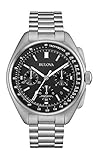
The Lunar Pilot’s credentials are not marketing copy. The original Bulova astronaut chronograph flew on Apollo 15, worn by David Scott. The modern reissue keeps that brief: a 46mm steel case, cathedral hands, a black anti-reflective dial, and a Swiss-made Valjoux 7750 automatic inside.
The 7750 is a workhorse caliber with real pedigree. It chronographs via a column wheel, gives you around 48 hours of power reserve, and a competent watchmaker can regulate it to respectable accuracy.
Owners on horological forums keep coming back to one thing: the dial’s instant readability. White hands on a deep black field, large Arabic numerals at the quarter-hours, a sweep seconds hand tracking clean hashmarks.
The onion-profile crown, lifted straight from the original pilot’s brief, works even without looking. At this price, nothing else in the pool matches its mix of heritage, movement, and cockpit-ready design. If you’ve ever wondered whether Bulova counts as luxury, this is the watch that complicates the question.
2. Citizen Promaster Air Skyhawk Eco-Drive — Best for Working Aviators
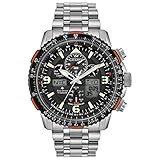
Here is what sets the Skyhawk apart: it’s the only watch here built specifically for aviation, not just inspired by it. The Eco-Drive solar movement charges off any light source and never needs a battery. For a pro who can’t risk a dead watch at preflight, that matters.
Multi-band radio control pulls atomic time signals from transmitters in the US, UK, Germany, Japan, and China. It self-corrects to within one second of UTC with no input from you.
The analogue slide rule bezel, a working circular slide rule borrowed from classics like the Breitling Navitimer, calculates airspeed, fuel burn, distance, and rate of descent without any electronics.
Aviation forums call it the “pilot’s pilot watch,” and the label fits. It solves real in-cockpit problems instead of just playing the part.
UTC display, a dual time zone hand, and a world time bezel round out a feature set that genuinely serves a working aviator. If the brand is new to you, the wider Citizen lineup rewards a closer look.
3. Citizen Eco-Drive PCAT Chronograph — Best for Atomic Precision

PCAT stands for Perpetual Calendar Atomic Timekeeping. In plain terms, it pairs radio-controlled correction with a perpetual calendar that handles leap years and daylight saving on its own.
If you cross time zones constantly and hate resetting a watch, the PCAT quietly does the work. It self-corrects whenever it catches a valid radio signal, and the Eco-Drive solar cell keeps it running with no battery to swap.
The chronograph covers the usual elapsed-time duties. The 43mm case sits a touch smaller than the Skyhawk or Lunar Pilot, so it slides from cockpit to office without shouting.
Daily-wear owners describe it the same way: it disappears, in the best sense. It’s simply correct, always, with no prompting.
4. Casio Edifice EQB-1000 — Best Connected Option

The Edifice EQB-1000 stacks three accuracy systems: Tough Solar charging, Multi-Band 6 atomic radio, and Bluetooth phone sync. It uses whichever signal it can get, radio tower, paired phone, or stored time data, to stay close to true time anywhere.
Fly somewhere with patchy radio reception and the Bluetooth fallback through the Casio Watches app picks up the slack. You also get world time across 39 timezones, a countdown timer, and a full start/stop/reset chronograph.
The all-metal case and integrated bracelet read like a business watch, not a G-Shock. The aviation crowd likes that: you can wear it to a ground briefing without looking out of place.
Owners rate the accuracy and the hands-off automation. The catch versus the Skyhawk is no slide rule bezel and a less aviation-flavored design.
5. Citizen Eco-Drive Brycen Chronograph — Best Entry-Level Pick

The Brycen is the easy entry point in Citizen’s sport chrono line: a no-fuss Eco-Drive movement, a clean sporty dial, 100m water resistance, and a solar cell that ends battery swaps for good.
No radio-controlled timekeeping like the Skyhawk or PCAT, and it doesn’t lean hard into aviation styling. What it gives you is an honest chronograph at a price student pilots can justify without flinching.
The dial reads clean, the pushers click with intent, and the Eco-Drive has years of owner reviews backing its reliability. If you already navigate off a tablet EFB and just want a trustworthy analogue chrono, the Brycen does the job, no extra cost or complexity.
6. Fossil Grant Chronograph — Best Off-Duty Style

Not every pilot wants a technical instrument strapped on after the flight deck. The Fossil Grant Chronograph borrows 1960s pilot-watch looks: applied baton indices, a sunray dial, well-spaced sub-registers, and a leather strap that reads smart-casual, not sporty.
The quartz chronograph is accurate and low-maintenance. It won’t sync to an atomic signal or calculate fuel burn, but it doesn’t need to. The Grant is a dress-adjacent piece for off-duty hours, and it nails that brief.
Owners call it their favourite everyday wear, mostly because it gives you pilot-watch language without the heft of a 46mm tool watch. At roughly $100–180, it’s the cheapest way onto this list.
Side-by-Side Comparison
| Watch | Case | Movement | Standout Pilot Feature | Approx. Price |
|---|---|---|---|---|
| Bulova Lunar Pilot Chrono | 46mm steel | Swiss auto (Valjoux 7750) | Astronaut heritage, max legibility | ~$450–600 |
| Citizen Skyhawk Eco-Drive | 46mm steel | Solar / radio atomic | Slide rule bezel, world time, atomic sync | ~$350–500 |
| Citizen PCAT Chronograph | 43mm steel | Solar / radio atomic | Perpetual calendar, atomic sync, chrono | ~$300–450 |
| Casio Edifice EQB-1000 | 45mm steel | Tough Solar + Bluetooth | Triple precision, world time, chrono | ~$250–350 |
| Citizen Brycen Chronograph | 42mm steel | Solar / Eco-Drive | Reliable chrono, 100m WR, solar | ~$200–280 |
| Fossil Grant Chronograph | 44mm steel | Quartz | Classic pilot aesthetic, off-duty wear | ~$100–180 |
What to Look For in a Pilot Watch
Legibility Is the Non-Negotiable Starting Point
Every design choice on a proper pilot watch comes from one demand: you must read the time at a glance, under stress, in bad light. High-contrast dials, black backgrounds with white or cream indices, cut the cognitive load. Big, clearly different hour and minute hands with proper lume keep it readable after dark.
Skip any pilot design that trades legibility for decorative complications. A cluttered dial is an anti-feature here, no matter how good it looks in the display case.
Movement Accuracy: Automatic vs. Solar vs. Atomic
Mechanical automatics, like the Valjoux 7750 in the Bulova, carry the romance of classic aviation instruments. Well-regulated, they typically run within ±15 seconds a day. That’s fine for most people, but short of what radio-controlled or atomic movements give you.
Solar Eco-Drive movements kill battery anxiety outright. Add atomic radio correction and the watch manages itself to sub-second accuracy with zero input.
If precise time is a job requirement, atomic is the right call. If you love mechanical craft and keep a phone or tablet nearby, a good automatic is perfectly defensible, and if you’re curious how long automatics last, the honest answer is decades with service.
Chronograph Pushers and Usability with Gloves
A chronograph is only as good as it is operable in the real world. Flush, recessed, or fiddly pushers turn frustrating the moment you’re wearing flight gloves or moving fast under pressure.
Enthusiasts want large, proud pushers with a positive click. The Bulova Lunar Pilot’s oversized crown and pushers get cited as the benchmark. Before you buy, think about how the watch will actually work in your hands: a chrono that’s lovely on a desk but fumbly in the field is a poor tool.
Case Size: Functional Large vs. Wearable Compromise
Classic pilot watches ran 45mm and up because the original brief assumed flight gloves and dials you could read without help. Modern pilots who want one watch for the cockpit and everyday life often land in the 42–44mm range instead.
The 46mm pieces here, the Lunar Pilot and Skyhawk, wear large on slimmer wrists. The 43mm PCAT and 42mm Brycen play better day to day. Neither call is wrong, but get a 46mm case on your wrist before buying if you’re not already a big-watch person.
Frequently Asked Questions
What features does a proper pilot watch need?
The aviation community lands on three non-negotiable features: high-contrast legibility (clear dial, luminous hands, uncluttered layout), a chronograph for elapsed time, and atomic or radio-corrected timekeeping for real accuracy. Useful extras include a second time zone, world time, and a slide rule bezel for VFR fuel and airspeed math. Decorative complications like moon phases or tourbillons are great on a dress watch and pointless for pilot function.
Are automatic or quartz movements better for pilots?
Quartz and radio-controlled movements keep better time on their own, which matters in aviation. Automatics drift ±10–25 seconds a day in normal service and need the occasional manual nudge. Most pros who own both wear an atomic-corrected watch in the cockpit and a mechanical piece off-duty.
For hobbyists and student pilots who keep a tablet EFB for precision, an automatic pilot watch is a perfectly valid, genuinely fun choice.
What is a slide rule bezel and do pilots still use it?
A slide rule (circular slide rule) bezel lets you do multiplication, division, and rate work, airspeed, fuel burn, wind correction, time-distance problems, mechanically, with no electronics. Glass cockpits and electronic flight bags handle most of that digitally now.
Plenty of VFR and student pilots still drill with one as a backup, especially around written and practical exams. The Citizen Promaster Air Skyhawk is the clearest modern watch keeping the feature genuinely functional at an affordable price.
Can pilots wear smartwatches in the cockpit?
It depends on the country and the airline. Many commercial carriers restrict or outright ban Bluetooth-enabled devices in the cockpit over avionics-interference concerns, and some name smartwatches specifically.
Traditional quartz, solar, and mechanical pilot watches carry no such restriction. If you fly commercially, check your airline’s ops manual before buying a Bluetooth piece like the Casio Edifice EQB-1000 for cockpit use. The same watch is fine off-duty.
What is the difference between a pilot watch and an aviation watch?
In most contexts they mean the same thing. Historically, “aviation watch” meant a precision instrument purpose-built for cockpit use, like early Longines navigators or pre-war IWC pilot’s watches.
“Pilot watch” today covers anything drawing its design or function from that heritage, including modern pieces like the Bulova Lunar Pilot that were never certified for commercial flight. The distinction has basically collapsed: both labels now mean watches built around legibility, precision, and timing over decoration.

Daniel Hart is the editor of Watch The Watch. He researches and writes the site’s buying guides, brand comparisons, and explainers, focused on accessible, enthusiast-level watches — affordable automatics, divers, field and dress watches, everyday quartz, and the straps, winders and tools that go with them. The goal is practical, budget-aware advice that helps readers choose the right watch for their wrist and their budget. Recommendations draw on manufacturer specifications and the wider enthusiast community.