
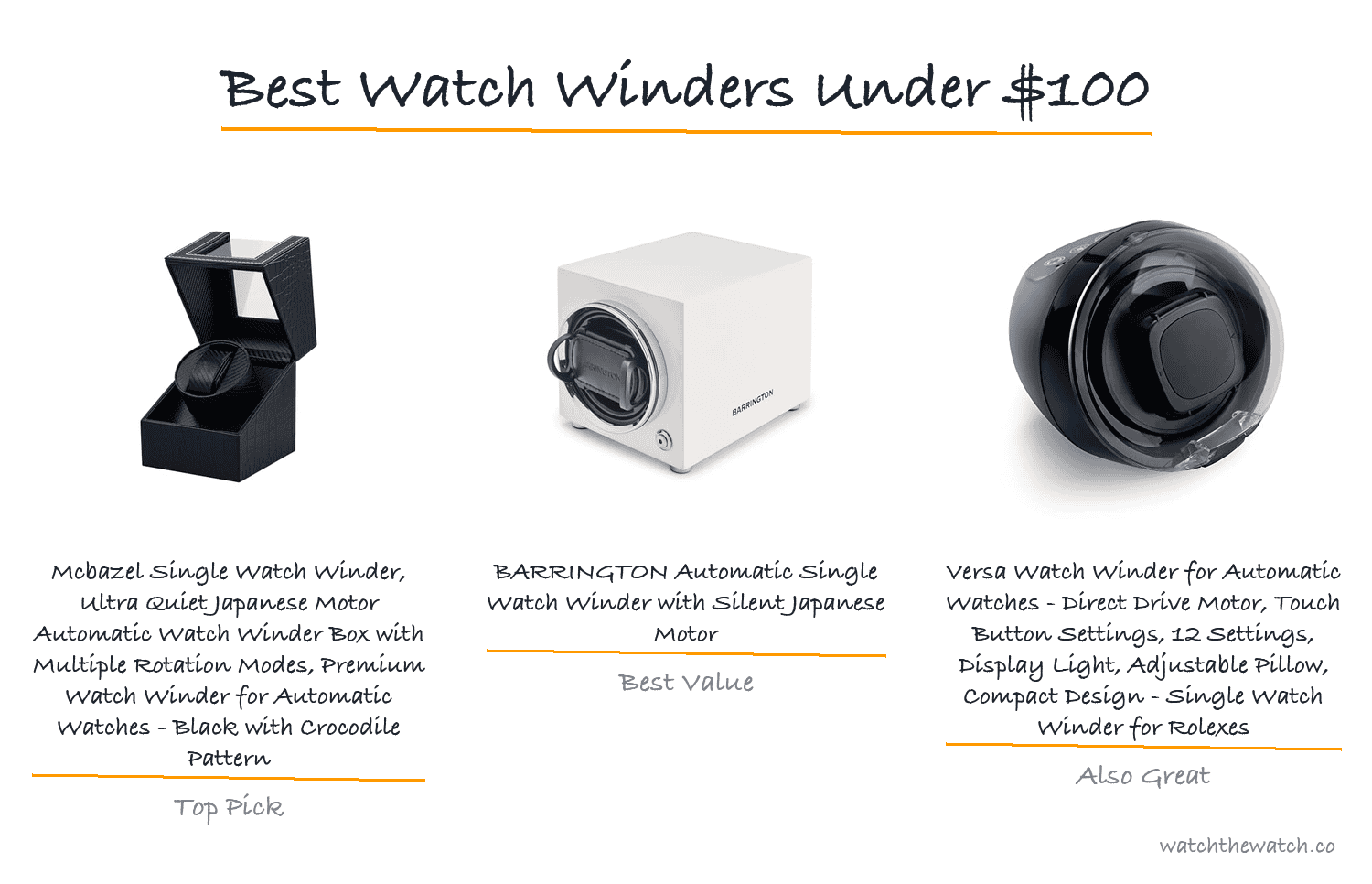
If you have under $100 to spend, the Mcbazel single and the Barrington single are the two I’d point you at first. Both run ultra-quiet Japanese motors, both cost well under $60, and both cover the TPD ranges that Seikos, ETA-movement Swiss watches, and most entry-level Rolex-compatible automatics actually need.
Here is the honest part: you do not need to spend $200 on a Wolf or Orbita to protect a mid-range automatic. The sub-$100 category has grown up.
Quiet, consistent winding in the right direction at the right turns-per-day rate is the whole job, and that job is fully doable on a tight budget now.
Our top picks at a glance
The standouts from this guide — prices change, so tap through for the current price.
As an Amazon Associate, Watch The Watch earns from qualifying purchases at no extra cost to you. Some links go to other retailers. See our affiliate disclosure.
How We Picked
The under-$100 market is mostly single-watch units, plus a handful of entry-level quads. To sort the useful ones from throwaway white-label boxes, we filtered on four things:
- Motor quality: Japanese-sourced motors run measurably quieter and last longer than generic alternatives. If the winder lives in a bedroom, this is the single most important spec to verify.
- Rotation modes: A winder must cover clockwise, counter-clockwise, and alternating directions with selectable TPD settings — not just a fixed-speed one-direction spin.
- Power flexibility: AC-only is fine for a dedicated desk spot; AC-plus-battery opens up travel use and display cabinets without mains access.
- Pillow fit range: The watch pillow needs to accommodate cases from around 38mm dress watches to 44mm-plus sport watches. Adjustable pillows are a meaningful differentiator at this price.
We threw out anything with repeated motor-noise complaints across review batches, plus generic drop-shipped units with no real brand behind them.
Want the bigger picture on how winders work and where budget ends and premium begins? Our guide to the best watch winders for automatic watches covers it.
The 6 Best Watch Winders Under $100
1. Mcbazel Single Watch Winder — Best Overall Value
The Mcbazel takes the top spot because it nails the three things that actually matter here: a real ultra-quiet Japanese motor, dual power (mains adapter or four AA batteries), and selectable rotation modes. All for around $35.
Owners report near-silent operation even on a hard nightstand, and the crocodile-pattern leatherette looks a lot pricier than it is.
The AC-plus-battery flexibility is the part most rivals skip at this price. It is equally happy on a dresser or tucked into a travel case.
2. Barrington Single Watch Winder — Best Build Quality Under $100

Barrington sits in a genuine middle tier, above the budget brands and below the luxury names, and you can feel it in the finish.
The interior cushioning and the enclosure are clearly a cut above the generic competition. The silent Japanese motor lives up to the name, too. Forum consensus: it runs quieter than just about anything at this price.
At around $50 it is the most you will spend in this guide. For a single daily-driver automatic, though, it is about as good as the sub-$100 bracket gets.
3. Versa Single Watch Winder — Best for Larger Cases and Rolex-Compatible Settings

The Versa single has been around long enough to build a steady owner consensus. The direct-drive motor holds up, the touch-button interface makes sense on the first try, and 12 rotation settings cover essentially every mainstream automatic.
The adjustable watch pillow is the real differentiator. It seats larger-cased sport watches that rigid-pillow budget winders fight with.
The built-in display light is more of a nice-to-have for shelf or cabinet display than a headline feature, but owners like having it.
4. MOZSLY Watch Winder — Best Minimalist Budget Pick

At around $30, the MOZSLY is the cheapest pick here, and it earns its slot with 12 rotation modes, more than enough for any mainstream automatic, wrapped in clean black leather that looks fine on a dresser.
Motor noise is the catch. It is acceptable, not exceptional, with owners calling it quiet enough for daytime but a step below the Japanese-motor units above.
For a second watch or a guest automatic that does not need the premium treatment, it is reliable value.
5. Heiden Quad Watch Winder — Best Multi-Watch Value

The Heiden quad is the most capable multi-watch option under $100, mostly because of one thing: per-bay motor control.
That matters more than it sounds if your watches have different TPD needs, which is common the moment you pair a Seiko NH35 with an ETA 2824.
The black leather exterior is well finished for the category, and at around $70 it is the only quad here that competes on build quality rather than just price. Own three or four automatics and want one tidy solution? This is the pick.
6. Versa Quad Watch Winder with Light — Best Quad for Display
The Versa quad adds built-in LED display lighting for around $80. That is the one to get if your winder lives on an open shelf or behind glass, where the watches are part of the room.
Versus the Heiden, the trade-off is mostly price. The extra $10 buys you the lighting, not a better motor or build.
Rotation coverage and reliability track Versa’s single-unit record, so it is a safe quad if the look earns the premium for you.
Head-to-Head Comparison
| Model | Capacity | Motor Type | Power | Rotation Modes | Approx. Price |
|---|---|---|---|---|---|
| Mcbazel Single | 1 watch | Japanese (ultra-quiet) | AC + battery | Multiple | ~$35 |
| Barrington Single | 1 watch | Japanese (silent) | AC | Standard | ~$50 |
| Versa Single | 1 watch | Direct drive | AC | 12 | ~$45 |
| MOZSLY | 1 watch | Quiet motor | AC | 12 | ~$30 |
| Heiden Quad | 4 watches | Per-bay motors | AC | Adjustable | ~$70 |
| Versa Quad | 4 watches | Standard | AC | Multiple | ~$80 |
What to Look For in a Watch Winder Under $100
Motor noise is the defining variable at this price
Motor quality is the single biggest differentiator in this bracket. It drives both long-term reliability and whether you can stand having it in the room.
Japanese-sourced motors, the ones Mcbazel and Barrington call out by name, run measurably quieter and survive more winding cycles than the generic units in cheaper boxes.
Quick trick before you buy: sort the Amazon reviews by lowest rating and search for “noise,” “hum,” or “loud.” Three or more recent complaints about sound is a red flag I’d take seriously.
Turns per day and direction settings
Every automatic movement has a recommended TPD (turns per day) range, usually somewhere between 650 and 1,800 rotations.
A winder stuck on one direction or one fixed speed is a liability. It can over-wind watches with high-efficiency rotors, or under-wind the ones that need more daily motion.
Look for clockwise, counter-clockwise, and alternating (bi-directional) modes with at least three TPD settings. The 12-mode units in this guide cover all the mainstream movements without making you think about calibration.
Single versus quad at this price
Quad winders under $100 come with real engineering compromises: thinner enclosures, shared motor buses, and looser per-watch TPD control.
If you own two automatics, two good singles at $35–50 each often beat one quad at $80.
The Heiden is the exception, it gets closest to true per-bay control for the money. But the general rule holds: go single for one or two watches, save the quad format for three or four.
Do you actually need a watch winder?
A winder earns its keep when you rotate between automatics and do not wear each one at least three or four days a week.
If you are a daily wearer, skip it. The watch winds itself through normal wrist motion.
Where a winder genuinely pulls its weight is keeping the lubricants inside a movement from pooling or congealing during long storage, a real worry for pieces left idle for weeks and a factor in how long an automatic lasts.
For a multi-watch collector, a winder counts as basic maintenance, not an indulgence.
Frequently Asked Questions
Are budget watch winders safe for automatic movements?
Yes, as long as the winder gives you proper direction and TPD selection.
The danger with a dirt-cheap fixed-speed, single-direction unit isn’t a broken movement. Modern automatics have a slipping clutch precisely to stop the mainspring over-tensioning.
Run it at the wrong TPD all day, though, and you are constantly engaging that clutch, which adds needless wear over time. Stick to CW/CCW/alternating modes with adjustable TPD and any standard automatic will be fine.
What TPD setting should I use for my watch?
Check the movement maker’s spec first when you can. Failing that, here are reliable defaults.
Seiko’s NH-series movements usually want 650–800 TPD; ETA 2824 and 2892 movements do well at 650–900 TPD.
Rolex calibres like the 3135 and 3235 are generally happy at 650–800 TPD in alternating mode. When you cannot find the spec at all, 650–800 TPD alternating is a safe starting point for just about any mainstream automatic.
Is the Barrington worth paying more than the Mcbazel or MOZSLY?
For your primary, everyday watch? Yes. The Barrington’s interior quality and motor silence are a real step up.
The $15–20 premium over the Mcbazel is small for something that will run every day for years.
Winding a secondary or rotation piece that isn’t your crown jewel? The Mcbazel at $35 or the MOZSLY at $30 are completely fine, since the core winding job is identical.
Can I use one of these winders for a Rolex?
Yes. The Rolex calibre family (3130, 3135, 3235) winds bi-directionally and works with any winder that offers an alternating mode at a moderate TPD.
The Versa single is openly marketed as Rolex-compatible and has a big owner base among entry-level Rolex sports owners who want something budget-appropriate.
You will not get the suede interior of a Wolf or Orbita at this price. The winding function, though, is mechanically identical.
How loud are budget watch winders at night?
It varies a lot by model. The Japanese-motor units, the Mcbazel and Barrington, are routinely described as near-inaudible in a quiet bedroom, about on par with a phone charger’s hum.
Generic-motor winders can put out a low, rhythmic whirr, especially on hard wooden surfaces that amplify the vibration.
If it is going in a bedroom, stick to units that explicitly use Japanese motors and read the one-star reviews for noise mentions before you commit.

Daniel Hart is the editor of Watch The Watch. He researches and writes the site’s buying guides, brand comparisons, and explainers, focused on accessible, enthusiast-level watches — affordable automatics, divers, field and dress watches, everyday quartz, and the straps, winders and tools that go with them. The goal is practical, budget-aware advice that helps readers choose the right watch for their wrist and their budget. Recommendations draw on manufacturer specifications and the wider enthusiast community.