
Daniel Hart · ·
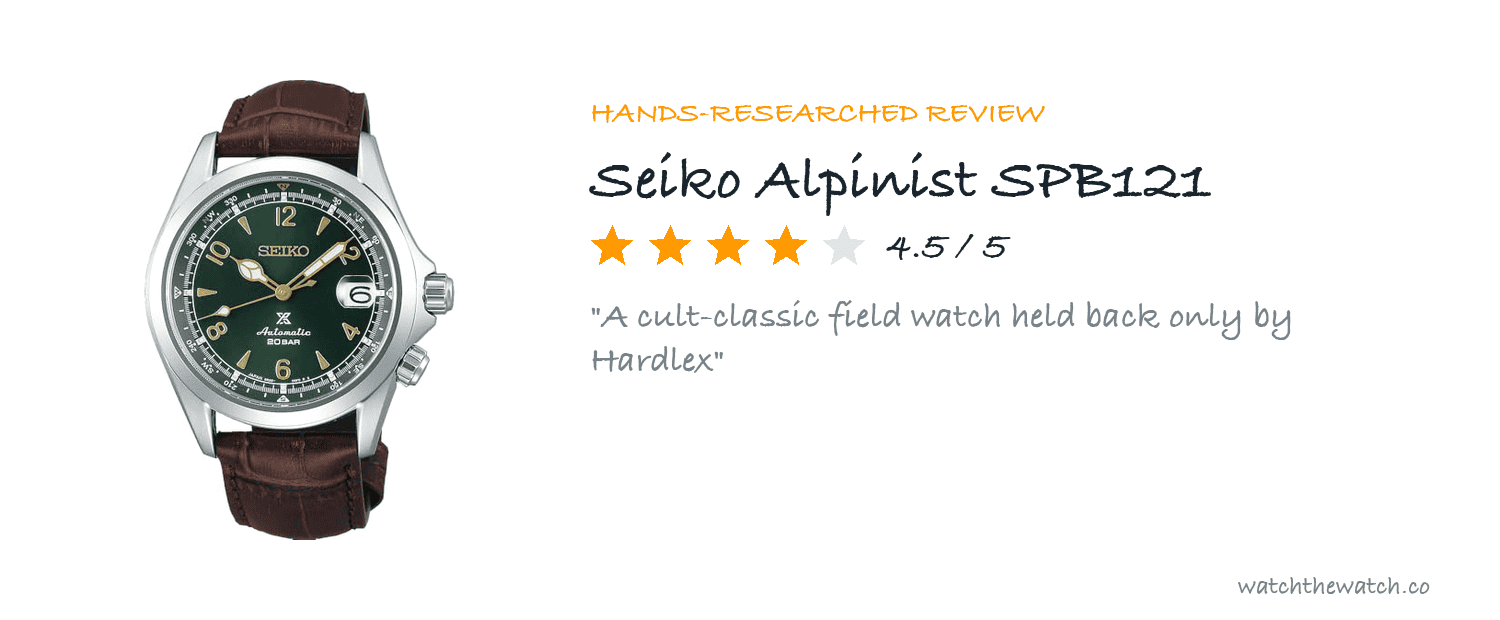
The Seiko Alpinist SARB017 is one of those watches that enthusiasts talk about in almost reverent tones, and for once the hype is earned. It is a 38mm Japanese-market field watch with a deep green sunburst dial, gold cathedral hands, an inner rotating compass bezel, and the well-regarded 6R15 automatic movement. It became a genuine modern cult classic, the kind of watch that turned thousands of newcomers into lifelong Seiko people.
There is one thing you need to know before you fall in love: the SARB017 is discontinued and no longer made by Seiko. Prices on the used market climbed steadily after it was dropped, and clean examples are not cheap anymore. If you want this exact look today, the practical route is its spiritual successor.
That successor is the Seiko Alpinist SPB121, which keeps the green dial, cathedral hands, and compass bezel while upgrading the crystal and movement. My headline verdict: the SARB017 is a near-perfect “one watch” charmer held back only by its dated Hardlex crystal — and the SPB121 is how most people should buy into the family now.

Quick verdict
The SARB017 is for the person who wants one characterful, do-everything automatic with real heritage and a dial that rewards a second look. It punches far above its original price on charm, finishing, and wearability. If you can find a clean one at a fair number, buy it; if not, the SPB121 gives you the same DNA with sapphire and a longer power reserve.
Specifications
| Spec | Detail |
|---|---|
| Case diameter | 38mm |
| Lug-to-lug | ~47mm |
| Thickness | ~12mm |
| Lug width | 20mm |
| Movement | Seiko 6R15 automatic (hacking, hand-winding) |
| Power reserve | ~50 hours |
| Crystal | Curved Hardlex (mineral) |
| Water resistance | ~200m (20 bar) |
| Lume | LumiBrite on hands and markers |
| Bezel | Internal compass ring, crown-operated at 2 o’clock |
| Strap | Brown leather (original equipment) |
Design and build
The Alpinist’s whole personality lives in the dial. The green sunburst shifts from near-black in shade to a rich forest green in sunlight, and the gold-tone cathedral hands and applied markers play off it beautifully. It is dressy and rugged at the same time, which is a genuinely hard trick to pull off.
The inner compass bezel, turned by the second crown at 2 o’clock, is more charm than survival tool, but it gives the watch its identity. Case finishing is excellent for the class, with a polished-and-brushed 38mm case that feels more expensive than it was.
The one real weak point is the crystal. The SARB017 uses curved Hardlex, Seiko’s proprietary mineral glass, rather than sapphire. It is reasonably tough but scratches more easily than the sapphire you would expect at this level today, and it is the single most common upgrade owners make.
Movement and accuracy
Inside is the 6R15, a workhorse automatic that hacks and hand-winds and carries roughly a 50-hour power reserve. For its tier it is a known, reliable, easily serviced movement that earned its good reputation honestly.
Be realistic about accuracy. Seiko’s official spec for the 6R15 is roughly +25 to -15 seconds per day, which is well behind a Swiss chronometer. In practice many owners report their watches settling somewhere in the single digits to low teens of seconds per day after wearing in.
If you need true precision, this is not a chronometer-grade instrument and was never priced like one. What it offers instead is dependable, regulate-able mechanical timekeeping that will run for years with basic care.
On the wrist
This is where the SARB017 wins people over. At 38mm with a lug-to-lug of around 47mm and a modest ~12mm thickness, it sits comfortably on a wide range of wrists, from genuinely small to medium-large.
It slips under a cuff, works with a suit, and looks just as right on a leather strap with jeans. The 20mm lugs make strap swaps easy, and the watch takes well to NATOs, suede, and rally straps if the stock leather is not your style.
If you have a large wrist and only ever wear chunky watches, 38mm may read small to you. For most people, though, this is close to the textbook everyday case size.
Pros and cons
- Stunning green sunburst dial with real depth and character
- Versatile 38mm sizing that suits most wrists
- Reliable, serviceable 6R15 automatic with ~50h reserve
- Distinctive compass bezel and cathedral hands give it true identity
- Strong finishing and heritage for the money
- Hardlex crystal instead of sapphire, the most-cited flaw
- Discontinued, so prices and availability are now buyer-beware
- Accuracy spec is modest for the segment
- Gold accents and green dial are polarizing for some tastes
- Compass bezel is more fun than function
Alternatives to consider
The most obvious alternative is the Seiko Alpinist SPB121 itself, the direct successor, which adds sapphire, the longer-running 6R35 movement, and a bracelet option while keeping the look. If you love the field-watch idea but want something cleaner and tougher, the Hamilton Khaki Field Mechanical or Automatic offers no-nonsense legibility and a slimmer profile. And if you want the dressy-rugged balance with in-house chronometer accuracy at a higher price, the Tissot Gentleman Powermatic 80 Silicium is worth a look.
Frequently asked questions
Is the Seiko Alpinist SARB017 still in production?
No. Seiko discontinued the SARB017, so new examples are no longer made. You will only find it on the used market, where prices have risen, which is why the modern SPB121 is the practical way to get the same look today.
What is the difference between the SARB017 and the SPB121?
The SPB121 is the modern successor with the same green dial, cathedral hands, and compass bezel. The big upgrades are a sapphire crystal instead of Hardlex and the 6R35 movement with a longer roughly 70-hour power reserve. The SPB121 is also slightly larger and comes with a bracelet option.
Does the SARB017 use sapphire crystal?
No, it uses curved Hardlex mineral glass. It holds up reasonably well but is more scratch-prone than sapphire, and swapping in an aftermarket sapphire is one of the most popular owner modifications.
Is 38mm too small for a modern watch?
For most wrists, 38mm is a comfortable, versatile size that dresses up or down easily. If you specifically prefer larger watches, the slightly bigger SPB121 may suit you better while keeping the same Alpinist character. Related reading here: where Seiko actually sits and the Seiko NH35 movement.

Daniel Hart is the editor of Watch The Watch. He researches and writes the site’s buying guides, brand comparisons, and explainers, focused on accessible, enthusiast-level watches — affordable automatics, divers, field and dress watches, everyday quartz, and the straps, winders and tools that go with them. The goal is practical, budget-aware advice that helps readers choose the right watch for their wrist and their budget. Recommendations draw on manufacturer specifications and the wider enthusiast community.

