
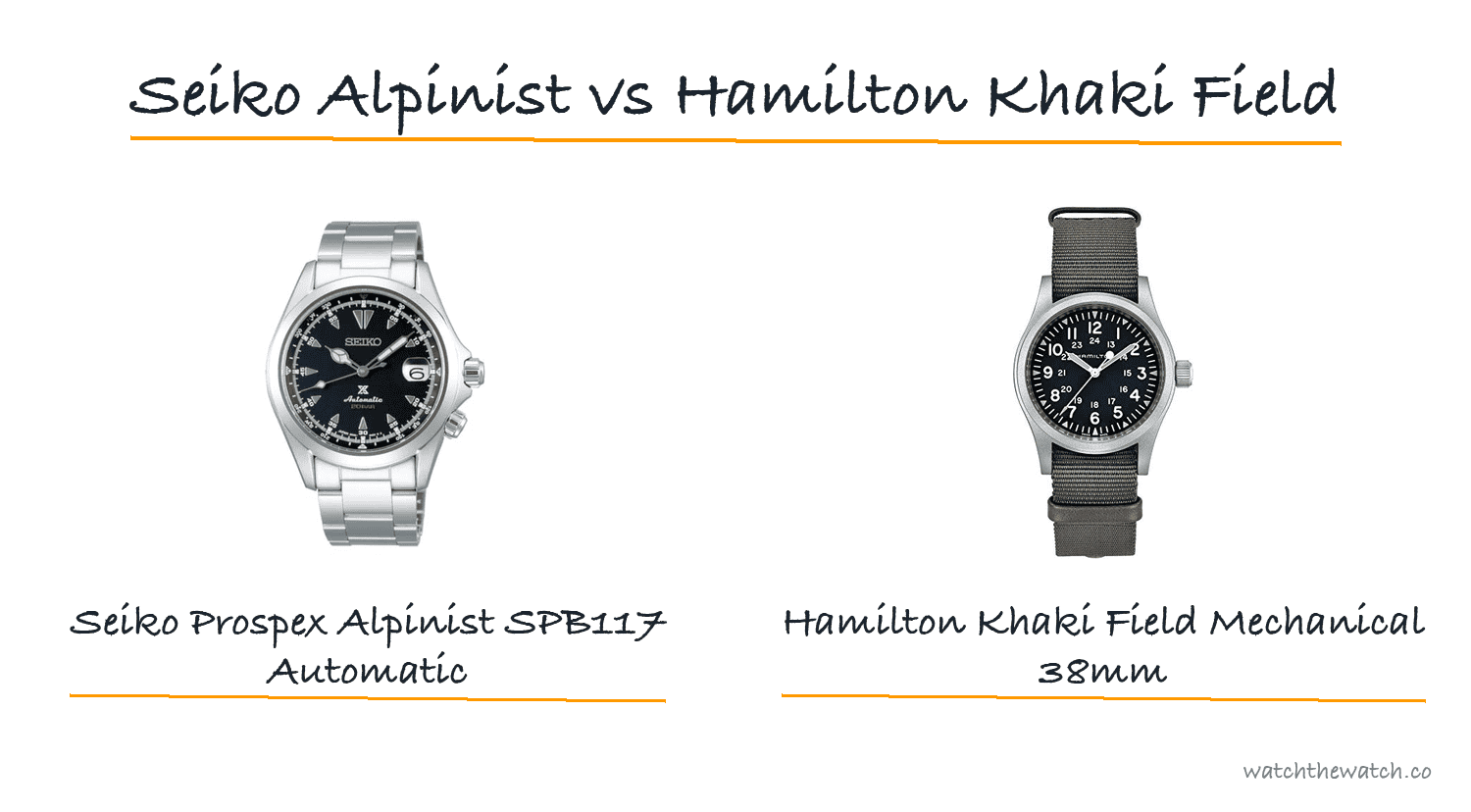
The Seiko Prospex Alpinist SPB117 and the Hamilton Khaki Field Mechanical share the same 38mm footprint. But they are built for completely different buyers.
The Alpinist is a mountain-tool watch: a self-winding 6R35 automatic, 200m water resistance, and an inner rotating compass bezel. It usually sells for around $550–650.
The Hamilton is a hand-wound Swiss field watch with military DNA and 80 hours of power reserve. You can usually find it for around $220–270.
If you want technical capability and an icon, go Seiko. If you want the best mechanical field watch under $300 with a hand-winding ritual, the Hamilton makes the stronger value case.


Side-by-Side Spec Comparison
| Specification | Seiko Alpinist SPB117 | Hamilton Khaki Field Mech |
|---|---|---|
| Case diameter | 38mm | 38mm |
| Case material | Stainless steel | Stainless steel |
| Movement type | Automatic (self-winding) | Manual hand-wind |
| Calibre | Seiko 6R35 | Hamilton H-50 |
| Power reserve | 70 hours | 80 hours |
| Water resistance | 200m | 50m |
| Crystal | Sapphire | Sapphire |
| Lug width | 20mm | 20mm |
| Crown position | 4 o’clock | 3 o’clock |
| Special feature | Inner rotating compass bezel | Military Arabic numeral dial |
| Typical price | ~$550–650 | ~$220–270 |
Size and Wearability
At 38mm, both sit at the smaller end of modern sizing. That suits wrists under roughly 7 inches well, and it has come back into fashion as the oversized trend fades.
On paper the sizes are identical. In practice they wear differently. The Alpinist carries more visual mass: the domed sapphire crystal, layered dial, and inner bezel add depth that makes it read closer to 40mm on the wrist.
The Hamilton’s dial is flatter and more open. It has a classic, understated presence that the busier Alpinist trades away for character.
Both use a 20mm lug width, so strap swaps are easy and the aftermarket selection is huge. The Alpinist ships with a leather strap and a rubber sports strap; the Hamilton comes on canvas or leather depending on the variant.
Neither is bulky under a shirt cuff. If you wear formal clothes often, the Seiko’s slightly greater thickness is the one thing worth a second thought.
Movement: Automatic vs Hand-Wind
This is the biggest functional split between the two. The Seiko Alpinist SPB117 runs Seiko’s in-house 6R35 calibre, a self-winding automatic that winds via a rotor as you wear it.
It hacks, the seconds hand stops when you pull the crown, so you can set the time precisely. It also takes a hand-wind if it has sat depleted.
A full 70-hour charge covers a long weekend off the wrist and is still ticking Monday morning, which is what makes the automatic genuinely low-maintenance. If you want the mechanical detail, the 6R35 movement is worth a read.
The Hamilton H-50 is a different philosophy. It is derived from the ETA 6497 pocket watch movement, hand-wound, with no rotor at all.
You wind it each morning, or every other morning given the 80-hour reserve, and that small ritual becomes part of owning it. What gets me is how many owners on forums cite the winding, not the looks, as the thing they love.
The tactile feedback of a pure mechanical movement connects you to the watch in a way an automatic never does. The 80-hour reserve is among the longest at this price; wind it Sunday evening and it runs through Wednesday.
Want to strap on a watch and forget about it? Then the Seiko wins, no pun intended.
Drawn to the ritual of hand-winding instead? Then the Hamilton’s H-50 is the more engaging movement at this price.
Legibility and Lume
The Hamilton Khaki Field is one of the most legible watches under $300. Big Arabic numerals, high-contrast printing, and an uncluttered dial make the time readable instantly, at a glance or in a moving vehicle.
That is exactly what a field watch is for. The Seiko’s dial says more, compass markings on the inner bezel, applied indices, a textured green face, but it asks more of your eyes.
At night or in low light, those inner-bezel markings can turn into visual noise. It is the price the Alpinist pays for being interesting.
On lume, the Seiko pulls clearly ahead. Its LumiBrite compound is one of the brightest in the sub-$700 segment, and owners report a strong glow well over an hour after exposure.
The Hamilton’s lume works, but enthusiast consensus rates it below LumiBrite in both brightness and how long it lasts. If you need reliable overnight legibility, that gap actually matters.
Value and Brand Context
At roughly double the Hamilton’s price, the Alpinist SPB117 has to justify the premium. It mostly does.
You get an automatic movement (much harder to make than a hand-wind), 200m water resistance against 50m, stronger lume, and six decades of design heritage. Whether that adds up to luxury is its own debate, and I dig into whether Seiko counts as luxury separately.
The first Alpinist arrived in 1959. The cult SARB017 built the legend before it was discontinued, and the SPB117 is Seiko’s modern reissue of that line.
That history carries real weight with collectors and props up secondary-market value. If you are still shortlisting, my roundup of the best Seiko watches puts it in context.
The Hamilton sits at a lower price tier, but not a lower pedigree tier. Hamilton is a real Swiss watchmaker, part of the Swatch Group, built in Biel, Switzerland; the “Swiss Made” on the dial is earned.
For anyone new to mechanical watches, the Khaki Field Mechanical is one of the most cited entry points on forums. It hands you Swiss manufacture, a well-regarded hand-wind movement, and real military looks for around $250.
That is hard to argue with. At this money, I struggle to name a field watch that does the basics better.
Choose the Seiko Alpinist SPB117 If…
- You want a watch that functions as a genuine outdoor tool — 200m water resistance handles swimming, snorkelling, and heavy rain without concern
- You prefer an automatic movement that winds itself with daily wear and requires no active management
- The Alpinist’s design heritage and collector cachet matter — this is a watch with a genuine story dating to 1959
- You want LumiBrite lume performance that genuinely works in dark environments for extended periods
- You’re buying for long-term daily wear and want Seiko’s established reliability and global service network behind the purchase
Choose the Hamilton Khaki Field Mechanical If…
- You want the best mechanical field watch under $300 with a legitimate Swiss manufacturing pedigree and “Swiss Made” on the dial
- Hand-winding appeals to you — the H-50’s 80-hour reserve is practically generous and the winding experience is genuinely satisfying
- Dial legibility is your top priority; the military Arabic numeral layout is exceptional and largely unmatched at this price
- Budget matters and the $300–400 difference could be redirected toward a second watch, a quality strap, or a service fund
- You want a versatile, understated dress-field hybrid that transitions from hiking trail to business-casual without drawing attention
Verdict
The Seiko Alpinist SPB117 is the more capable watch on paper: better water resistance, an automatic movement, stronger lume, and genuine collector standing.
It earns its premium if those features match how you actually use a watch. For one watch that handles both adventure and daily wear, it is hard to fault, and the enthusiast consensus backs that up: one of the most well-rounded 38mm watches at its price.
The Hamilton Khaki Field Mechanical punches well above its price. Swiss Made, well-built, very legible, and running an 80-hour hand-wind from a respected lineage.
For a first mechanical watch, or a deliberate second one, it is hard to beat at around $250.
Buy the Alpinist if you can afford it comfortably and want the full package. Buy the Hamilton if budget leads, you value hand-winding, or you just want the most legible field dial under $300.
Either way, you are getting a watch built to outlast a decade of daily wear. Neither choice is a mistake.
Frequently Asked Questions
Is the Seiko Alpinist SPB117 automatic or hand-wind?
The SPB117 is automatic, powered by Seiko’s in-house 6R35 calibre, with a rotor that winds the mainspring as you wear it. It also accepts manual hand-winding when run down, and it hacks (the seconds hand stops when you pull the crown) for accurate setting. Power reserve is 70 hours.
What movement is in the Hamilton Khaki Field Mechanical?
It uses the H-50 calibre, derived from the ETA 6497 pocket watch movement. It is hand-wound only, with no rotor and no automatic winding. The 80-hour reserve is one of the longest at this price; a full wind covers roughly three days before it needs attention.
How water resistant is the Hamilton Khaki Field Mechanical?
The Hamilton is rated to 50m. That covers rain, splashes, and hand-washing, but not swimming or submersion. If water is a regular part of your life, the Seiko Alpinist at 200m is the right call.
Is the Seiko Alpinist SPB117 worth twice the price of the Hamilton Khaki Field?
It depends on which features you will actually use. The Seiko gives you an automatic movement, 200m water resistance, and stronger lume, real advantages if you need them. If your reality is desk wear, the odd hike, and no water, the Hamilton covers it for half the money.
Which watch has better lume — Seiko Alpinist or Hamilton Khaki Field?
The Seiko Alpinist SPB117 has clearly better lume. Its LumiBrite compound is among the brightest and longest-lasting in the sub-$700 market, with owners reporting a strong glow well beyond an hour after exposure. The Hamilton’s lume is fine for short low-light reading, but enthusiasts rate it lower in both brightness and duration.

Daniel Hart is the editor of Watch The Watch. He researches and writes the site’s buying guides, brand comparisons, and explainers, focused on accessible, enthusiast-level watches — affordable automatics, divers, field and dress watches, everyday quartz, and the straps, winders and tools that go with them. The goal is practical, budget-aware advice that helps readers choose the right watch for their wrist and their budget. Recommendations draw on manufacturer specifications and the wider enthusiast community.