Daniel Hart · ·
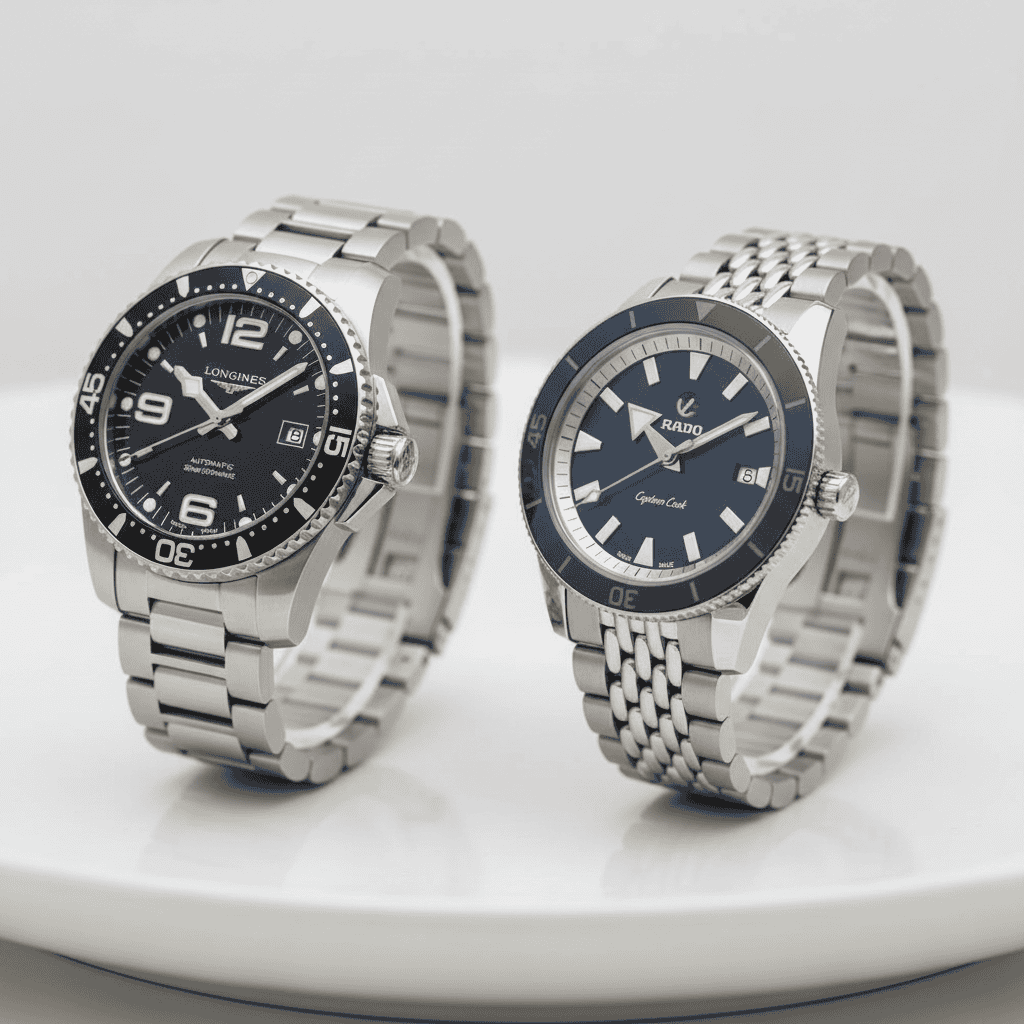
These two brands share a parent, a movement supplier and a price bracket, and almost nothing else.
Longines sells watchmaking: exclusive calibres, an archive going back to 1832, classical proportions. Rado sells a material, and spends its engineering budget on ceramic instead of movements.
Both arguments are legitimate, and they suit completely different buyers.
The short answer
Same group, opposite bets
Swatch Group owns both, along with Omega, Tissot, Hamilton and the movement maker ETA. Rado joined in 1998; Longines has been in the group for decades.
Longines gets ETA calibres developed exclusively for it, several with silicon balance springs, and warranties self-winding watches for five years. Rado draws on the same industrial base but puts its differentiation into high-tech ceramic.
Fuller takes are in the Longines guide and the Rado guide.
Head to head
Rado publishes the material numbers on its own Art of Ceramic pages: around 1250 HV on the Vickers scale, up to five times harder than stainless steel, and about thirty percent lighter.
The practical consequence is that a ceramic Rado looks essentially new after years of wear that would leave a steel watch dull. Colour is also blended into the material rather than plated, so there is nothing to wear through.
Longines answers with movement pedigree and a deeper archive. Both fit sapphire crystal, so the crystal is a wash.
| Longines HydroConquest | Rado Captain Cook | |
|---|---|---|
| Group | Swatch Group | Swatch Group |
| Sells | Movement and archive | Material |
| Movement | ETA calibre exclusive to Longines | Automatic, Swatch Group supply |
| Crystal | Sapphire | Sapphire |
| Signature | Exclusive calibres, 1832 archive | High-tech ceramic, about 1250 HV |
| Price | About $1,600 | About $1,980 |
The trade-off nobody mentions
Ceramic is hard but brittle. It resists scratching far better than steel and tolerates sharp impact considerably worse, so the failure mode is a chip rather than a dent.
A chipped ceramic component is a replacement rather than a polish, and replacements flow through authorised service. That makes buying from an authorised dealer matter more with Rado than with most brands.
Longines has the more forgiving failure mode: steel marks, then gets polished. It is the safer choice if the watch will lead a rough life.
Which to buy
Longines if you want the more complete watch. The HydroConquest is the better value of the two and the movement story is the stronger one.
Rado if you are hard on finishes and hate seeing a watch age. Nothing else at this price keeps its surface the way ceramic does, and that is a practical benefit rather than a talking point.
Buy either from an authorised dealer. In this bracket manufacturer warranties are registered at the point of sale, so unauthorised marketplace purchases usually carry only the seller’s own cover.
The three to consider
One from each brand plus the Rado that actually showcases the material. Check the seller is authorised.


As an Amazon Associate, Watch The Watch earns from qualifying purchases at no extra cost to you. See our affiliate disclosure. Our Swatch Group guide covers the parent both brands share, and our white ceramic guide covers the material Rado built its identity on.
Frequently asked questions
Are Longines and Rado owned by the same company?
Yes, both belong to Swatch Group, which also owns Omega, Tissot, Hamilton, Certina, Mido and the movement maker ETA.
Is Rado ceramic really more scratch resistant?
Yes. Rado states about 1250 HV on the Vickers scale, up to five times harder than stainless steel. The trade-off is brittleness: ceramic chips where steel dents.
Which has the better movement?
Longines, in the sense that its calibres are developed by ETA exclusively for it and several use silicon balance springs. Rado draws on the same group supply without the same exclusivity story.
Which is better value?
Longines, on price and movement pedigree. Rado wins if keeping a pristine finish for years is worth more to you than the calibre.
Do both use sapphire crystal?
Yes, sapphire is standard across both mechanical ranges, so crystal hardness is not a differentiator between them.
The verdict
Same group, same crystal, same shelf, and two completely different products underneath.
Longines is the better watch and Rado is the better-looking watch in five years. Pick the axis you actually care about.

Daniel Hart is the editor of Watch The Watch. He researches and writes the site’s buying guides, brand comparisons, and explainers, focused on accessible, enthusiast-level watches — affordable automatics, divers, field and dress watches, everyday quartz, and the straps, winders and tools that go with them. The goal is practical, budget-aware advice that helps readers choose the right watch for their wrist and their budget. Recommendations draw on manufacturer specifications and the wider enthusiast community.