Daniel Hart · ·
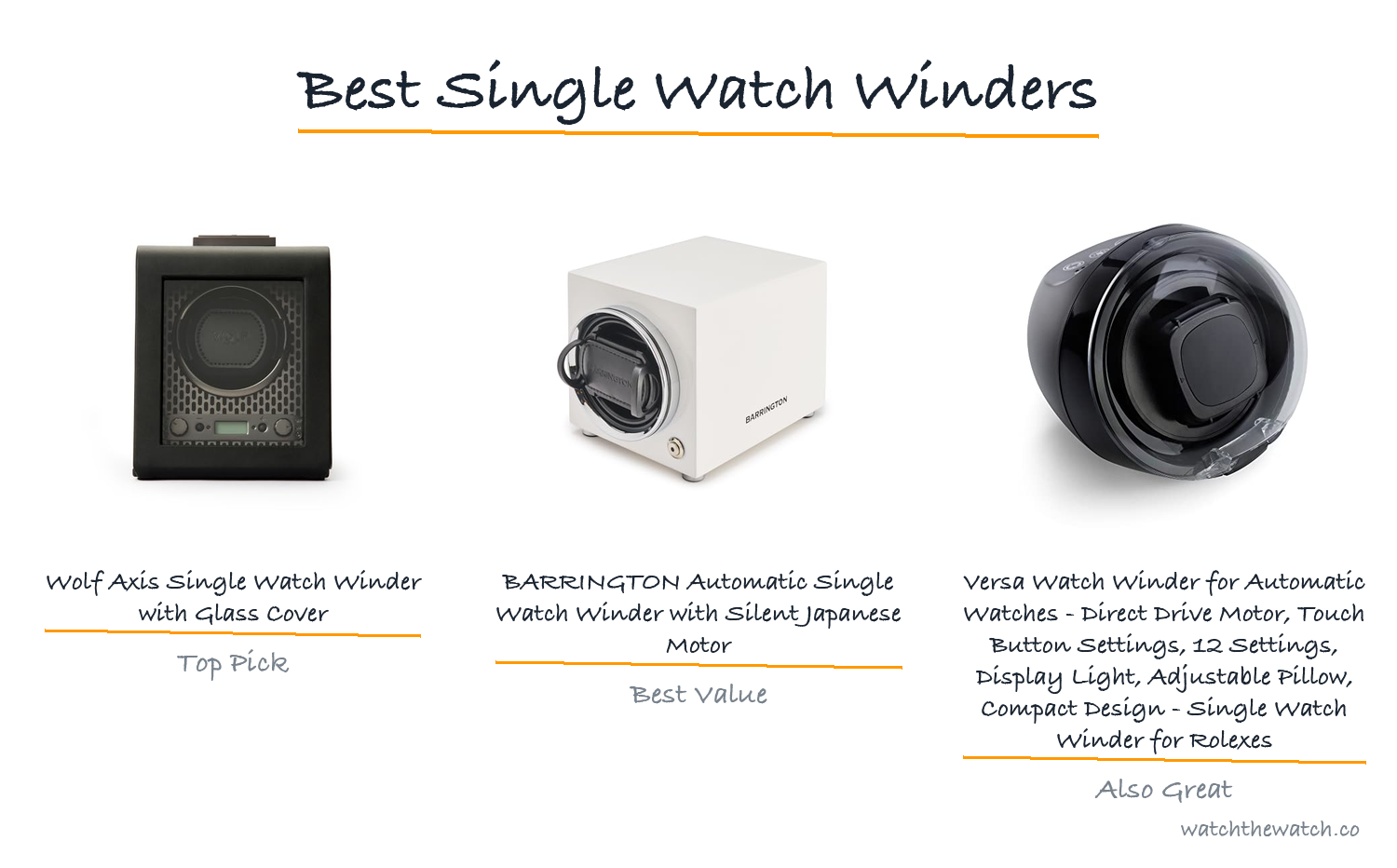
The Wolf Axis is the one most enthusiasts name first. It pairs a near-silent Japanese motor with a glass display lid and programmable rotation modes that handle everything from entry Seikos to Patek Philippe complications.
On a tighter budget, the Barrington Automatic gives you near-identical motor quality for less. These two dominate collector-forum recommendations, and honestly, that reputation is earned.
Both keep your automatic wound, set, and ready to wear. No audible motor soundtrack at 2 a.m.
Our top picks at a glance
The standouts from this guide — prices change, so tap through for the current price.
As an Amazon Associate, Watch The Watch earns from qualifying purchases at no extra cost to you. Some links go to other retailers. See our affiliate disclosure.
How We Picked
A single watch winder has one job: keep a rotor spinning at the right cadence so your automatic stays wound. The gap between a good unit and a frustrating one comes down to four things:
- Motor noise. The unit typically lives on a nightstand or dresser. Japanese motors — the specification used by Wolf, Barrington, and Mcbazel — are the industry benchmark for quiet operation. Generic motors hum; Japanese motors do not.
- Turns per day (TPD) range. Most automatics need 650–1,800 TPD. Some high-power-reserve movements need far fewer. A winder locked to one fixed programme risks under-rotating or over-stressing the motor. Adjustable TPD programmes are non-negotiable for serious use.
- Rotation direction. Clockwise (CW), counter-clockwise (CCW), and bidirectional (bi) modes each matter. Most modern Swiss movements wind bidirectionally; some specialty calibres are direction-specific. Every pick here covers at minimum CW, CCW, and bi.
- Pillow security and case fit. A loose pillow lets a heavy sports watch rattle against the housing. Better winders use adjustable pillows that grip securely across case sizes from around 38 mm to 52 mm without stressing lugs or crystal.
These picks span roughly $35 to around $200. All five use quiet motor tech and cover the rotation modes that matter for mainstream automatics.
Winding more than one watch? See our full guide to the best watch winders for automatic watches for multi-watch options.
The 5 Best Single Watch Winders
1. Wolf Axis Single Watch Winder — Best Overall

Wolf has made watch and jewellery accessories since 1834, and the Axis carries that pedigree into single-winder form. The hinged glass cover keeps the watch visible while keeping dust off it.
The pillow handles a wide case-size range, and the motor runs at near-ambient noise. Owners report leaving the Axis on a bedside table with no detectable sound overnight.
The rotation programme covers CW, CCW, and bidirectional modes with adjustable turns-per-day settings. That makes it compatible with virtually every automatic movement out there, including direction-specific calibres from Patek Philippe and vintage Rolex.
This is the winder you buy when the watch on the pillow is genuinely worth protecting. What gets me is how unbothered it is by anything you put on it.
- Pros: premium build quality, glass display lid, near-silent Japanese motor, broad movement compatibility, Wolf brand credibility
- Cons: premium price; more capability than an entry-level automatic requires
2. Barrington Automatic Single Watch Winder — Best Mid-Range

The Barrington is the consensus pick across collector forums for buyers who want real Japanese-motor quiet without the Wolf price tag.
Forum regulars treat it as the point where winder quality turns genuinely good. The motor is properly hushed, the turns-per-day settings are configurable to match a specific movement, and the suede-lined interior keeps bracelet links and polished lugs away from the scratching risk bare plastic pillows carry.
The exterior finish holds up well across extended use.
Own one automatic in the $500–$3,000 range and want it wound correctly without overspending on the winder? The Barrington is the pragmatic choice.
- Pros: silent Japanese motor, configurable TPD, suede-lined interior, strong owner reviews across forums
- Cons: more utilitarian aesthetic than Wolf; fewer colour and finish options
3. Versa Direct Drive Single Watch Winder — Best for Programmability

The Versa stands out with twelve pre-set rotation programmes on a touch button, a control layer you normally see on winders at double the price.
The direct drive motor drops the belt or gear go-between that makes cheaper units rattle. An interior light lets you read the dial without lifting the lid or interrupting a cycle.
The adjustable pillow handles most case diameters, and the compact footprint slips into tighter shelf spaces than bulkier winders.
If you rotate through watches with different needs, a Seiko with one TPD window, an ETA-based dress watch with another, the twelve-programme depth gives flexibility three-setting winders cannot match.
- Pros: 12 programmable settings, direct drive motor, interior LED display light, touch controls, compact form factor
- Cons: exterior finish is functional rather than premium
4. Mcbazel Single Watch Winder — Best Value
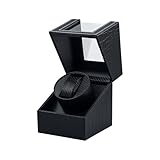
The Mcbazel earns its place next to better-known brands on two practical strengths. First, an ultra-quiet Japanese motor that reviewers keep flagging as the standout spec at this price.
Second, dual power, AC adapter or batteries, which makes it genuinely portable. The textured crocodile-pattern finish reads pricier than it is, and the rotation modes cover CW, CCW, and bidirectional for broad compatibility.
Owners who keep one on an office desk or in a travel bag say it just works over the long haul. At this tier the Japanese motor is the whole difference, because rivals at the same price run generic motors that hum.
- Pros: ultra-quiet Japanese motor, AC and battery power, portable, attractive exterior finish for the price
- Cons: smaller TPD range than premium options; pillow sizing is adequate rather than generous
5. MOZSLY Single Watch Winder — Best Entry-Level

The MOZSLY makes sense in two specific cases. One, you’re buying your first winder and want to confirm daily winding fits your routine before spending more.
Two, you want a cheap travel backup for a watch that normally lives in a premium winder at home. Twelve rotation modes give it more range than the price suggests.
The leather-wrapped exterior looks tidier than the bare plastic competition in this bracket, and the slim profile drops into luggage without fuss.
Enthusiasts treat it as a credible stepping stone. It won’t replace a Barrington or Wolf long term, but as a low-risk way in for anyone new to single watch winders, it does the job.
- Pros: 12 rotation modes, leather-wrapped exterior, slim profile, low price
- Cons: motor quality below Japanese-motor tier; not recommended as a primary long-term winder for high-value watches
Side-by-Side Comparison
| Model | Motor | Rotation Programmes | Power | Approx. Price | Best For |
|---|---|---|---|---|---|
| Wolf Axis | Japanese (ultra-quiet) | CW / CCW / Bi + adjustable TPD | AC | ~$150–250 | Luxury watches, display piece |
| Barrington Automatic | Japanese (silent) | CW / CCW / Bi + configurable TPD | AC | ~$80–130 | Best all-round mid-range |
| Versa Direct Drive | Direct drive (quiet) | 12 preset programmes | AC | ~$60–100 | Maximum programmability |
| Mcbazel | Japanese (ultra-quiet) | CW / CCW / Bi | AC + battery | ~$40–70 | Portable / best value |
| MOZSLY | Quiet (generic) | 12 modes | AC | ~$30–50 | Entry-level / travel backup |
What to Look for When Buying a Single Watch Winder
Match Turns Per Day to Your Specific Movement
TPD is the most important spec here, full stop. Most Swiss ETA-based movements, the ones in Hamilton, Longines, and many Tudor and Mido models, need roughly 650–800 TPD and wind bidirectionally.
Rolex Perpetual movements (Calibre 3235 and its predecessors) sit in a similar range. High-power-reserve movements, those with 72-hour reserves or more, common in IWC and some Jaeger-LeCoultre calibres, may need as few as 300 TPD to stay fully wound without pointless motor cycling.
The slipping mainspring clutch in any modern automatic prevents overwinding, so the watch itself is safe. But a winder running at 2,000 TPD when 650 suffices just wears itself out faster.
Check your movement documentation and match the programme to it. If you’re weighing whether all this winding actually matters, it’s tied to how long automatics last between wears.
Prioritise Motor Noise If the Winder Lives in a Bedroom
A generic motor at 45 dB is very much audible at 2 a.m. in a quiet room. Japanese motors, the explicit spec in Wolf, Barrington, and Mcbazel, run measurably quieter.
That spec is the most reliable signal of sleep-compatible operation I’ve found. If a listing doesn’t say “Japanese motor” or give a decibel rating, trust owner reviews that mention overnight or bedside use over marketing words like “ultra-silent.”
Verify Rotation Direction Compatibility
Most modern Swiss and Japanese movements wind bidirectionally. A bi setting covers everything from a Seiko 5 to a current Omega Seamaster.
Some calibres are direction-specific, though. Certain vintage Rolex movements, some Jaeger-LeCoultre calibres, and a number of vintage Longines movements wind one way only.
Not sure which way your rotor winds? Set the winder to bidirectional. It won’t harm any movement, and it covers both CW-only and CCW-only calibres with zero fiddling.
AC vs. Battery: Power Source Matters for Portability
Most winders in this guide run off an AC adapter. That’s fine for a permanent dresser or desk spot, less so for travel.
The Mcbazel is the only pick here with a battery option, which makes it the obvious choice for winding a watch in a hotel room with no convenient outlet.
One honest caveat: battery life on winders is shorter than most buyers expect. A standard set usually lasts weeks at normal rotation cycles, not months.
Frequently Asked Questions
How many turns per day does a single watch winder need?
Most automatic movements need between 650 and 1,800 turns per day. Rolex Perpetual movements typically want around 650–800 TPD.
High-power-reserve movements, those with 72-hour reserves or more, may need as few as 300 TPD to stay fully wound. Check the movement’s documentation or the maker’s website for the exact figure.
Then pick a winder with programmable TPD settings instead of a fixed-programme unit you can’t adjust.
Can a watch winder damage an automatic movement?
Not through overwinding, no. Every modern automatic has a slipping mainspring clutch that disengages once the spring is fully tensioned, so it’s physically impossible to overwind a watch on a winder.
The real risk from a cheap winder is a loose pillow that lets the watch rattle against the housing and scratch the case or crystal. A poorly balanced rotation can also stress the rotor pivot over months of nonstop use.
A winder with a secure, adjustable pillow takes both of those off the table.
Are single watch winders suitable for Rolex?
Yes. Rolex Perpetual movements wind bidirectionally and typically need around 650–800 TPD, a range all five picks here can match.
Set the programme to bidirectional, dial TPD into that range, and check the pillow holds the watch firmly with no pressure on the crystal or bezel.
The Wolf Axis and Barrington come up most among Rolex owners specifically, on the strength of motor quality and pillow security reported across collector forums.
What is the difference between a direct drive and a Japanese motor watch winder?
“Japanese motor” refers to where the motor is made. Japanese motors are valued for consistent, quiet torque.
“Direct drive” describes the mechanical link: the motor turns the watch pillow directly, with no belt or gear train in between. Belt-drive winders can pick up an audible slapping noise as the belt ages, and direct drive removes that variable.
The Versa here uses direct drive; Wolf, Barrington, and Mcbazel use Japanese motors. Both run quietly, and between well-made examples the real-world bedroom difference is minimal.
Should a watch winder run continuously or in timed cycles?
Timed cycles win. A winder that spins for a set period, then pauses, mimics real wrist wear far better than constant spinning.
Most modern automatics reach full wind after roughly 30–60 minutes of active wrist movement.
Winders with programmable rotation-and-rest cycles let you set a realistic programme rather than spinning all day. The Versa and MOZSLY, with their 12-mode settings, handle this well.
Continuous spinning does nothing extra for the movement and shortens motor bearing life over years of use.

Daniel Hart is the editor of Watch The Watch. He researches and writes the site’s buying guides, brand comparisons, and explainers, focused on accessible, enthusiast-level watches — affordable automatics, divers, field and dress watches, everyday quartz, and the straps, winders and tools that go with them. The goal is practical, budget-aware advice that helps readers choose the right watch for their wrist and their budget. Recommendations draw on manufacturer specifications and the wider enthusiast community.