
Daniel Hart · ·
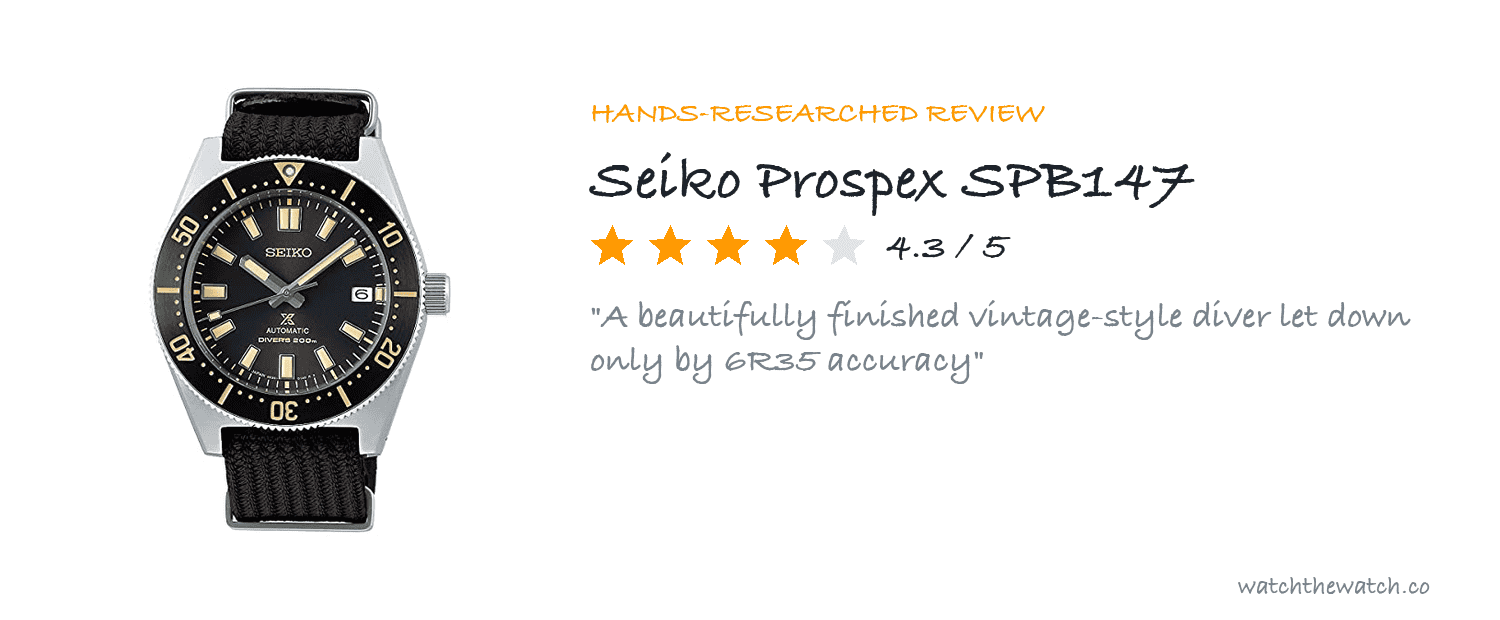
The Seiko Prospex SPB147 is one of those watches that quietly earned a cult following the moment it landed. It belongs to Seiko’s modern 62MAS-inspired diver line, a tribute to the brand’s first proper dive watch from 1965, reworked with a 200m rating, a sapphire crystal, and the 6R35 automatic movement. The standout is its silvery-blue sunburst dial, the colour that put this reference on so many shortlists.
If you have been circling the Seiko diver world looking for something more grown-up than an SKX but less precious than a Marinemaster, this is the sweet spot. My headline take is simple: the SPB147 is the most wearable, best-finished mid-tier Seiko diver of its generation, and the design ages far better than the spec sheet alone suggests.
It is not flawless, and the 6R35 movement keeps it honest at this tier. But as a daily-wear vintage-flavoured diver, very few watches near this money feel as resolved.

Quick verdict
This is for the buyer who wants a do-anything automatic diver with genuine heritage and grown-up finishing, without stepping up to luxury-Swiss prices. It nails proportions, lume, and dial drama, and the bracelet is properly good. If the gilt-blue 62MAS look speaks to you, the SPB147 is close to the smartest money in Seiko’s catalogue.
Specifications
| Spec | Detail |
|---|---|
| Reference | SPB147 (JDM equivalent SBDC141) |
| Case diameter | ~40.5 mm |
| Lug-to-lug | ~47.2 mm |
| Thickness | ~13.2 mm |
| Lug width | 20 mm |
| Movement | Seiko 6R35 automatic |
| Power reserve | ~70 hours |
| Crystal | Sapphire (flat, internal AR) |
| Water resistance | 200 m |
| Lume | LumiBrite on hands and markers |
| Bezel | 120-click unidirectional, aluminium insert |
| Bracelet/strap | Stainless steel bracelet with diver’s extension |
Design and build
The SPB147 is a faithful reinterpretation rather than a slavish reissue. The cushion-adjacent case, slim bezel, and broad arrow-and-pencil hands all nod to the 1965 original, but the proportions are tuned for modern wrists. The signature here is that silvery sunburst dial that shifts from steel-grey to soft blue depending on the light.
Finishing is a clear step above the old SKX and 5 Sports divers. You get sharply applied indices, a polished-and-brushed case with crisp edges, and a sapphire crystal instead of Seiko’s old Hardlex. The bezel insert is aluminium rather than ceramic, which suits the vintage brief and ages gracefully.
The bracelet deserves a mention because Seiko historically skimped here. On the SPB147 it is solid, with a milled clasp and a diver’s extension. Some owners still wish for on-the-fly micro-adjustment, but it is a genuinely good bracelet for the segment.
Movement and accuracy
Inside is the Seiko 6R35, the workhorse that replaced the older 6R15. The big upgrade is the roughly 70-hour power reserve, which comfortably survives a weekend off the wrist. It hacks and hand-winds, both expected at this level.
On accuracy, be realistic. Seiko rates the 6R35 at around -15 to +25 seconds per day, which is a wide window by Swiss standards. In practice many examples settle into single-digit daily deviation once worn, but there is genuine unit-to-unit variation, and you should not expect chronometer behaviour.
That is the honest trade-off at this tier. The movement is robust, serviceable, and long-running, but it is not a precision instrument. If timekeeping to a few seconds a day matters more to you than heritage and feel, that is worth weighing.
On the wrist
This is where the SPB147 wins people over. At roughly 40.5mm with a 47mm lug-to-lug, it suits a wide spread of wrists, and the relatively short lugs keep it planted. It wears like a tool watch that actually fits, not a slab.
Thickness is around 13mm, which is reasonable for a 200m automatic diver with a sapphire crystal. It tucks under a cuff better than many chunkier Seiko divers, though it is not what anyone would call thin.
The lume is classic Seiko, which is to say excellent. LumiBrite charges fast and glows bright deep into the night, and the dial colour does its quiet party trick in changing light throughout the day.
Pros and cons
- Gorgeous silvery-blue sunburst dial with real depth
- Sapphire crystal and a clear finishing step up from SKX-era divers
- ~70-hour power reserve from the 6R35
- Excellent LumiBrite
- Genuinely good bracelet with diver’s extension
- Balanced 40.5mm sizing that fits most wrists
- 6R35 accuracy spec is wide and varies between units
- Aluminium bezel insert scratches more easily than ceramic
- No on-the-fly micro-adjust on the clasp
- Pricing has crept up over the years for what it is
- Still around 13mm thick, not a dress-thin diver
Alternatives to consider
If you want similar vintage-diver charm but more refined Swiss timekeeping, the Tudor Black Bay Fifty-Eight is the obvious step up, at a notably higher price. For better value and a COSC-grade movement, the Christopher Ward C60 Trident gives you sharper accuracy and ceramic, though with less heritage cachet. And if you simply want maximum Seiko toughness for less, a Prospex Turtle or Samurai delivers the diver essentials with a bigger, more overtly tool-like presence.
Frequently asked questions
Is the SPB147 the same as the SBDC141?
Essentially yes. The SPB147 is the international reference and the SBDC141 is the Japan domestic market equivalent, and they share the same case, dial, and 6R35 movement. Differences come down to market packaging and warranty rather than the watch itself.
Is the SPB147 discontinued?
Seiko regularly rotates its 62MAS-style line, and specific dial colours come and go. The silvery-blue SPB147 has been a staple of this family, but availability can vary by region and over time, so checking current stock and recent variants is wise before buying.
Can you actually dive with it?
Yes. It carries a true 200m ISO-style dive rating, a screw-down crown, and a 120-click unidirectional bezel, so it is fully capable for recreational diving. For most owners it lives as a daily desk diver, but the capability is genuinely there.
How accurate is the 6R35 in the SPB147?
Seiko’s official spec is roughly -15 to +25 seconds per day, which is broad. Many real-world examples perform better once regulated by wear position, often landing in single digits, but you should buy expecting good-not-great accuracy rather than chronometer precision. If this raised further questions, where Seiko actually sits and the Seiko NH35 movement pick them up.

Daniel Hart is the editor of Watch The Watch. He researches and writes the site’s buying guides, brand comparisons, and explainers, focused on accessible, enthusiast-level watches — affordable automatics, divers, field and dress watches, everyday quartz, and the straps, winders and tools that go with them. The goal is practical, budget-aware advice that helps readers choose the right watch for their wrist and their budget. Recommendations draw on manufacturer specifications and the wider enthusiast community.

