Daniel Hart · ·
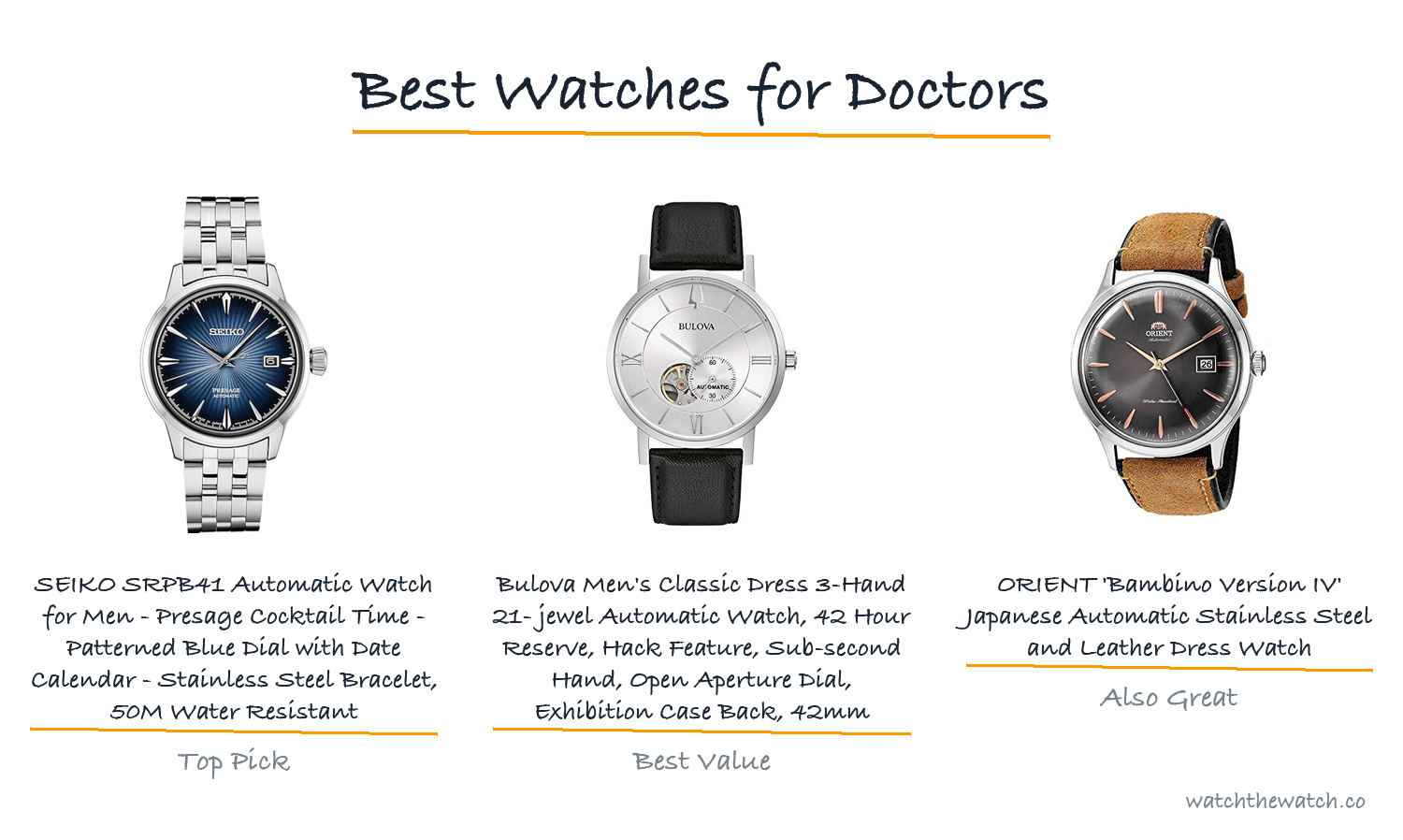
The best watch for a doctor is a working tool first, an accessory second. It needs a dial you can read mid-handshake, a running seconds hand for quick pulse checks, and a case tough enough to survive antiseptic wipe-downs.
My pick is the Seiko Presage Cocktail Time SRPB41. You get a sapphire crystal, a hacking automatic movement for precise time-setting, and a stainless steel bracelet that wipes clean, all for around $200.
Everything below sits under $350. Each one is chosen to work as well on a teaching ward as it does at a post-shift dinner.
Our top picks at a glance
The standouts from this guide — prices change, so tap through for the current price.
As an Amazon Associate, Watch The Watch earns from qualifying purchases at no extra cost to you. Some links go to other retailers. See our affiliate disclosure.
How We Picked: Criteria for a Doctor’s Watch
A doctor’s watch is a working instrument as much as an accessory. Here is what shaped every pick on this list.
- Seconds hand: a central sweeping or sub-seconds hand is essential for timing a 15-second pulse count. Any watch without a visible seconds track was excluded.
- Dial legibility: high-contrast indexes, an uncluttered layout, and no colour gradients that make reading difficult in dim ward lighting or a bright theatre.
- Practical water resistance: at minimum 30 M, enough for repeated hand-washing without anxiety about moisture ingress. A steel bracelet or cleanable leather strap is preferred over fabric or exotic materials.
- Appropriate proportions: 38–43 mm cases slip under a lab coat cuff without snagging on gloves or protruding awkwardly during patient examinations.
- Professional appearance: conservative enough for a consultant’s outpatient clinic, characterful enough that it reads as a deliberate choice rather than an afterthought.
- Budget: all six picks are priced between roughly $120 and $350, meaningful quality without the conspicuous-wealth optics that a five-figure watch can create in a patient-facing role.
The 6 Best Watches for Doctors in 2026
1. Seiko Presage Cocktail Time SRPB41 — Best Overall

This is the clearest answer to what a doctor’s watch should be. The sunburst blue dial, inspired by the Blue Moon cocktail, looks genuinely luxurious yet still reads as office-appropriate through a full shift.
If you have ever wondered whether Seiko is worth it, this watch is the argument. The Japanese-made Cal. 4R35 movement does two things clinicians actually use: hacking and hand-winding.
Hacking stops the seconds hand when you pull the crown, so you can sync to a wall clock or system time. Hand-winding means it never needs a shaker or rotor motion to stay topped up.
At 40.5 mm with a steel bracelet and a sapphire crystal, it shrugs off repeated hand-washing and the odd knock against a bed frame. Owners on the forums rate it as one of the best-value dress automatics at any price, and I agree.
2. Bulova Men’s Classic Dress 42mm — Best for Pulse Timing

Bulova’s 42 mm automatic earns second place for one reason: a dedicated sub-seconds hand at 6 o’clock paired with hacking. Together they make it easy to count a radial pulse or time an infusion.
The 21-jewel movement holds a 42-hour power reserve. Set it down on Friday and it is still running Monday morning, no winding needed.
An open aperture on the lower dial shows the balance wheel ticking away. Owners call it refined rather than novelty, and at around $200–280 it punches above its price.
3. Orient Bambino Version IV — Best Classic Dress Value

The Bambino Version IV has a near-cult following among new enthusiasts, and it earns it. The domed sapphire crystal, cathedral hands, and Roman numeral chapter ring are details you usually see on Swiss watches costing three to four times as much.
The white dial is easy to read in any light. The 42 mm case wears trimmer than the number suggests because the curved crystal compresses the footprint.
Enthusiast forums keep calling it one of the most overachieving watches at its price, and it has held that spot for several generations. The leather strap is fine, though I would swap to steel or rubber for clinical hygiene.
4. Citizen Eco-Drive Gold-Tone Dress — Best Low-Maintenance Option
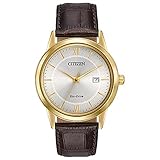
Citizen’s Eco-Drive turns light into charge, including the fluorescent strips above a ward or theatre. In the hands of long-term owners, this watch has never needed a battery change.
For a doctor working 60-hour weeks with no headspace for watch upkeep, that zero-maintenance appeal is real, not a marketing line. The gold-tone case and clean dial keep things formal enough for a consulting room or a board meeting.
If hands-off reliability is your top priority, this is the one to buy.
5. Orient Sun & Moon — Best Characterful Dress Watch

The Orient Sun & Moon adds a rotating day/night disk at 12 o’clock, a sun by day and a crescent moon at night. It is personality without an impractical complication.
Most enthusiasts rank it among the most characterful automatics under $200, and its dress proportions keep it clinic-appropriate. It does pull questions from curious patients and colleagues.
Whether that is a nice icebreaker or a small distraction depends on your temperament. For a doctor who wants something a notch above the ordinary, it consistently delivers.
6. Orient Bambino Open Heart — Best Exhibition Dial
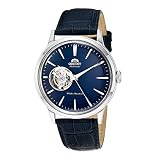
The Bambino Open Heart cuts an aperture at 9 o’clock to show the balance wheel in motion. That little mechanical window tends to win over analytically minded doctors and their patients alike.
The main dial keeps full Bambino legibility: clean markers, cathedral hands, a formal chapter ring. Owners say the cut-out does not hurt time-reading at all.
It sits in the same price bracket as the standard Bambino but offers more visual interest for the money. The movement-on-show look has stayed well regarded for years.
Side-by-Side Comparison
| Watch | Case Size | Movement | Water Resistance | Key Feature | Approx. Price |
|---|---|---|---|---|---|
| Seiko Presage SRPB41 | 40.5 mm steel | Seiko 4R35 auto, hacking | 50 M | Sapphire crystal, steel bracelet | ~$200 |
| Bulova Classic Dress 42mm | 42 mm steel | 21-jewel auto, hack | Splash-resistant | Sub-seconds hand, 42h reserve | ~$230 |
| Orient Bambino V4 | 42 mm steel | Japanese automatic | 30 M | Domed sapphire, Roman dial | ~$150 |
| Citizen Eco-Drive Dress | Dress proportions | Solar quartz | Model-dependent | No battery ever | ~$150 |
| Orient Sun & Moon | ~42 mm steel | Japanese automatic | 30 M | Day/night aperture | ~$175 |
| Orient Bambino Open Heart | 42 mm steel | Japanese automatic | 30 M | Exhibition balance wheel | ~$150 |
What to Look for When Buying a Watch as a Doctor
Strap Material: Steel vs. Leather in Clinical Settings
A steel bracelet wipes clean with an alcohol swab in seconds and dries just as fast. Leather is more comfortable but porous, soaking up sweat and cleaning products until it degrades and gets hard to sanitise.
If infection control matters where you work, and in most hospitals it does, a steel bracelet or silicone-backed strap is the safer bet. Several picks here ship on leather but take standard-width steel or rubber straps.
Automatic vs. Quartz: The Practical Trade-off
Automatic movements are mechanically interesting and need no battery, but they drift a few seconds a day and need wrist time or winding to keep going. If you are curious how long automatics last, a well-kept one runs for decades.
A good quartz movement, especially Citizen’s solar Eco-Drive, keeps time to within seconds a month and never runs flat on a dresser between shifts.
So if you love mechanical watches as objects and enjoy the daily ritual, go automatic. If you just want reliable time with zero upkeep, quartz fits a demanding schedule better.
Case Size and Lab Coat Compatibility
For most doctors the sweet spot is 38–42 mm wide and under 12 mm thick. That sits cleanly under a lab coat cuff, will not snag on nitrile gloves, and stays comfortable across a 12-hour shift.
Anything over 44 mm tends to catch on cuffs during exams and bulk up under tight protective clothing. Lug width matters too: a 20 mm or 22 mm lug takes most aftermarket straps, so swapping to something more hygienic is easy.
Wearing a Watch in a Clinical Environment
Policies vary by country and hospital. Some systems run bare-below-the-elbow protocols during direct patient care, where wristwatches are officially discouraged, though enforcement is patchy.
In most outpatient medicine, general practice, and admin settings, a wristwatch is completely standard. Fob watches, clipped to a lapel or breast pocket, are the workaround when you need a seconds hand but cannot wear anything on the wrist.
For most clinicians, a well-chosen wristwatch stays both appropriate and useful.
Frequently Asked Questions
What features should a doctor’s watch have?
Three features matter most: a running seconds hand for timing pulse or procedures, a high-contrast dial with clear markers, and at least 30 M water resistance for repeated hand-washing.
A hacking movement stops the seconds hand when you pull the crown, so you can sync precisely to a wall clock or hospital system time. A steel bracelet beats leather for hygiene and wipes down fast between patients.
Is an automatic or quartz watch better for doctors?
Both work; it depends on priorities. Quartz, especially solar Eco-Drive, is more accurate day-to-day and never runs flat, which suits doctors who want zero maintenance.
Automatics are mechanically interesting, need no battery, and are what enthusiasts reach for. My honest take: if you work long shifts and forget upkeep, go quartz; if you love the craft and the self-winding ritual, go automatic.
What watch size fits best under a lab coat?
For most physicians, 38–42 mm wide and under 12 mm thick is the sweet spot. It slides under a lab coat cuff easily, will not snag on gloves, and stays comfortable during long exams.
Watches over 44 mm tend to catch on protective clothing and feel heavy by the end of a long shift.
Can doctors wear smartwatches at work?
Plenty of doctors do, especially in primary care and admin medicine. But smartwatches bring three downsides: silicone bands are hard to sanitise, the battery needs managing, and notifications distract during consults.
A traditional wristwatch sidesteps all three. Many doctors just own both, a smartwatch for off-duty tracking and a dress watch for clinical work.
What is a reasonable watch budget for a doctor?
The $120–$350 range on this list is the practical sweet spot: solid automatic or solar movements, sapphire where available, and a professional look without conspicuous-wealth optics.
Want to spend more? The $500–$1,500 bracket opens up Swiss movements from Tissot, Longines, and Mido with extra finishing and brand cachet.
Still, the watches here are hard to fault for the money, especially the Seiko Presage and Orient Bambino lines, which consistently outperform their price tags.

Daniel Hart is the editor of Watch The Watch. He researches and writes the site’s buying guides, brand comparisons, and explainers, focused on accessible, enthusiast-level watches — affordable automatics, divers, field and dress watches, everyday quartz, and the straps, winders and tools that go with them. The goal is practical, budget-aware advice that helps readers choose the right watch for their wrist and their budget. Recommendations draw on manufacturer specifications and the wider enthusiast community.