
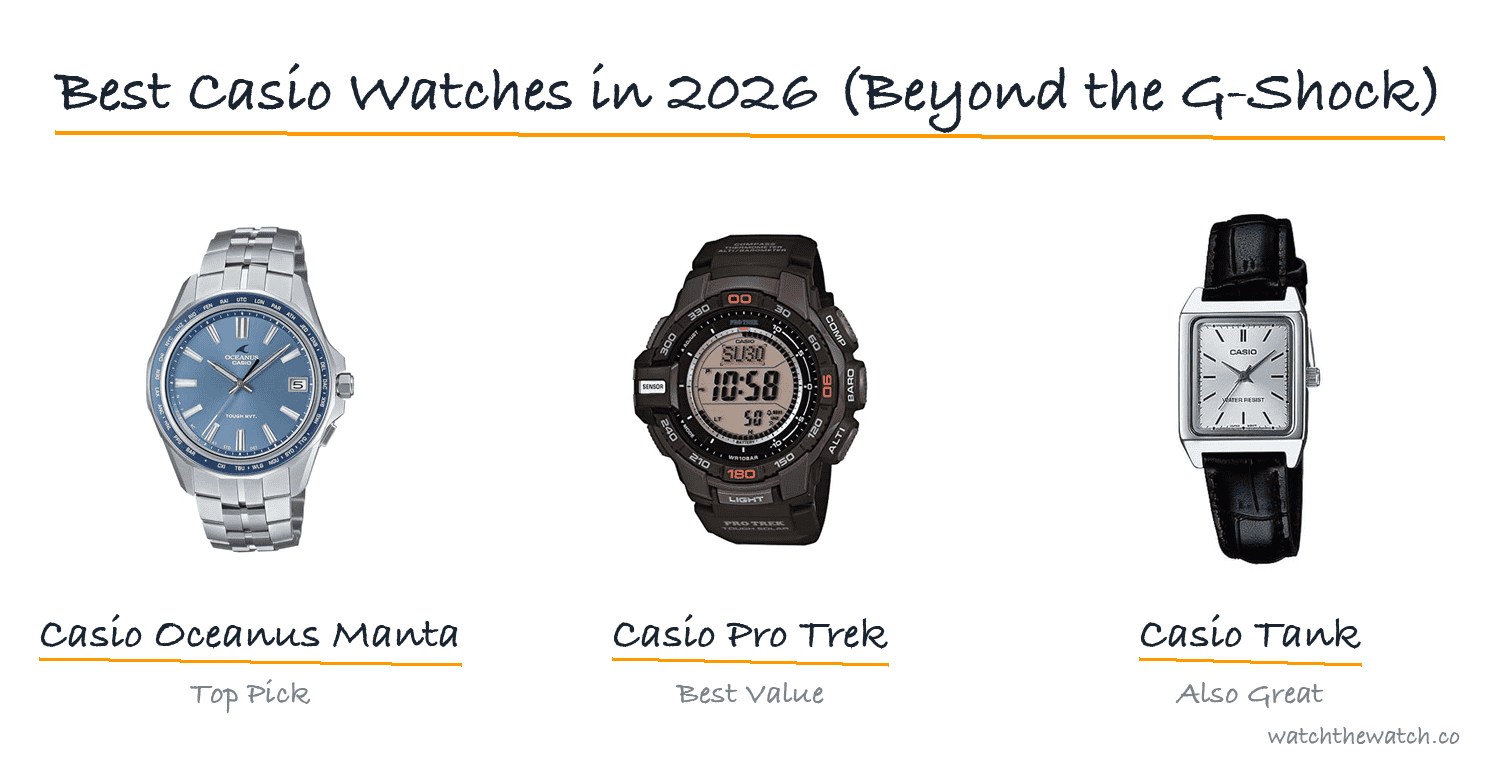
Most people picture one thing when they hear Casio: the rugged square. The catalog runs much wider than that. There’s the solar Oceanus dress-sport line, the triple-sensor Pro Trek for hikers, retro Tank-style classics, and ultra-premium MR-G titanium pieces that go toe-to-toe with Swiss watches on engineering.
My top overall pick for 2026 is the Casio Oceanus Manta OCW-S400. Sapphire crystal, solar charging, Bluetooth, radio-controlled timekeeping, and it looks nothing like a G-Shock.
Whether your budget is $50 or $2,000, there’s a Casio worth your attention outside the standard G-Shock lineup, and a few inside it too.
Our top picks at a glance
The standouts from this guide — prices change, so tap through for the current price.
As an Amazon Associate, Watch The Watch earns from qualifying purchases at no extra cost to you. Some links go to other retailers. See our affiliate disclosure.
How We Picked
Every watch here ran through four filters: how distinctly it represents a Casio line beyond the entry-level DW-series, feature-to-price ratio, reputation from owner reviews and forum consensus, and concrete build markers like crystal type, solar capability, and radio or Bluetooth connectivity.
Prices listed are approximate street prices as of mid-2026. Always verify before you buy, because Casio pricing moves around, especially on Japan imports.
Want the bigger picture on whether the brand earns its keep? Our Is Casio a Good Watch Brand? breakdown digs into the reliability record, movement quality, and where Casio lands against rivals.
1. Casio Oceanus Manta OCW-S400 — Best Non-G-Shock Casio Overall

The Oceanus line is Casio’s answer to a fair question: can you build a proper dress-sport watch? The Manta OCW-S400 answers yes, and not quietly.
You get sapphire crystal, a titanium case, solar charging, multi-band 6 radio synchronization, and Bluetooth, all in a design that belongs at a business dinner.
Owners report zero maintenance over years of daily wear, and forums call the Manta Casio’s best-kept secret for anyone who finds G-Shock too bulky for the office. What gets me is that it looks expensive because it actually is.
2. Casio Pro Trek PRW-2500R-1CR — Best for Hikers and Outdoor Pursuits

The Pro Trek is Casio’s outdoor instrument line. The difference from G-Shock is the priority: sensor accuracy and a sane case size come before maximum shock resistance.
The PRW-2500R packs altimeter/barometer, compass, and thermometer into a case owners call wearable all day, without the G-Shock bulk.
It’s solar-powered and radio-controlled, so no battery swaps and no manual time-setting. That combination keeps it a favorite among weekend hikers who want real outdoor data from a sub-$250 watch that still looks fine at the trailhead café.
3. Casio Tank — Best Vintage and Affordable Classic

Want proof Casio understood style decades before smartwatches? Look at the Tank.
The rectangular case and clean quartz movement make a surprisingly wearable retro piece. It pulls consistent five-star reviews from buyers who want vintage-inspired looks without the vintage price.
This is the pick when someone wants a conversation-starting Casio under $60 that is emphatically not a G-Shock. It does exactly what it says: no-fuss timekeeping with real character.
4. Casio G-Shock Rangeman — Best G-Shock for Outdoor Use

The Rangeman is where G-Shock toughness meets Pro Trek sensor logic. A 20-bar water-resistant, shock-proof case carries the full triple-sensor suite, altimeter/barometer, digital compass, and thermometer, plus solar charging and radio-controlled timekeeping.
You can wear it for years and effectively forget about maintenance.
Owners in outdoor and military communities reach for it when the terrain gets genuinely demanding, not just urban-rough. It regularly tops “best tool watch under $250” threads on the forums.
5. Casio G-Shock MR-G MRGB5000D Titanium — Best Premium and Pinnacle G-Shock
The MR-G is about as far beyond a standard G-Shock as you can go while still wearing the name. Full titanium, sapphire crystal, Bluetooth, and multi-band radio give it a spec sheet that competes with Swiss tool watches at twice the price.
The MRGB5000D reworks the iconic square DW-5000 silhouette in MR-G materials. Enthusiasts treat that combination as one of the most compelling value buys in premium watchmaking right now.
If you want lifetime toughness and real luxury finishing in one watch, this is the ceiling. Our most expensive Casio watches guide puts the full MR-G family in context.
6. Casio G-Shock MT-G MTG-B3000 — Best Mid-Premium Connected G-Shock

The MT-G sits between the standard G-Shock and the MR-G on both price and ambition, and the MTG-B3000 is the current standout.
A layered carbon fiber and stainless structure gives it rigidity at lower weight, and Bluetooth sync plus multi-band 6 radio handle timekeeping on their own.
If you need a G-Shock that reads right at a Monday client meeting and survives a Saturday trail, the MT-G is usually the answer. It’s the rare G-Shock that makes no apologies for dressing up.
7. Casio G-Shock Frogman GWF-A1000C-1AJF — Best for Divers

The Frogman is Casio’s ISO-certified dive G-Shock, and it’s been the loyalist’s go-to rugged diver for decades.
The GWF-A1000 generation updates the classic with a carbon fiber reinforced resin case, solar charging, and Bluetooth dive-log connectivity. That’s a rare mix on a watch with genuine ISO 200m dive certification.
It’s a Japan market import, so pricing varies, but divers and collectors rate it as the most capable all-in-one dive instrument Casio makes. If you want a diver that also shrugs off being tossed in a gear bag, nothing else from Casio comes close.
8. Casio G-Shock G-Lide — Best for Surf and Active Water Sports

The G-Lide is the G-Shock built around surf culture and water sports. It packs tide graphs and moon-phase data with timers into a lighter, more wearable case than the Rangeman.
Solar-powered and Bluetooth-connected, it puts real tidal data on your wrist so you’re not pulling out a phone in the lineup.
At around $150–$200, it’s one of the most affordable solar G-Shocks with Bluetooth in the current range. An honest performance watch at a price that doesn’t sting.
How All Eight Compare
| Watch | Line | Key Angle | Water Resistance | Solar | Bluetooth | Approx. Price |
|---|---|---|---|---|---|---|
| Oceanus Manta OCW-S400 | Oceanus | Dress-sport, sapphire, titanium | 100m | Yes | Yes | ~$450–$500 |
| Pro Trek PRW-2500R | Pro Trek | Triple sensor, low profile | 100m | Yes | No | ~$200–$250 |
| Casio Tank | Vintage | Retro rectangular, budget | 30m | No | No | ~$40–$60 |
| G-Shock Rangeman | G-Shock | Triple sensor + MIL-STD-810 | 200m | Yes | No | ~$200–$250 |
| MR-G MRGB5000D | G-Shock MR-G | Full titanium, pinnacle | 200m | Yes | Yes | ~$1,500+ |
| MT-G MTG-B3000 | G-Shock MT-G | Carbon core, mid-premium | 200m | Yes | Yes | ~$700–$900 |
| Frogman GWF-A1000C | G-Shock | ISO 200m dive certified | 200m ISO | Yes | Yes | ~$600–$750 |
| G-Shock G-Lide | G-Shock | Surf/tide data, most affordable | 200m | Yes | Yes | ~$150–$200 |
What to Look for When Buying a Casio in 2026
Solar vs. Battery
Any Casio priced above roughly $100 today should have solar charging. It kills battery replacement entirely and keeps the watch accurate through years of normal use.
If the model you’re eyeing has no solar in 2026, make sure the price reflects that. There’s no good reason to pay full freight for a battery you’ll be replacing.
Radio-Controlled Timekeeping and Bluetooth Sync
Multi-band 6 radio synchronization (covering North America, Europe, Japan, and China) keeps a watch accurate to the atomic second with zero manual input.
Bluetooth sync through the Casio Connected app does the same thing anywhere on earth, even outside radio coverage. The best picks have both, but if you can only get one, Bluetooth wins globally.
Sensor Suite
Both the Pro Trek and Rangeman lines carry the triple-sensor package: altimeter/barometer, digital compass, and thermometer.
If you spend time in the mountains, on the water, or navigating off-trail, prioritize it. One watch replaces three separate instruments.
Crystal Type: Mineral vs. Sapphire
Most Casio models use mineral crystal, which is scratch-resistant but not scratch-proof.
The Oceanus and MR-G lines step up to sapphire, which is much harder and shrugs off scratches under almost all everyday conditions. If your watch will see desk-diving or regular contact with hard surfaces, sapphire is worth the premium.
Case Size and Wearability
G-Shock models tend to run large. The Rangeman and Mudmaster series hover around 53–55mm, which can swallow a smaller wrist.
The Pro Trek and Oceanus lines size more like traditional watches. If dress-occasion wearability matters, start with Oceanus or Pro Trek before defaulting to G-Shock.
Frequently Asked Questions
Is Casio a good watch brand beyond G-Shock?
Yes. The Oceanus line uses sapphire crystal, titanium cases, and solar-radio movements that rival Swiss dress-sport watches at a fraction of the cost.
The Pro Trek series is a legitimate outdoor instrument. Casio’s engineering breadth gets underestimated by buyers who only know the square.
What is the difference between G-Shock, Pro Trek, and Oceanus?
G-Shock leads with shock resistance and ruggedness in a bold design. Pro Trek leads with sensor accuracy (altimeter, compass, thermometer) in a more conventional silhouette aimed at hikers and outdoor athletes.
Oceanus targets dress-sport wearers who want solar, sapphire, and Bluetooth in a slim case. All three can be solar-powered, but only Oceanus and MR-G G-Shock models use sapphire crystal as standard.
Which Casio is best for everyday office wear?
The Casio Oceanus Manta OCW-S400 is the strongest choice. It’s slim enough for a dress shirt, refined enough for a client meeting, and sophisticated enough to keep an enthusiast happy.
The MT-G MTG-B3000 works if you want something sportier. Skip full-size G-Shocks like the Rangeman or Mudmaster for the office, they read as outdoor tools, not dress watches.
What is the most advanced Casio watch you can buy?
The G-Shock MR-G MRGB5000D is currently Casio’s technical and material pinnacle. Full titanium case and bracelet, sapphire crystal, solar charging, multi-band 6 radio, and Bluetooth, all in a shock-resistant body with 200m water resistance.
It’s the watch Casio builds when price is no object.
How does Casio compare to Swiss brands like Tissot or Seiko for value?
Casio usually gives you more technology per dollar at the sub-$300 level. Solar charging, radio sync, and multi-sensor capability are rare in Swiss watches under $500.
For dress watches, Swiss brands like Tissot bring mechanical movements and heritage Casio can’t match at the same price. If you’re leaning toward a mechanical Swiss piece, it helps to know how long automatic watches last before you commit.
For outdoor tool watches, Casio’s Pro Trek and G-Shock lines are genuinely hard to beat on feature density. For a deeper head-to-head on the Swiss side, see our Tissot vs Seiko comparison.

Daniel Hart is the editor of Watch The Watch. He researches and writes the site’s buying guides, brand comparisons, and explainers, focused on accessible, enthusiast-level watches — affordable automatics, divers, field and dress watches, everyday quartz, and the straps, winders and tools that go with them. The goal is practical, budget-aware advice that helps readers choose the right watch for their wrist and their budget. Recommendations draw on manufacturer specifications and the wider enthusiast community.